Four rules to keep beside the sealer
Vacuum packaging removes substantially all air from a package before sealing. That is USDA FSIS's own definition, and the qualifier "substantially all" is doing real work: the pump changes one storage variable, the oxygen inside the pouch. Temperature, sanitation, elapsed time, the food's water activity and its acidity all sit exactly where they were before the lid came down.
Clostridium botulinum needs six conditions at once before it grows and makes toxin. CDC lists them in order: low-oxygen or no oxygen, low acid, low sugar, low salt, a certain temperature range, and a certain amount of water. A chamber sealer supplies the first condition and none of the other five. CDC also records how rarely this happens: the bacteria that make botulinum toxin "are found naturally in many places, but it's rare for them to make people sick," and the spores "usually do not cause people to become sick, even when they're eaten." CDC publishes no rate or proportion alongside those sentences, and neither does this page. The hazard is conditional and serious, not automatic.
The four rules below survive every disagreement recorded further down this page. Each published storage figure quoted later — a few days, 30 days, 45 days, four months, 12 months, three years — assumes them, and none of those figures means anything without them. The fourth rule is the one the consumer charts bury: the published limits are written per food class, and fish, cured meat, raw meat and cooked food each sit under a different one.
Is vacuum-sealed food safe at room temperature?
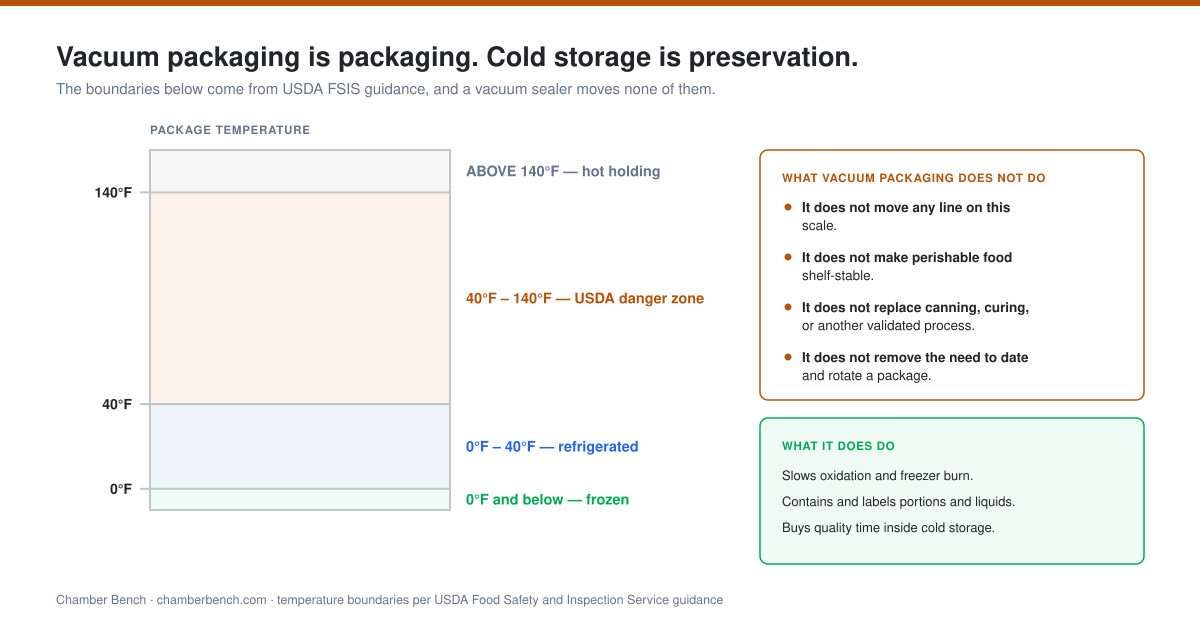
Vacuum-sealed perishable food is not safe at room temperature. USDA FSIS answers the question directly: "The removal of oxygen from a food package does not eliminate microbial growth," and perishable meats and poultry in vacuum packaging "must be kept either in the refrigerator at 40 ºF or below, or for longer storage, in the freezer at 0 °F or below." The same FSIS answer draws the exception at moisture rather than at the seal: jerky, nuts and crackers are "low enough in moisture that microbial growth is prevented," so those keep at room temperature in a vacuum package. The dryness makes them shelf-stable, not the vacuum.
Scroll horizontally to see every column.
| Rule | What it means | Source basis |
|---|---|---|
| Keep perishables cold | Refrigerate at 40°F or below or freeze at 0°F | USDA FSIS low-oxygen guidance |
| Do not create shelf-stable claims | Vacuum alone does not replace canning, dehydration, or another validated process | USDA FSIS |
| Use time and label controls | Date packages and follow product and use-by guidance | USDA FSIS and food-specific instructions |
| Match the rule to the food | Fish, cured meat, raw meat and cooked food each sit under different published limits | FDA Food Code 2022 § 3-502.12 |
Source basis[8] USDA Food Safety and Inspection Service: Can Clostridium botulinum be in vacuum-packaged foods? · [9] USDA Food Safety and Inspection Service: Can I keep meat in vacuum packages at room temperature? · [10] USDA Food Safety and Inspection Service: What is vacuum packaging? · [13] U.S. Food and Drug Administration · [16] Centers for Disease Control and Prevention, National Center for Emerging and Zoonotic Infectious Diseases
What vacuum packaging can—and cannot—do
Removing air can slow oxidation and some forms of spoilage, which helps protect quality when the food is otherwise handled and stored correctly. It does not remove all oxygen, kill all microorganisms, reverse unsafe handling, or protect food left at an unsafe temperature.
The FDA Food Code 2022 attaches a number to the condition a sealer creates. Reduced oxygen packaging means "the reduction of the amount of oxygen in a PACKAGE by removing oxygen; displacing oxygen and replacing it with another gas or combination of gases; or otherwise controlling the oxygen content to a level below that normally found in the atmosphere (approximately 21% at sea level)." Reduced oxygen packaging in the regulatory sense begins below that 21 percent — but only for the foods named in the definition's second limb, and that limb, not the percentage, is where the regulation's scope actually sits. A chamber cycle is designed to reduce oxygen below the atmospheric level the definition names; no source in this page's ledger publishes a residual-oxygen percentage for any chamber machine, so this page states none.
That second limb is the reason the chapter exists at all. A package counts as reduced oxygen packaging only when it "involves a FOOD for which the HAZARDS Clostridium botulinum or Listeria monocytogenes require control in the final PACKAGED form." The regulation is not about the vacuum as such. It is about two named organisms, and § 3-502.12 says so in one line: an establishment using a reduced oxygen packaging method "shall control the growth and toxin formation of Clostridium botulinum and the growth of Listeria monocytogenes."
A chamber sealer's strong package and clean appearance can create false confidence, and University of Maine Cooperative Extension publishes the mechanism behind that false confidence: "ROP conditions suppress most spoilage microorganisms, allowing C. botulinum to proliferate undetected if safety measures are not followed. Foods contaminated with botulinum toxin often appear, smell, and taste normal, making detection difficult without laboratory testing." The pouch removes the warning system along with the oxygen. Treat temperature control, sanitation, labeling, thawing, cooking, and validated preservation as separate controls that the sealer does not perform.
Does vacuum sealing kill bacteria?
Vacuum sealing kills nothing. Removing air slows oxidation and some forms of spoilage; it does not sterilize the contents, and USDA FSIS warns specifically that some pathogenic bacteria "prefer low-oxygen environments and reproduce well in vacuum-packaged foods." FDA goes further and names why two organisms govern the rules for these packages: non-proteolytic Clostridium botulinum and Listeria monocytogenes "are able to multiply well below 5°C (41°F)." A tight, clean-looking package is evidence about the seal and about nothing else in the food.
Source basis[8] USDA Food Safety and Inspection Service: Can Clostridium botulinum be in vacuum-packaged foods? · [10] USDA Food Safety and Inspection Service: What is vacuum packaging? · [13] U.S. Food and Drug Administration · [14] University of Maine Cooperative Extension (Jason Bolton, Ph.D. and Gulsun Akdemir Evrendilek)
How long vacuum-sealed meat keeps in the freezer, by publisher
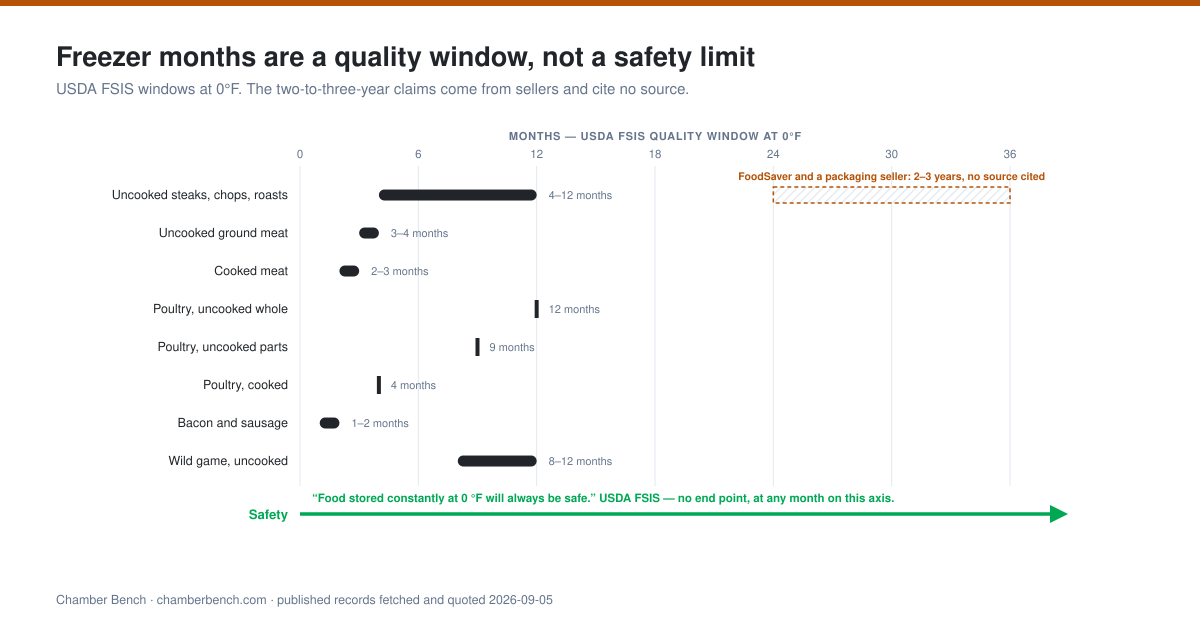
USDA FSIS settles the safety half of the freezer question in one sentence: "Food stored constantly at 0 °F will always be safe. Only the quality suffers with lengthy freezer storage." Every figure in the rest of this section is therefore a quality figure, and FSIS labels its own chart that way — "Because freezing keeps food safe almost indefinitely, recommended storage times are for quality only" — with the chart header repeating it: "Note: Freezer storage is for quality only. Frozen foods remain safe indefinitely."
The FSIS freezer chart at 0°F reads, in months: uncooked roasts 4 to 12; uncooked steaks or chops 4 to 12; uncooked ground meat 3 to 4; cooked meat 2 to 3. Poultry: uncooked whole 12; uncooked parts 9; uncooked giblets 3 to 4; cooked 4. Cured and prepared foods: bacon and sausage 1 to 2; ham, hotdogs and lunchmeats 1 to 2; casseroles 2 to 3; frozen dinners and entrees 3 to 4; gravy 2 to 3; soups and stews 2 to 3; egg whites or egg substitutes 12. The same chart carries a "Wild game, uncooked | 8 to 12" months row, which is the only game figure in this page's ledger; no source here publishes freezer quality for game meat broken down by wrap type, so no such comparison appears on this page.
FoodSafety.gov's Cold Food Storage Chart, last reviewed September 19, 2023, agrees with FSIS on the rows people search for most: steaks, chops and roasts 4 to 12 months; hamburger, ground beef, turkey, chicken, veal, pork and lamb 3 to 4 months; whole chicken or turkey 1 year, which is FSIS's 12 months stated in a different unit; poultry pieces 9 months. Two federal charts publishing the same figure is worth stating out loud, because it makes the two places where their freezer figures diverge meaningful rather than random.
They diverge on cooked meat and on bacon. FSIS gives "Meat, cooked | 2 to 3" months and "Poultry, cooked | 4" months; FoodSafety.gov gives leftover cooked meat or poultry "2 to 6 months." Two federal charts, three different upper bounds for one leftovers category. FSIS combines bacon with sausage at 1 to 2 months; FoodSafety.gov splits them and gives bacon 1 month. The refrigerator figures for bacon agree exactly — FSIS's 7 days and FoodSafety.gov's 1 week are the same number written twice. Neither divergence is resolved here, because neither publisher shows its working and both are current.
FoodSafety.gov is also far more granular on seafood, where the FSIS refrigerator chart carries a single collapsed row. Its frozen figures: fatty fish such as salmon, tuna, mackerel and catfish 2 to 3 months; lean fish such as cod, flounder, haddock, halibut and sole 6 to 8 months; pollock, ocean perch, rockfish and sea trout 4 to 8 months; fresh crab meat 2 to 4 months; shrimp and crayfish 6 to 18 months; shucked clams, mussels, oysters and scallops 3 to 4 months. Live clams, mussels, oysters and scallops carry the entry "Not recommended."
The beef industry publishes a vacuum-specific frozen figure that neither federal chart supplies. The Beef Checkoff's "Beef Shelf-life" fact sheet, authored by Robert J. Delmore, Ph.D. of California Polytechnic State University, states: "From a bacterial shelf-life point of view, beef that is held below a temperature of 0°F has an indefinite shelf-life. From an optimal quality standpoint, vacuum–packaged, frozen, whole-muscle beef has a recommended shelf-life of 12 months." Twelve months, for exactly the object a chamber sealer produces, published by the industry that sells the beef.
FoodSaver, a vacuum-sealer manufacturer, publishes a different figure: "With proper preparation and Food Saver vacuum sealers, meat can stay in the freezer for up to two to three years," with beef and poultry at 2-3 years and fish at 1-2 years. U.S. Packaging & Wrapping, which sells vacuum pouches, publishes a two-column chart headed "Normal Shelf" against "Vacuum Shelf," reading "Meat | 4-12 months | 2-3 years" and "Ground Meat | 3-4 months | 1 year." The "Normal" column matches the federal quality figures almost exactly. The "Vacuum" column has no stated basis at all. Both pages were read in full and neither cites a source, a study, or a standard for the multiplier. The absence is the finding: 4 to 12 months from two federal charts, 12 months from the beef industry for vacuum-packed frozen whole muscle, and 24 to 36 months from two sellers of vacuum packaging who attribute the number to nothing. Three published figures across five publishers; this page names every one of them and resolves none.
How long does vacuum sealed meat last in the freezer?
Vacuum-sealed meat held constantly at 0°F is safe indefinitely, per USDA FSIS, so the question is entirely about quality and the published quality figures differ by publisher. FSIS and FoodSafety.gov both give uncooked steaks, chops and roasts 4 to 12 months and ground meat 3 to 4 months, and both label those charts as quality guidance. The Beef Checkoff gives vacuum-packaged frozen whole-muscle beef a recommended 12 months. FoodSaver and U.S. Packaging & Wrapping both publish 2 to 3 years and neither cites a source for it.
Does freezing kill the bacteria in meat?
Freezing does not kill the bacteria in meat. USDA FSIS states the mechanism: "Freezing to 0 °F inactivates any microbes — bacteria, yeasts and molds — present in food. Once thawed, however, these microbes can again become active, multiplying under the right conditions to levels that can lead to foodborne illness. Since they will then grow at about the same rate as microorganisms on fresh food, you must handle thawed items as you would any perishable food." FoodSaver's guide to this exact subject states the opposite — "By freezing first, you can ensure the bacteria have been killed" — and the federal agency responsible for meat safety contradicts that sentence in writing. Clostridium botulinum spores in particular endure "freezing, refrigeration, boiling water (212°F/100°C)," per University of Maine Cooperative Extension.
Scroll horizontally to see every column.
| Publisher | Uncooked steaks, chops, roasts | Ground meat | Stated basis |
|---|---|---|---|
| USDA FSIS, Freezing and Food Safety | 4 to 12 months | 3 to 4 months | Chart labeled "for quality only"; food safe indefinitely at 0°F |
| FoodSafety.gov, Cold Food Storage Chart | 4 to 12 months | 3 to 4 months | "guidelines for freezer storage are for quality only" |
| Beef Research, Beef Shelf-life fact sheet | 12 months, stated for vacuum-packaged frozen whole-muscle beef | Not stated | "optimal quality standpoint"; indefinite bacterial shelf-life below 0°F |
| FoodSaver | 2 to 3 years | Not stated | None cited on the page |
| U.S. Packaging & Wrapping | 4-12 months "Normal", 2-3 years "Vacuum" | 3-4 months "Normal", 1 year "Vacuum" | None cited on the page |
Source basis[1] USDA Food Safety and Inspection Service: Freezing and Food Safety · [11] FoodSafety.gov (U.S. Department of Health and Human Services): Cold Food Storage Chart · [14] University of Maine Cooperative Extension (Jason Bolton, Ph.D. and Gulsun Akdemir Evrendilek) · [19] Beef Research / National Cattlemen's Beef Association, a contractor to the Beef Checkoff; authored by Robert J. Delmore, Ph.D., California Polytechnic State University · [20] FoodSaver (Sunbeam Products / Newell Brands) · [21] U.S. Packaging & Wrapping LLC
The refrigerator window: every published figure carries its own object and temperature
USDA FSIS gives the home reader one instruction for refrigerated vacuum-packed meat, and it is not a number of weeks: "Use refrigerated, vacuum-packaged meat and poultry within a few days, or by the manufacturer's recommended use-by date." The same askFSIS answer marks the outer boundary of what the packaging does: vacuum packaging "may extend the storage time of refrigerated foods, dried foods and frozen foods, but it is not a substitute for safely processing perishable foods to be stored at room temperature, such as canning or dehydrating."
The FSIS refrigerator chart puts numbers on the unsealed baseline: ground beef, turkey, veal, pork and lamb 1-2 days; stew meats 1-2 days; steaks, chops and roasts 3-5 days; variety meats 1-2 days; whole chicken or turkey 1-2 days; poultry parts 1-2 days; giblets 1-2 days; fresh fish and shellfish 1-2 days; bacon 7 days; raw sausage from meat or poultry 1-2 days; cooked casseroles, soups, stews and store-cooked entrees 3-4 days. The chart contains exactly one vacuum row, filed under the heading "Deli and Vacuum-Packed Products": "Commercial brand vacuum-packed dinners with/USDA seal, unopened | 2 weeks." No row on that chart describes home vacuum-packed raw meat. That absence is itself part of the record.
FoodSafety.gov's chart disagrees with the FSIS chart on seafood by a factor of five, and both are current federal documents. Where FSIS collapses the category into "Fresh Fish and Shellfish | 1-2 days," FoodSafety.gov gives fatty fish 1 to 3 days, fresh crab meat 2 to 4 days, shrimp and crayfish 3 to 5 days, shucked clams, mussels, oysters and scallops 3 to 10 days, and live clams, mussels, oysters and scallops 5 to 10 days. The older FSIS page is the more conservative and the newer FoodSafety.gov chart the more granular. FoodSafety.gov also carries its own plant-sealed vacuum row — fully cooked ham, "vacuum-sealed at plant, unopened | 2 weeks or 'use by' date | 1 to 2 months" — and every qualifier in it, fully cooked, plant-sealed, unopened, describes something other than a home-sealed raw cut.
The FDA Food Code 2022 publishes a 30-day figure, and every qualifier attached to it matters. Section 3-502.12(B)(4) "Limits the refrigerated shelf life to no more than 30 calendar days from PACKAGING to consumption, except the time the product is maintained frozen, or the original manufacturer's 'sell by' or 'use by' date, whichever occurs first." That allowance belongs to a licensed food establishment operating a HACCP plan, holding the food at 41°F or less, relying on one of four named secondary barriers, and labeling the package in bold type with a hold temperature and a discard date. None of those conditions describes a home kitchen.
The Beef Checkoff fact sheet reports the longest refrigerated figures in this page's ledger: "The shelf-life of vacuum-packaged fresh beef primals and subprimals is generally reported as approximately 35 to 45 days, with longer shelf-life of 70 to 80 days possible when refrigeration is optimally low (28-32°F)." The object described is a plant-sealed primal in a commercial cold chain held below the freezing point of water. The same fact sheet supplies the comparison baseline: "The expected shelf-life of air-permeable overwrap packages is three to seven days depending on whether the beef product is ground or whole muscle." Three to seven days against 35 to 45 days is a film-permeability difference, not a sealer-brand difference.
Meat & Livestock Australia and the University of Tasmania publish the series that reconciles the whole set. For one tracked consignment of vacuum-packed primals, their shelf-life model gives "Expected shelf-life remaining at: -1°C: 103 days 0°C: 70 days 1°C: 50 days 2°C: 38 days 4°C: 23 days." Four degrees Celsius is 39°F, a correctly set domestic refrigerator, and it cuts the model's output from 103 days to 23. The manual states the rate directly: "For every 1 degree the rate of shelf life decreased by about 30%." It also reports that "with storage temperature of -0.5°C vacuumed beef primals can achieve 160 days and lamb achieve 90 days," and a 2012 Journal of Food Protection study of Australian striploins and cube rolls from six establishments found "all product was acceptable organoleptically for at least 26 weeks" at -0.5°C. Both of those figures describe export primals in plant bags at sub-zero holding, not food in a household refrigerator.
Vacuum sealed is not a duration. It is a duration multiplied by a temperature and attached to a specific object. A home-sealed steak at 40°F, a plant-sealed primal at 28-32°F, and a monitored commercial kitchen at 41°F are three different objects, and the eight published figures above — a few days, 2 weeks, 30 days, 35 to 45 days, 70 to 80 days, 103 days, 160 days and 26 weeks — each attach to one object at one stated holding temperature. Two of them describe the same object at two temperatures: the Beef Checkoff's 35 to 45 days and 70 to 80 days are both plant-sealed primals, separated only by how cold the chain runs. Two more describe one object at one temperature from two publishers: MLA's 160 days and the Journal of Food Protection's 26 weeks are both vacuum-packed primals at -0.5°C. Neither pairing makes any of the four figures wrong, and none of the eight transfers to a household refrigerator. This page prints the whole set rather than averaging it, because averaging it is what produces a wrong number. U.S. Packaging & Wrapping's chart flattens all of it into "Chicken (raw) | 1-2 days | 4-5 days"; the same chart's berries row runs from "5-7 days" to "4-8 months," which is the tell that no measurement sits behind either column.
FoodSafety.gov directs item-level questions to FoodKeeper, "storage tips for over 650 food and beverages," developed by USDA FSIS with Cornell University and the Food Marketing Institute. Its item data is rendered by a JavaScript application and no item row could be read at the time of access, so no FoodKeeper figure is quoted anywhere on this page. It is named here as the federal tool to consult for foods the charts above do not cover.
How long does vacuum sealed meat last in the fridge?
Vacuum-sealed meat in a home refrigerator has one federal consumer instruction, from USDA FSIS: "Use refrigerated, vacuum-packaged meat and poultry within a few days, or by the manufacturer's recommended use-by date." FSIS's refrigerator chart gives the underlying baselines of 3-5 days for steaks, chops and roasts and 1-2 days for ground meat and poultry, and its only vacuum entry is a commercially sealed, USDA-sealed, unopened dinner at 2 weeks. Longer published figures — 30 days, 35 to 45 days, 70 to 80 days — describe regulated kitchens and plant-sealed primals held colder than a domestic refrigerator runs.
Why do published refrigerator figures for vacuum-packed meat run from a few days to more than 100 days?
Published refrigerator figures for vacuum-packed meat range that widely because they describe different objects at different temperatures, not the same object under different opinions. USDA FSIS writes "a few days" for a home refrigerator at 40°F. The FDA Food Code allows 30 calendar days for a licensed establishment at 41°F with a HACCP plan and a secondary barrier. The Beef Checkoff reports 35 to 45 days for plant-sealed beef primals, extending to 70 to 80 days at 28-32°F. Meat & Livestock Australia's model shows why: shelf life falls by roughly 30 percent per degree Celsius, from 103 days at -1°C to 23 days at 4°C.
Source basis[2] USDA Food Safety and Inspection Service: Refrigeration & Food Safety · [8] USDA Food Safety and Inspection Service: Can Clostridium botulinum be in vacuum-packaged foods? · [11] FoodSafety.gov (U.S. Department of Health and Human Services): Cold Food Storage Chart · [12] FoodSafety.gov (U.S. Department of Health and Human Services): FoodKeeper App · [13] U.S. Food and Drug Administration · [17] Meat & Livestock Australia and the University of Tasmania · [18] Journal of Food Protection, Volume 75, Issue 8 (International Association for Food Protection / Elsevier) · [19] Beef Research / National Cattlemen's Beef Association, a contractor to the Beef Checkoff; authored by Robert J. Delmore, Ph.D., California Polytechnic State University · [21] U.S. Packaging & Wrapping LLC
Five published numbers for one cold-holding boundary
The low-oxygen limit has no single temperature. Five numbers are published as answers to it across this page's sources — 40°F, 41°F, 38°F, 50°F and 30°F — and they disagree only because they answer five different questions. FSIS's 40°F is consumer guidance for a refrigerator. FDA's 41°F is the regulatory cold-holding limit for reduced oxygen packaging in a food establishment. The 38°F and 50°F figures are the lowest temperatures at which two different families of Clostridium botulinum are recorded growing, and only the 38°F figure carries a published toxin-formation statement beside it. The 30°F figure is the temperature down to which Listeria monocytogenes still grows, very slowly.
The Food Code does not permit reduced oxygen packaging on temperature alone. Section 3-502.12(B)(2) "requires that the PACKAGED FOOD shall be maintained at 5°C (41°F) or less and meet at least one of the following criteria: (a) Has an AW of 0.91 or less, (b) Has a PH of 4.6 or less, (c) Is a MEAT or POULTRY product cured at a FOOD PROCESSING PLANT regulated by the USDA using substances specified in 9 CFR 424.21 ... and is received in an intact PACKAGE, or (d) Is a FOOD with a high level of competing organisms such as raw MEAT, raw POULTRY, or raw vegetables." Annex 3 supplies the numbers behind those barriers: "C. botulinum will not produce toxin below an aw of 0.91, and the minimum aw for growth of L. monocytogenes is 0.92," and "C. botulinum will not produce toxin when the pH is 4.6 or below." Nitrite used in curing "inhibits the outgrowth of C. botulinum spores." This is the sourced reason jerky and cured meat behave differently in a pouch than a raw steak does.
Raw meat enters a vacuum pouch under barrier (d), competing organisms, and Annex 3 explains why crowding counts as a barrier: "Most foodborne pathogens do not compete well with other microorganisms. Therefore foods that have a high level of spoilage organisms or lactic acid bacteria that grow under ROP conditions can safely be packaged using ROP and held for up to 30 days at 5°C (41°F)." Annex 3 attributes that barrier to competing spoilage organisms and lactic acid bacteria; it says nothing about odor, and this page draws no link between the two. What the barrier explains is why the Food Code lets raw meat into a 30-day reduced oxygen package at all, while jerky and cured meat reach the same place by a different route — water activity under 0.91 and curing nitrite rather than crowding. Two of the four barriers are properties the packer can measure, water activity and pH; the third is documented provenance, a cure applied at a USDA-regulated plant and received in an intact package; and the fourth is a property of the food's own resident microflora, which nobody sets deliberately.
Annex 3 also states why 41°F is a floor and not a guarantee, and it states it as a direction of travel rather than a switch: "Non-proteolytic C. botulinum spores are able to germinate and produce toxin at temperatures down to 3ºC (38ºF). Therefore, holding ROP foods at 3ºC (38ºF) or less should prevent the formation of C. botulinum toxin. L. monocytogenes is able to grow, although very slowly, at temperatures down to -1ºC (30ºF)." Read the verbs: at 38°F the organism is still recorded acting, and "should prevent" is a recommendation, not a threshold. FDA names those two organisms as the pathogens of concern for that exact reason: they "are able to multiply well below 5°C (41°F). For this reason, C. botulinum and L. monocytogenes are the pathogens of concern for ROP. Controlling their growth will control the growth of other foodborne pathogens as well." These are published findings about reduced oxygen packaged foods in regulated settings. They are not an instruction to run a household refrigerator at 38°F.
University of Maine Cooperative Extension Bulletin #3107 splits the strains by food class, and publishes the Celsius conversion one-third of a degree away from FDA's. Type E and non-proteolytic Types B and F, "often associated with fish and fishery products," can "grow and produce deadly toxins at temperatures as low as 38°F (3.3°C)." FDA writes the same Fahrenheit figure as "3ºC (38ºF)." Type A and proteolytic Types B and F, "commonly found in red meat, poultry, pork, vegetables, and other commodities," have "a slightly higher minimum growth temperature of 50°F (10°C)." That split is why the Food Code treats fish as its own case: "Except for FISH that is frozen before, during, and after PACKAGING and bears a label indicating that it is to be kept frozen until time of use, a FOOD ESTABLISHMENT may not PACKAGE FISH using a REDUCED OXYGEN PACKAGING method." The rule governs food establishments rather than households, and it identifies which food regulators treat as the highest-risk vacuum candidate.
The Food Code also marks where regulators consider the low-oxygen hazard to effectively begin. Section 3-502.12(F) waives the HACCP plan entirely when a reduced oxygen package is "Labeled with the production time and date," is "Held at 5°C (41°F) or less during refrigerated storage," and is "Removed from its PACKAGE in the FOOD ESTABLISHMENT within 48 hours after PACKAGING." Annex 3 gives the reason for the waiver: growth and toxin formation by anaerobic pathogens "in that limited time frame is not considered a significant hazard" in such foods. The Code's own term of art, pathogens of concern for ROP, names only Clostridium botulinum and Listeria monocytogenes and is narrower than the sentence Annex 3 actually wrote, so the sentence is reported here at its published width. The provision is written for a food establishment operating under regulatory oversight, and the Food Code writes no equivalent provision for a household, because it does not regulate households. This page reports the exemption and its scope and extends it to nothing.
FSIS names the refrigerator exception plainly: "some bacteria such as Listeria monocytogenes thrive at cold temperatures, and if present, will multiply in the refrigerator over time and could cause illness." Cold does not touch spores at all. Maine Extension records that C. botulinum spores "can remain dormant for years, enduring extreme conditions, including freezing, refrigeration, boiling water (212°F/100°C)," and that "Standard cooking methods like pasteurization or sous vide do not kill C. botulinum spores." Temperature control governs the growth of the organism; nothing in a home kitchen removes the spore.
What temperature stops Clostridium botulinum from producing toxin in a vacuum pouch?
Clostridium botulinum has two published low-temperature limits, because two strain families behave differently, and neither is written as a hard stop. FDA Food Code Annex 3 states that non-proteolytic strains "are able to germinate and produce toxin at temperatures down to 3ºC (38ºF)," so holding reduced oxygen packaged food at 38°F or less "should prevent" toxin formation. University of Maine Cooperative Extension gives the fish-associated Type E and non-proteolytic B and F strains the same 38°F floor, converted as 3.3°C, and the red-meat-associated Type A and proteolytic B and F strains a minimum growth temperature of 50°F (10°C). Both figures describe reduced oxygen packaged foods under regulatory conditions, not a target setting for a household refrigerator.
Scroll horizontally to see every column.
| Figure | Publisher | What the number answers |
|---|---|---|
| 40°F or below | USDA FSIS, consumer guidance | The refrigerator setting for perishable vacuum-packed meat, poultry, seafood and cooked food |
| 41°F (5°C) or less | FDA Food Code 2022 § 3-502.12(B)(2) | The regulatory cold-holding limit for reduced oxygen packaging, required alongside one of four secondary barriers |
| 38°F (3°C FDA / 3.3°C Maine) | FDA Food Code 2022 Annex 3; University of Maine Extension Bulletin #3107 | The lower limit at which non-proteolytic C. botulinum is recorded germinating and producing toxin; FDA says holding at 38°F or less "should prevent" toxin formation |
| 50°F (10°C) | University of Maine Extension Bulletin #3107 | The minimum growth temperature of the Type A and proteolytic B and F strains found in red meat, poultry and pork |
| 30°F (-1°C) | FDA Food Code 2022 Annex 3 | The temperature down to which Listeria monocytogenes still grows, very slowly |
Source basis[2] USDA Food Safety and Inspection Service: Refrigeration & Food Safety · [13] U.S. Food and Drug Administration · [14] University of Maine Cooperative Extension (Jason Bolton, Ph.D. and Gulsun Akdemir Evrendilek)
Thawing and refreezing a sealed pouch
Frozen food's safety is unconditional and its thaw is not. USDA FSIS: raw or cooked meat, poultry and egg products "are safe indefinitely while frozen. However, as soon as they begin to thaw and become warmer than 40 °F, bacteria that may have been present before freezing can begin to multiply." Freezing removed nothing. It paused the organisms, and the thaw restarts them.
Counter thawing fails while the package still looks frozen. FSIS: "Even though the center of the package may still be frozen as it thaws on the counter, the outer layer of the food could be in the 'Danger Zone,' between 40 and 140 °F — temperatures where bacteria multiply rapidly." The agency's forbidden list is specific: never thaw foods in a garage, basement, car, dishwasher or plastic garbage bag, out on the kitchen counter, outdoors, or on the porch. A vacuum pouch changes none of that, because it is a barrier to air rather than to heat.
Three thawing methods are safe — the refrigerator, cold water, and the microwave — and FSIS adds that cooking from the frozen state is safe as well. Refrigerator thawing is slower than most people plan for: "A large frozen item like a turkey requires at least a day (24 hours) for every 5 pounds of weight. Even small amounts of frozen food — such as a pound of ground meat or boneless chicken breasts — require a full day to thaw." A colder refrigerator thaws more slowly still: "Food will take longer to thaw in a refrigerator set at 35 °F than one set at 40 °F."
Refrigerator thawing buys a window afterward, and FSIS publishes that window by product class on The Big Thaw: ground meat, stew meat, poultry and seafood "should remain safe and good quality for an additional day or two before cooking; red meat cuts (such as beef, pork or lamb roasts, chops and steaks) 3 to 5 days." The refrigerator and freezer charts quoted earlier in this guide do not carry that window: they give storage times for food placed directly into cold storage and say nothing about the clock that starts when a frozen package finishes thawing, so the two sets of figures are additive rather than interchangeable.
Cold-water thawing carries three conditions. FSIS requires a leak-proof bag: "The bag should be submerged in cold tap water, changing the water every 30 minutes so it continues to thaw. Small packages of meat, poultry or seafood — about a pound — may thaw in an hour or less. A 3-to 4-pound package may take 2 to 3 hours. For whole turkeys, estimate about 30 minutes per pound. If thawed completely, the food must be cooked immediately." Whether any given pouch and seal meet the leak-proof condition is a question about that seal, and this page publishes no seal data and no leak-test result for any machine or pouch.
Cooking from frozen costs time rather than safety. FSIS: "The cooking will take approximately 50% longer than the recommended time for fully thawed or fresh meat and poultry." The Freezing and Food Safety page states the same figure as one and a half times the usual time, which is the same number written two ways rather than a disagreement between the two pages.
How long does vacuum sealed meat take to thaw in the refrigerator?
Refrigerator thawing runs at 24 hours per 5 pounds, per USDA FSIS, and the small-package figure is the counterintuitive one: "Even small amounts of frozen food — such as a pound of ground meat or boneless chicken breasts — require a full day to thaw." A refrigerator set at 35°F thaws more slowly than one set at 40°F. Cold-water thawing is far quicker — about an hour or less for a one-pound package, 2 to 3 hours for a 3-to-4-pound package, and roughly 30 minutes per pound for a whole turkey — but requires a leak-proof bag, a change of water every 30 minutes and immediate cooking once thawed.
Can you refreeze vacuum sealed meat after it has thawed?
Refreezing permission depends on the thawing method, and USDA FSIS publishes three different answers. Food thawed in the refrigerator "can be refrozen without cooking, although there may be some loss of quality." Food thawed by the cold water method "should be cooked before refreezing," and so should food thawed in the microwave. FSIS sets a separate hard limit regardless of method: "Do not refreeze any foods left outside the refrigerator longer than 2 hours; 1 hour in temperatures above 90 °F." A single yes or no to this question collapses a three-way conditional.
- Thawed in the refrigerator: safe to refreeze without cooking, though moisture lost through thawing costs quality (USDA FSIS).
- Thawed by the cold water method: cook the food before refreezing it (USDA FSIS).
- Thawed in the microwave: cook the food before refreezing it (USDA FSIS).
- Left outside the refrigerator longer than 2 hours, or 1 hour above 90°F: do not refreeze (USDA FSIS).
- Cooked after being previously frozen raw: the cooked food may be frozen, and leftovers should be frozen within 3 to 4 days (USDA FSIS).
Source basis[1] USDA Food Safety and Inspection Service: Freezing and Food Safety · [3] USDA Food Safety and Inspection Service: The Big Thaw — Safe Defrosting Methods · [4] USDA Food Safety and Inspection Service: "Danger Zone" (40°F - 140°F)
Purple meat, a sour smell, and what neither one proves
Vacuum-packed beef is purple because it is fresh, not because it has spoiled. USDA FSIS: "When meat is fresh and protected from contact with air (such as in vacuum packages), it has the purple-red color that comes from myoglobin, one of the two key pigments responsible for the color of meat. When exposed to air, myoglobin forms the pigment, oxymyoglobin, which gives meat a pleasingly cherry-red color." The Beef Checkoff fact sheet publishes the same chemistry — "with vacuum packaging, myoglobin remains in the native form and has a purple color" — and gives a wait time for the color to return: low-oxygen packaged beef "blooms in approximately 30 minutes from the atmospheric O2 it is exposed to after removal from the bag." That sentence describes beef removed from a CO2-flushed masterpack, not a chamber pouch, and no source in this page's ledger publishes a bloom time for a chamber-sealed cut.
University of Wisconsin–Madison Division of Extension publishes the same explanation for consumers: "Meat that is vacuum packaged, where the oxygen is excluded, will retain its purplish color. In most retail cases you'll find beef wrapped in plastic wrap that allows oxygen to pass through, this helps grocery store meats retain the cherry-red color that consumers have come to expect." The cherry red people treat as the freshness signal is a property of the packaging film, and the purple in a vacuum pouch is the meat's own pigment in its unoxygenated state.
The sour smell on opening a vacuum pack has a name, and the source that names it also says it is not part of the spoilage assessment. Meat & Livestock Australia and the University of Tasmania, in their cold chain and shelf-life manual: "There is almost always an odour detectable on opening the pack, usually slightly sour, which dissipates after a few minutes. It is called confinement odour, is a normal occurrence as the meat ages and should not be considered as part of the odour assessment." The same manual supplies the procedure that follows from it: "The odour which must be assessed is that which persists around the meat when it has been removed from its packaging for a few minutes."
The same manual separately reports which organisms dominate under vacuum: "in the case of vacuum-packed beef and lamb, the dominant microflora was composed of Lactic Acid Bacteria," and that bacterial count "is not a reliable indicator for shelf life" for that reason. The manual does not connect that finding to confinement odor, and this page does not connect them either — they are two separate statements in one document, and no source in this ledger publishes a mechanism for the smell. None of the USDA FSIS documents in this page's ledger names or explains confinement odor; the term is documented here by Meat & Livestock Australia and the University of Tasmania, and the attribution stays with them rather than implying a federal source.
FSIS publishes the spoilage test with the color exclusion stated first: "Change in color alone does not mean the product is spoiled. Color changes are normal for fresh product. With spoilage there can be a change in color—often a fading or darkening. In addition to the color change, the meat or poultry will have an off odor, be sticky or tacky to the touch, or it may be slimy. If meat has developed these characteristics, it should not be used." University of Wisconsin Extension states the same triad independently: with spoilage, beef "tends to develop an off-odor, to be sticky or tacky to the touch, or it may be slimy."
That check settles a quality question and never a safety question. FSIS states the rule and its reason together: pathogenic bacteria "do not generally affect the taste, smell, or appearance of a food. In other words, one cannot tell that a pathogen is present." FSIS separates the two families of organisms — spoilage bacteria "eventually ... cause food to develop off or bad tastes and smells. Most people would not choose to eat spoiled food, but if they did, they probably would not get sick. It comes down to an issue of quality versus safety." The Beef Checkoff fact sheet states it a third time: spoilage growth "renders the product organoleptically undesirable but not necessarily unsafe." Inside a reduced-oxygen package the gap between the two widens, because Maine Extension records that ROP conditions suppress the very spoilage organisms that would otherwise produce the warning.
Frozen color carries the same ambiguity. FSIS: "The bright red color of meat as purchased usually turns dark or pale brown depending on its variety. This may be due to lack of oxygen, freezer burn or abnormally long storage." Lack of oxygen is the condition a chamber sealer creates deliberately, so a darkened frozen vacuum pouch has at least three published explanations and the darkness alone distinguishes none of them. FSIS answers the refrigerated version of the same question separately: a darkened beef roast in the refrigerator is safe, and "the darkening is due to oxidation, the chemical changes in myoglobin due to the oxygen content."
How do you tell if vacuum sealed meat is bad?
Vacuum-sealed meat is assessed on odor and surface texture rather than color, and the check answers a quality question rather than a safety one. USDA FSIS: "Change in color alone does not mean the product is spoiled ... the meat or poultry will have an off odor, be sticky or tacky to the touch, or it may be slimy." Meat & Livestock Australia adds the timing that matters for a vacuum pack specifically: the odor to judge "is that which persists around the meat when it has been removed from its packaging for a few minutes," because the sour smell on opening is normal confinement odor that dissipates. FSIS is explicit that pathogens "do not generally affect the taste, smell, or appearance of a food," so no sensory check can clear a package whose temperature history is unknown.
Why does vacuum-sealed beef smell sour when the pouch is opened?
The sour smell on opening a vacuum pack is a documented phenomenon called confinement odor, which its publishers spell "odour". Meat & Livestock Australia and the University of Tasmania describe it as "almost always ... detectable on opening the pack, usually slightly sour, which dissipates after a few minutes," and state that it "is a normal occurrence as the meat ages and should not be considered as part of the odour assessment." The same manual separately reports that under vacuum "the dominant microflora was composed of Lactic Acid Bacteria," but it does not link that finding to the odor and neither does this page. No USDA FSIS document in this page's ledger names confinement odor, so the attribution here is to Meat & Livestock Australia, not to a federal source.
Source basis[1] USDA Food Safety and Inspection Service: Freezing and Food Safety · [2] USDA Food Safety and Inspection Service: Refrigeration & Food Safety · [5] USDA Food Safety and Inspection Service: The Color of Meat and Poultry · [14] University of Maine Cooperative Extension (Jason Bolton, Ph.D. and Gulsun Akdemir Evrendilek) · [15] University of Wisconsin–Madison Division of Extension (Winnebago County) · [17] Meat & Livestock Australia and the University of Tasmania · [19] Beef Research / National Cattlemen's Beef Association, a contractor to the Beef Checkoff; authored by Robert J. Delmore, Ph.D., California Polytechnic State University
Build safety into the packaging workflow
The packaging bench is itself a temperature exposure. FSIS defines the Danger Zone as 40°F to 140°F, and its Refrigeration & Food Safety page records that bacteria grow most rapidly there, "some doubling in number in as little as 20 minutes." The organisms the Danger Zone page names are Staphylococcus aureus, Salmonella Enteritidis, Escherichia coli O157:H7 and Campylobacter. Food out of refrigeration has two hours in total, dropping to one hour when the room is above 90°F, and a trimming, portioning and sealing session spends that budget before the pouch ever reaches the freezer.
Freezing rate is a specification the packaging shape affects, and FSIS publishes a target for it: "Ideally, a food 2-inches thick should freeze completely in about 2 hours. If your home freezer has a 'quick-freeze' shelf, use it. Never stack packages to be frozen." A chamber-sealed pouch is typically flat and close to that two-inch case; stacking warm pouches on top of each other is the habit that defeats the target.
Cooked food packaged for storage runs two clocks of its own. FSIS: leftovers "must be put in shallow containers for quick cooling and refrigerated at 40 °F or below within two hours," and reheating must reach "an internal temperature of 165 °F or until hot and steaming." Sealing cooked food while it is still warm is the failure mode, because the pouch insulates against the rapid cooling the rule requires.
Home freezing is not a validated kill step for parasites either. FSIS: "Trichina and other parasites can be destroyed by sub-zero freezing temperatures. However, very strict government-supervised conditions must be met. Home freezing cannot be relied upon to destroy trichina. Thorough cooking, however, will destroy all parasites." A sealer plus a freezer is a storage arrangement, not a process with a validated lethality step behind it.
Are there foods that should never be vacuum sealed?
Four foods carry a named manufacturer prohibition: soft cheeses, fresh mushrooms, garlic and onions. VacMaster's June 2024 VP215 user guide states they should never be vacuum packaged, citing anaerobic bacteria. The same guide states the head-space figure three times, in three places and for two stated reasons. Twice as spill prevention, on its tips page and again under vacuum packaging guidelines: "Leave a minimum of 3" of space between the contents and the open end of the pouch. This is called head space. This will prevent spills during the vacuum sealing process." Once as a seal condition, in the sealing steps: "Allow 3" of extra headspace at the top of the pouch to ensure a quality, air-tight seal." All three figures are 3 inches, so this edition has nothing to resolve. That is a manufacturer instruction for its own machine. The regulatory parallel sits in the FDA Food Code, which prohibits a food establishment from packaging fish by a reduced oxygen packaging method unless the fish "is frozen before, during, and after PACKAGING." For storage times and temperatures in a home kitchen, current USDA FSIS guidance governs and no manual replaces it.
- Start with food that has been handled safely; a sealer cannot rescue compromised food.
- Keep raw and ready-to-eat workflows separate and clean contact surfaces between them.
- Use food-contact pouches intended for the storage or cooking process.
- Label contents and packaging date before cold storage.
- When in doubt about a specific food, follow USDA, FDA, extension, or the food manufacturer's current guidance, not a generic storage chart.
Source basis[1] USDA Food Safety and Inspection Service: Freezing and Food Safety · [2] USDA Food Safety and Inspection Service: Refrigeration & Food Safety · [4] USDA Food Safety and Inspection Service: "Danger Zone" (40°F - 140°F) · [13] U.S. Food and Drug Administration · [22] VacMaster
Finish every package with a cold-storage handoff
A sealed pouch is not the end of the safety workflow. Label the contents and packaging date, then move perishable food to a refrigerator at 40°F or below or a freezer at 0°F. USDA guidance for refrigerated, vacuum-packaged meat and poultry says to use it within a few days or by the manufacturer's use-by date. That guidance does not create one storage life for every food.
Low oxygen changes the storage hazard; it does not make an unsafe food visibly obvious. USDA notes that Clostridium botulinum can grow in low-oxygen conditions, so refrigeration slows risk rather than converting a vacuum package into an indefinite-storage product. Keep appliance temperature control, package dating, and the food's own time limits as separate checks. If a label or current food-specific authority gives a stricter instruction, follow that instruction instead of extending it from a generic guide.
The regulated version of "date the package" carries more than a date, and it is written as a HACCP-plan requirement rather than as a rule addressed to the package. Food Code § 3-502.12(B)(3) requires the plan to describe how the package will be "prominently and conspicuously labeled on the principal display panel in bold type on a contrasting background, with instructions to: (a) Maintain the FOOD at 5oC (41oF) or below, and (b) Discard the FOOD if within 30 calendar days of its PACKAGING if it is not served for on-PREMISES consumption, or consumed if served or sold for off-PREMISES consumption." A hold temperature and a discard date, not a date alone, and the discard clause is conditional on how the food is served. FSIS adds the nuance that keeps the home version honest: "Except for infant formula and some baby food, product dating — having a 'use-by,' 'sell-by,' or 'best-if-used-by' date — is not required by Federal regulations. Dating is for quality, not safety." The date written on a home pouch is a quality clock the packer creates for themselves.
A freezer failure has a published decision rule, which is better than guessing from the pouch. FSIS: "A freezer full of food will usually keep about 2 days if the door is kept shut; a half-full freezer will last about a day." When power returns: "If food is partly frozen, still has ice crystals, or is as cold as if it were in a refrigerator (40 °F), it is safe to refreeze or use. It's not necessary to cook raw foods before refreezing. Discard foods that have been warmer than 40 °F for more than 2 hours. Discard any foods that have been contaminated by raw meat juices." Ice crystals or 40°F is the refreeze test; two hours above 40°F is the discard test. A package whose history cannot be reconstructed against those two tests still needs food-specific guidance, and resealing reverses nothing.
A failed seal in the freezer is a quality event rather than a discard trigger. FSIS: "Freeze unopened vacuum packages as is. If you notice that a package has accidentally been torn or has opened while food is in the freezer, the food is still safe to use; merely overwrap or rewrap it." A companion FSIS page, Meat and Poultry Packaging Materials, gives the baseline a vacuum pouch is being compared against: supermarket wrap is "permeable to air," and "Unless you will be using the food in a month or two, overwrap packages with airtight heavy-duty foil or freezer wrap." That is a packaging-permeability difference between two films, published by FSIS. It matches the comparison the Beef Checkoff draws earlier in this guide, where air-permeable overwrap gets three to seven days against 35 to 45 days for a vacuum-packaged primal. Both are film comparisons published by other people rather than measurements made here, and the color section earlier in this guide sets the same two films against each other on a different property: the Beef Checkoff and University of Wisconsin–Madison Extension each contrast a vacuum pouch with oxygen-permeable retail wrap to explain why the meat inside is purple. Freezer burn sits on the same side of that line: it "does not make food unsafe, merely dry in spots," and the affected portions can be cut away before or after cooking.
Canning is defined by a temperature a chamber sealer never applies. FSIS: canning places food "in airtight, vacuum-sealed containers and heat processed at 250 degrees F. This destroys microorganisms and inactivates enzymes." Canning does produce a vacuum as the jar cools, and FSIS gives that seal a job of its own on the same page: "As the food cools, a vacuum seal is formed that prevents any new bacteria from getting in." The seal keeps recontamination out; the 250°F is what destroyed the microorganisms and inactivated the enzymes before the seal ever mattered. A chamber sealer can form a seal. It applies no heat to the contents, so the step that made a canned food commercially sterile is the one step it does not perform. Cook-chill and sous vide sit in an open federal disagreement worth knowing about: FSIS states that "Sous Vide products must be kept refrigerated but can be stored for 3 to 4 weeks," while Food Code § 3-502.12(D)(2)(e)(ii) allows cook-chill and sous vide food to be "Held at 5°C (41°F) or less for no more than 7 days, at which time the FOOD must be consumed or discarded." The Code's adjacent clause widens rather than closes the gap: 30 days is available, but only when the food is cooled to 1°C (34°F) within 48 hours. Twenty-one to twenty-eight days against seven against thirty, all federal, all current at the time of access, and this page names all three rather than picking one.
- Keep the product's own refrigerated or frozen instructions with the package record.
- Do not use appearance, tightness, or odor as proof that a package is safe.
- Treat canning, dehydration, and other shelf-stable preservation as separate validated processes.
- Check a current food-specific authority when the food or process falls outside the cited meat-and-poultry guidance.
Source basis[1] USDA Food Safety and Inspection Service: Freezing and Food Safety · [6] USDA Food Safety and Inspection Service: Shelf-Stable Food Safety · [7] USDA Food Safety and Inspection Service: Meat and Poultry Packaging Materials · [8] USDA Food Safety and Inspection Service: Can Clostridium botulinum be in vacuum-packaged foods? · [13] U.S. Food and Drug Administration
Questions readers still ask
Does vacuum sealing prevent freezer burn?
Vacuum packaging reduces the surface air contact that produces freezer burn, which USDA FSIS describes as "grayish-brown leathery spots ... caused by air coming in contact with the surface of the food." FSIS also states that freezer burn "does not make food unsafe, merely dry in spots," and that burned portions can be cut away before or after cooking. Freezing at 0°F is the safety control; the pouch is a quality layer on top of it, and the two should not be traded against each other.
Does vacuum sealing replace canning?
Canning is a heat process rather than a packaging process. USDA FSIS defines it as food placed "in airtight, vacuum-sealed containers and heat processed at 250 degrees F," which "destroys microorganisms and inactivates enzymes." A chamber vacuum sealer applies no heat to the contents at all. Canning does form a vacuum as the jar cools, and FSIS credits that seal with preventing recontamination — "As the food cools, a vacuum seal is formed that prevents any new bacteria from getting in" — but the 250°F heat process, not the vacuum, is what destroys the microorganisms. A vacuum-sealed pouch or jar of a low-acid food is not a canned product and should not be stored as one.
What has to go on the label?
Contents and packaging date, written on before the package goes into cold storage. The regulated version is stricter: FDA Food Code § 3-502.12(B)(3) requires a HACCP plan to describe how the package will be labeled, in bold type on a contrasting background, with instructions to hold the food at 41°F or below and to discard it within 30 calendar days of packaging if it is not served for on-premises consumption or consumed if served or sold for off-premises consumption. USDA FSIS notes separately that product dating "is not required by Federal regulations" outside infant formula and some baby food, and that "Dating is for quality, not safety."
A vacuum seal failed in the freezer — is the food still safe?
A vacuum package that tears or opens in the freezer holds safe food, per USDA FSIS: "If you notice that a package has accidentally been torn or has opened while food is in the freezer, the food is still safe to use; merely overwrap or rewrap it." The same guidance says unopened vacuum packages can go into the freezer as they are. A lost seal costs the quality protection the pouch was providing, and FSIS treats the freezer burn that follows as a quality defect that can be trimmed away rather than a reason to discard the food.
How long does a freezer hold food through a power outage?
USDA FSIS gives two figures: "A freezer full of food will usually keep about 2 days if the door is kept shut; a half-full freezer will last about a day." Afterward the test is physical rather than chronological. Food that is "partly frozen, still has ice crystals, or is as cold as if it were in a refrigerator (40 °F)" is safe to refreeze or use, while food "warmer than 40 °F for more than 2 hours" should be discarded, along with anything contaminated by raw meat juices.
Is it safe to cook meat straight from the frozen pouch?
USDA FSIS states that it is safe to cook foods from the frozen state, and puts a figure on the cost: "The cooking will take approximately 50% longer than the recommended time for fully thawed or fresh meat and poultry." The Freezing and Food Safety page states the same figure as one and a half times the usual cooking time. Cooking from frozen also removes the thaw window from the plan, which is the interval where FSIS says microbes inactivated by freezing become active again.
Sources
Each record carries its own access date. Manufacturer statements are attributed; they are not treated as Chamber Bench test results.
- Freezing and Food SafetyUSDA Food Safety and Inspection Service — 0°F safety statement, the freezer storage chart labeled for quality only including the wild game row, freezer-burn and power-outage rules, refreezing conditions, trichina, 2-inch/2-hour freezing target. Page states 'Last Updated: Aug 09, 2024'. · Accessed
- Refrigeration & Food SafetyUSDA Food Safety and Inspection Service — Danger Zone definition with the 'some doubling in number in as little as 20 minutes' wording, refrigerator storage chart including the single vacuum-packed row, spoilage-versus-pathogen split and the Listeria exception. Page states 'Last Updated: Mar 23, 2015'. The widely cited /refrigeration-and-food-safety URL returns HTTP 404; this is the live address. · Accessed
- The Big Thaw — Safe Defrosting MethodsUSDA Food Safety and Inspection Service — Three safe thawing methods, the 24-hours-per-5-pounds rule, post-thaw windows by product class, the leak-proof-bag cold-water procedure, and the method-conditional refreezing permissions. Page states 'Last Updated: Jun 15, 2013'. · Accessed
- "Danger Zone" (40°F - 140°F)USDA Food Safety and Inspection Service — Two-hour and one-hour out-of-refrigeration limits, the four named pathogens, shallow-container cooling and the 165°F reheating figure. Page states 'Last Updated: Jun 28, 2023'. · Accessed
- The Color of Meat and PoultryUSDA Food Safety and Inspection Service — Purple-red myoglobin in vacuum packages, the three-part spoilage test with the color exclusion stated first, and the oxidation explanation for darkened refrigerated beef. Page states 'Last Updated: Aug 06, 2013'. · Accessed
- Shelf-Stable Food SafetyUSDA Food Safety and Inspection Service — Canning defined at 250°F with the statement that this "destroys microorganisms and inactivates enzymes", the adjacent sentence crediting the cooling vacuum seal with preventing recontamination, the 3-to-4-week refrigerated figure for commercial sous vide products, and the statement that product dating is for quality rather than safety. Page states 'Last Updated: Oct 24, 2024'. Re-fetched and read in full on 2026-09-05. · Accessed
- Meat and Poultry Packaging MaterialsUSDA Food Safety and Inspection Service — Supermarket wrap described as permeable to air and the 'unless you will be using the food in a month or two' overwrap advice, plus refrigerator windows by packaging type. Page states 'Last Updated: Mar 24, 2015'. · Accessed
- Can Clostridium botulinum be in vacuum-packaged foods?USDA Food Safety and Inspection Service — Low-oxygen preference of C. botulinum, cold-storage requirement, and the 'use within a few days' instruction for refrigerated vacuum-packaged meat and poultry. Page states 'Last Updated: Jul 3, 2024'. · Accessed
- Can I keep meat in vacuum packages at room temperature?USDA Food Safety and Inspection Service — Statement that removing oxygen does not eliminate microbial growth, plus the moisture-based exception for jerky, nuts and crackers. Page states 'Last Updated: Jul 3, 2024'. · Accessed
- What is vacuum packaging?USDA Food Safety and Inspection Service — Federal definition of vacuum packaging as removing 'substantially all air' before sealing. Page states 'Last Updated: Apr 3, 2024'. · Accessed
- Cold Food Storage ChartFoodSafety.gov (U.S. Department of Health and Human Services) — Refrigerator and freezer figures by food, including the granular fish and shellfish rows, the leftovers and bacon rows that diverge from FSIS, and the plant-sealed ham row. Page states 'Date Last Reviewed September 19, 2023'. · Accessed
- FoodKeeper AppFoodSafety.gov (U.S. Department of Health and Human Services) — Federal item-level storage tool covering over 650 foods, developed by USDA FSIS with Cornell University and the Food Marketing Institute. Cited as a tool only: the item database is rendered by a JavaScript application and no item figure could be read. · Accessed
- Food Code 2022 (Chapter 1 definitions, § 3-502.12, Annex 3)U.S. Food and Drug Administration — Reduced oxygen packaging defined against 21% atmospheric oxygen; the 41°F limit and four secondary barriers; the 30-day cap; the bold-type labeling clause quoted in full including its on-premises and off-premises conditions; the fish prohibition; the 48-hour HACCP exemption and Annex 3's stated reason for it, quoted at its published width as a statement about anaerobic pathogens generally; the cook-chill 7-day and 30-day limits; and Annex 3's 38°F, 30°F, aw 0.91 and pH 4.6 thresholds. PDF read as text. · Accessed
- Bulletin #3107, Reduced Oxygen Packaging (ROP): Requirements and Guidelines in Maine for Food ServiceUniversity of Maine Cooperative Extension (Jason Bolton, Ph.D. and Gulsun Akdemir Evrendilek) — Strain-by-food split at 38°F (3.3°C) and 50°F (10°C), the 50°F figure published only as a minimum growth temperature with no toxin claim attached, spore survival through freezing and boiling, and the statement that ROP conditions suppress the spoilage organisms that would otherwise warn a consumer. Page last modified 2025-08-14. · Accessed
- Can You Tell If Meat Is Safe By Looking? by Barb InghamUniversity of Wisconsin–Madison Division of Extension (Winnebago County) — Extension explanation that oxygen exclusion keeps vacuum-packaged meat purplish while oxygen-permeable retail wrap keeps it cherry-red, plus an independent statement of the off-odor, tacky and slimy spoilage triad. Published 2019-01-16. · Accessed
- About BotulismCenters for Disease Control and Prevention, National Center for Emerging and Zoonotic Infectious Diseases — The six simultaneous conditions under which botulinum spores grow and make toxin, and the qualitative statements that illness is rare and that the spores usually do not cause illness when eaten. No rate or proportion is published on the page. Page states 'Updated: February 26, 2026'. · Accessed
- Managing the cold chain and shelf life of chilled vacuum packed beef and sheep meatMeat & Livestock Australia and the University of Tasmania — Names confinement odor — published as "odour" — and its assessment procedure, separately reports lactic acid bacteria as the dominant microflora under vacuum without linking the two, and publishes the temperature-versus-shelf-life series from 103 days at -1°C to 23 days at 4°C. PDF text searched directly; CC-BY-SA 4.0. · Accessed
- Vacuum-Packed Beef Primals with Extremely Long Shelf Life Have Unusual Microbiological CountsJournal of Food Protection, Volume 75, Issue 8 (International Association for Food Protection / Elsevier) — Abstract records that vacuum-packed striploins and cube rolls from six Australian establishments were organoleptically acceptable for at least 26 weeks at -0.5°C. Abstract read in full; the article body is not open access. · Accessed
- Beef Shelf-life (fact sheet)Beef Research / National Cattlemen's Beef Association, a contractor to the Beef Checkoff; authored by Robert J. Delmore, Ph.D., California Polytechnic State University — 35-to-45-day and 70-to-80-day figures for vacuum-packaged beef primals, the 12-month frozen vacuum-packed quality recommendation, the 3-to-7-day air-permeable overwrap baseline, the myoglobin color explanation and the 30-minute bloom time stated for beef removed from a CO2-flushed masterpack. Posted 2020-10-26. · Accessed
- How Long Does Vacuum Sealed Meat Last? How to Preserve MeatsFoodSaver (Sunbeam Products / Newell Brands) — Publishes 2-to-3-year freezer figures for meat and 1-to-2-year figures for fish with no source cited, and the claim that freezing first ensures bacteria have been killed, which USDA FSIS contradicts in writing. Fetched and read in full. · Accessed
- Vacuum Sealed Food Shelf-Life ChartU.S. Packaging & Wrapping LLC — Two-column 'Normal Shelf' versus 'Vacuum Shelf' chart whose normal column matches the federal quality figures and whose vacuum column carries no cited basis. Fetched and read in full. · Accessed
- VP215 Chamber Vacuum Sealer User Guide (June 2024)VacMaster — Manufacturer instruction that soft cheeses, fresh mushrooms, garlic and onions should never be vacuum packaged, quoted verbatim from the Vacuum Packaging Guidelines page. The same edition states the head-space figure three times and all three are 3 inches — twice as spill prevention ("Leave a minimum of 3" of space between the contents and the open end of the pouch") and once as a seal condition ("Allow 3" of extra headspace at the top of the pouch to ensure a quality, air-tight seal"). The June 2024 PDF was retrieved and read in full on 2026-09-05; the 2016 edition of the same manual is not what is cited here. · Accessed