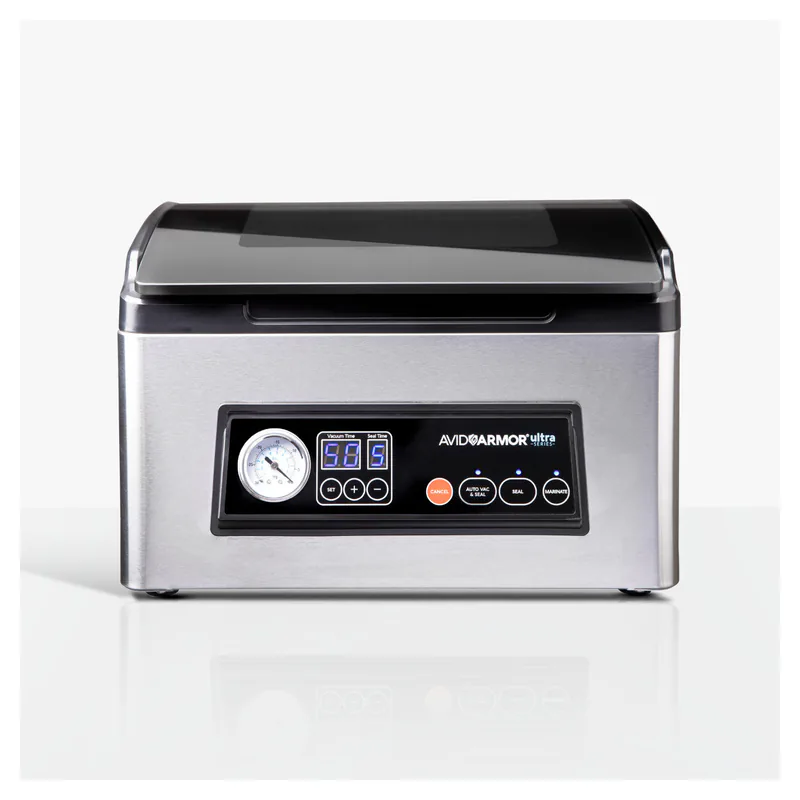
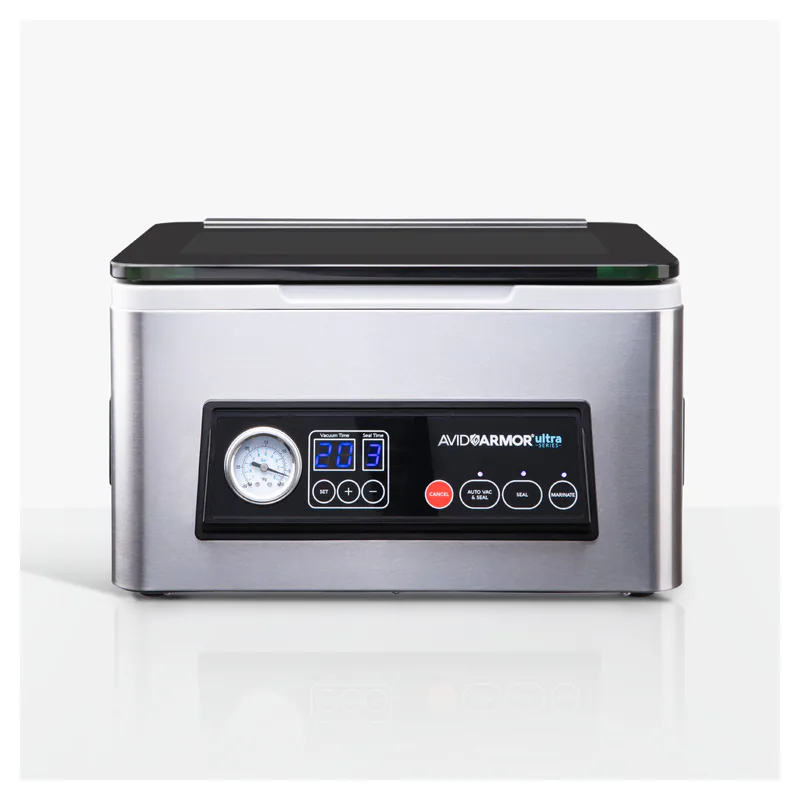
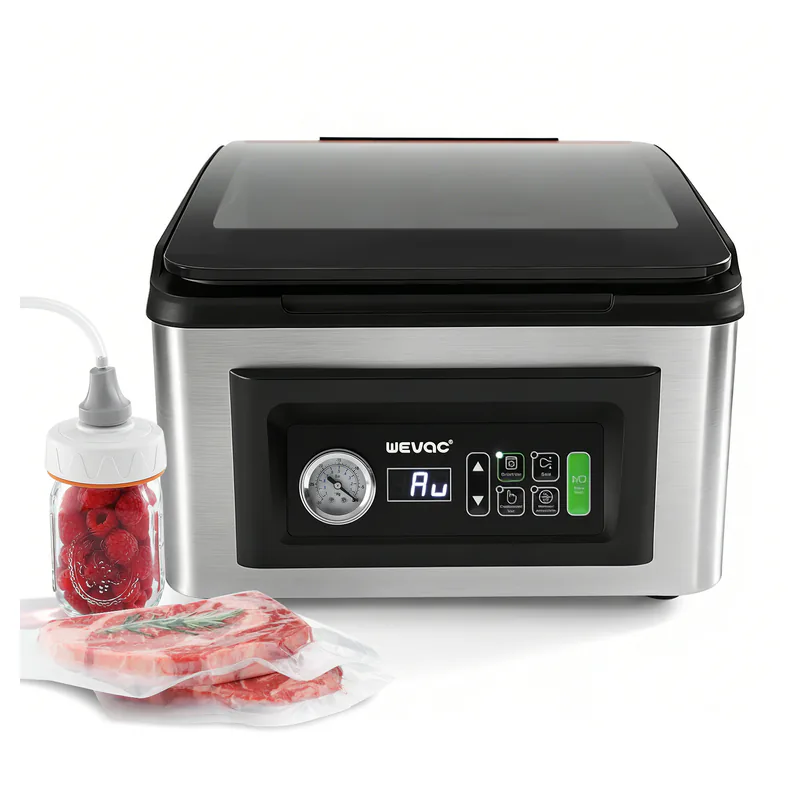
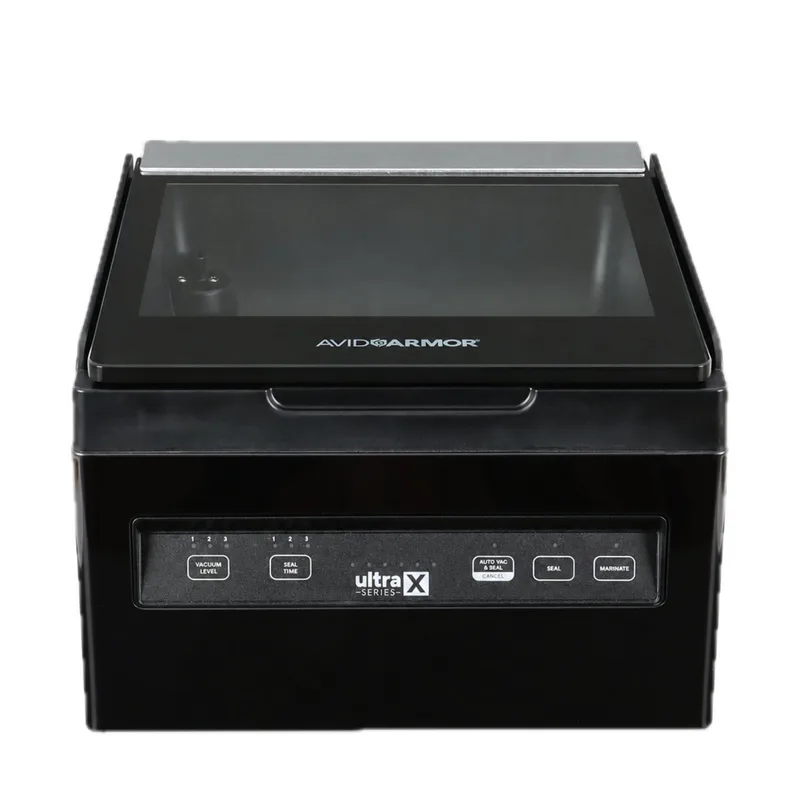
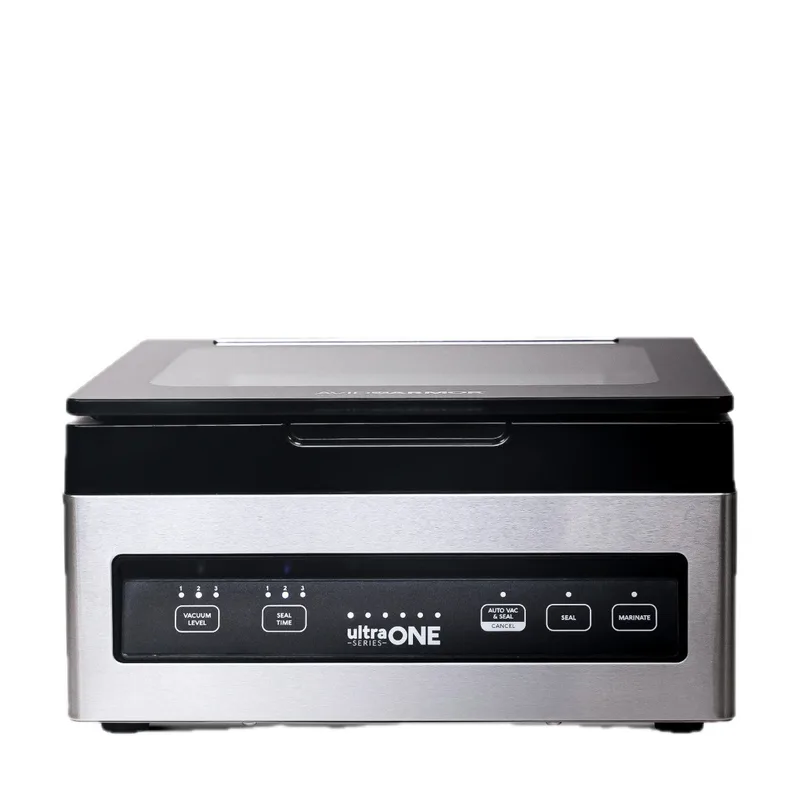
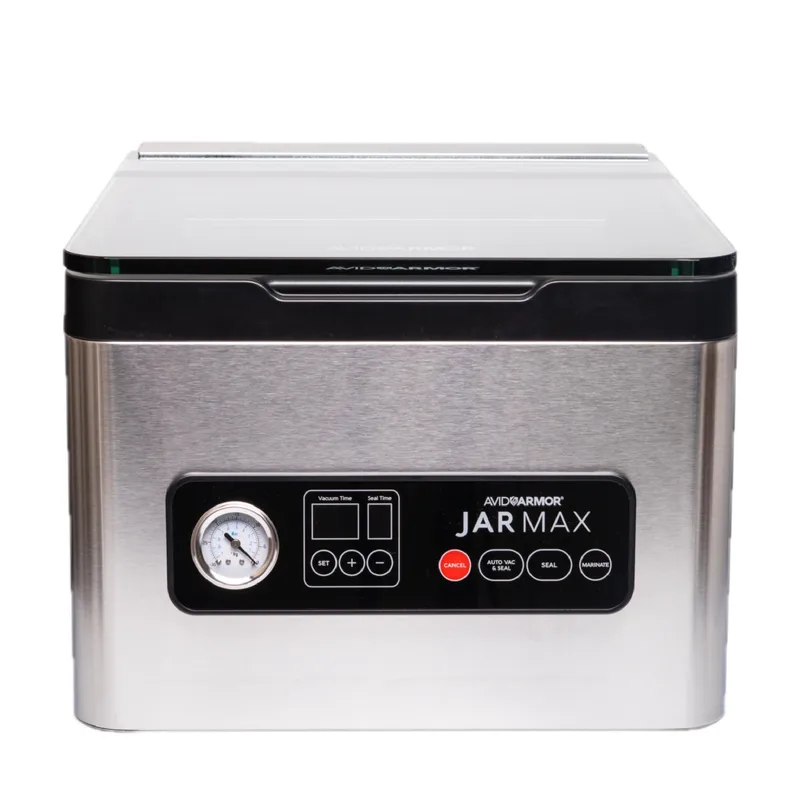
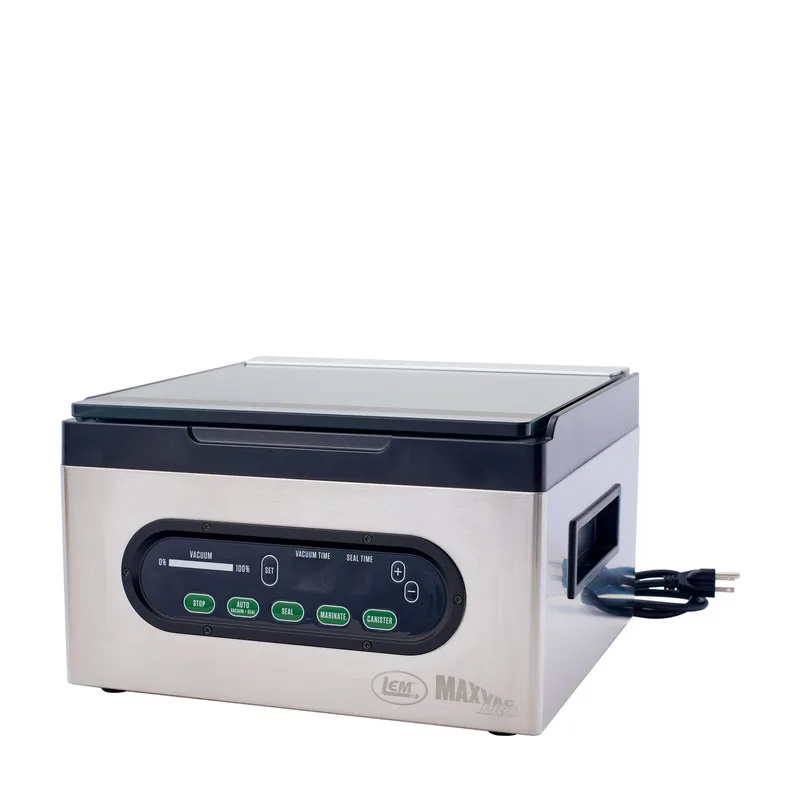
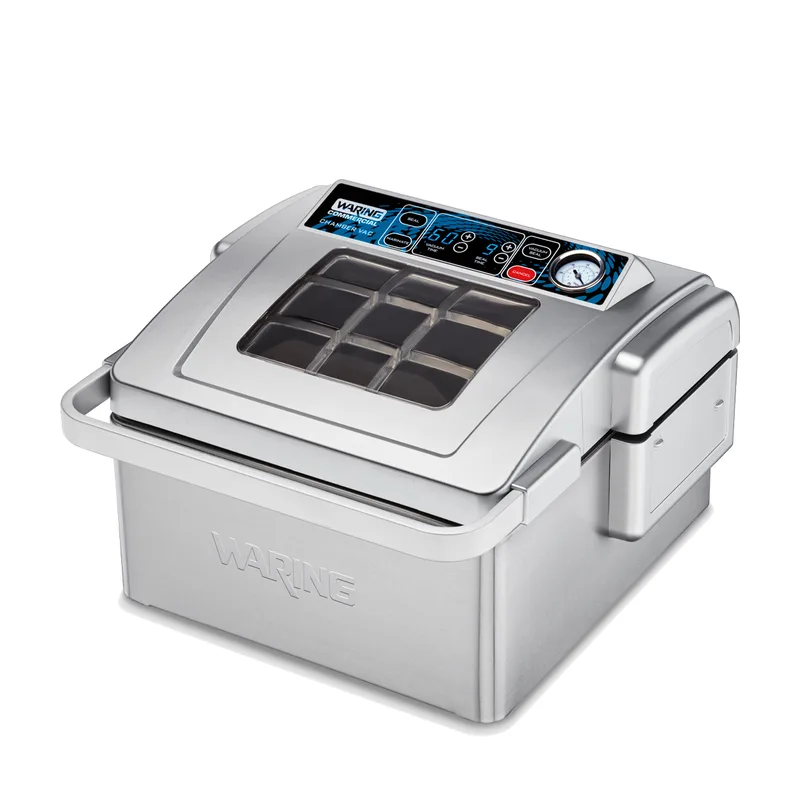
The differences that change a buying decision
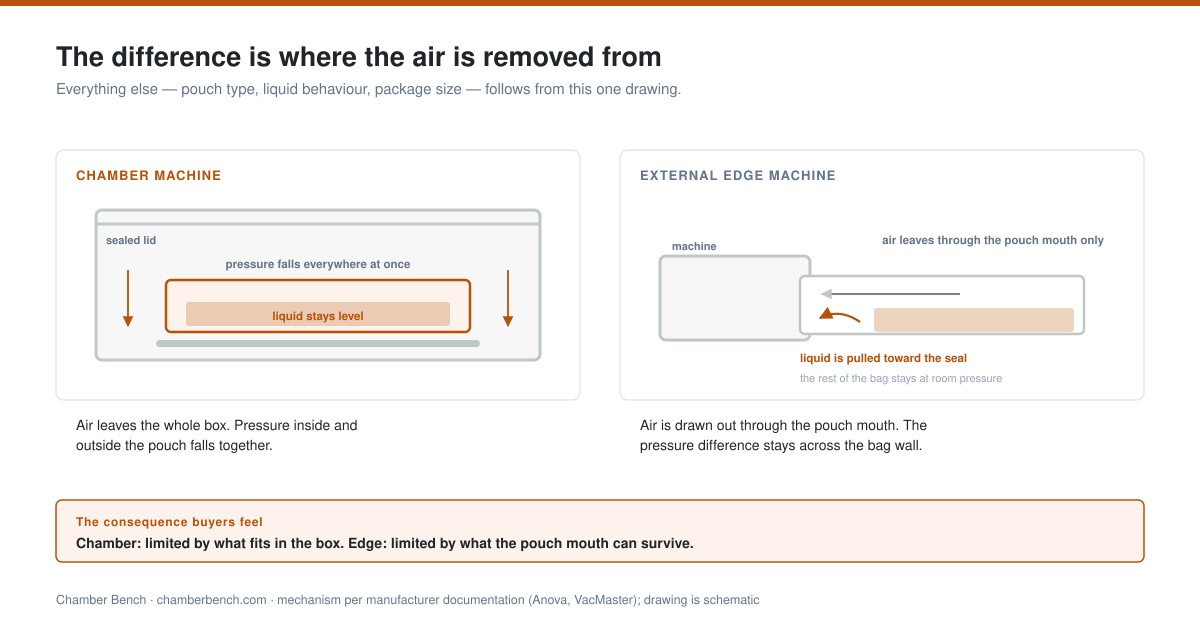
Anova Culinary names the split in the manufacturer's own words: "The most important distinction between a chamber sealer and the more common edge sealer or 'suction sealer' is the way in which the air is removed from the sealer bag or pouch." Anova continues that edge sealers "simply suck the air directly out of the bag that's being sealed," while chamber sealers "remove air from the entire chamber, including inside the pouch, creating an equally pressurized environment, both inside and outside of the bag." A second sentence on the same Anova page describes the pump step in stronger terms — "A powerful pump then removes all air from the entire chamber" — and the distance between removing air and removing all of it is exactly what the published pressure figures later on this page are used to test. Every other difference here descends from that first sentence.
Vacuum on this page means the pressure condition inside the package, not the appliance that produces it. The two architectures reach that condition by different routes, and the route decides what the machine can accept. A chamber machine lowers pressure around a pouch lying flat inside a rigid box, so the pouch never carries the airflow. An external machine lowers pressure at the bag mouth and pulls air along the length of the bag, so the bag itself has to carry the airflow to the seal line. Bag construction, package size, liquid behavior, counter footprint and run-time limits all fall out of that difference, and none of them is a preference.
Terminology across the category is inconsistent, which is why one decision gets searched half a dozen ways. "Regular vacuum sealer," "external sealer," "suction sealer" and "edge sealer" all name the same architecture: the countertop appliance that clamps a bag mouth and evacuates through it. Anova uses "edge sealer" and "suction sealer" in a single sentence. FoodSaver calls its FM2000 a "Vacuum Sealing System." Gasbye calls the category "external vacuum sealers." One architecture, four published names, and no standard settling which is correct — so a shopper comparing two pages is often comparing the same machine type under two labels.
Gasbye, which sells a chamber machine and is therefore an interested party, describes the competing architecture in mechanism terms: "External vacuum sealers clamp around the bag and pull air directly from the opening, which can draw liquids and soft foods toward the seal." Anova states the chamber-side consequence: "Equalized pressure within the chamber ensures that the food or liquid being sealed stays wherever you have placed it within the sealer pouch." VacMaster's VP215 user guide states two advantages over "non-chamber, external suction units": that "a much higher level of vacuum can be achieved, which means a longer shelf life for foods that you package," and that "liquids and liquid-rich foods can be effectively vacuum packaged." The second is a mechanism claim. The first is unquantified — VacMaster publishes no pressure figure, no percentage and no comparison basis for the VP215, VP210 or VP230 anywhere in the documents cited here.
Two of the nine chamber machines cited on this page do publish a chamber pressure, and they do not publish it the same way. Anova publishes "-0.95bar" in its product-page specification block and "Vacuum capacity what %: 99.9%" in its support FAQ. VEVOR publishes "Max Relative Vacuum -100KPa" in the same specification block that carries the chamber dimensions and sealing length this page quotes elsewhere. FoodSaver publishes no vacuum figure of any kind for the FM2000, so even those two chamber records have nothing on the external side to sit against. A buyer cannot compare achieved vacuum across the two architectures on the published evidence, and this page does not estimate what the record leaves out.
What actually separates a chamber sealer from an external sealer?
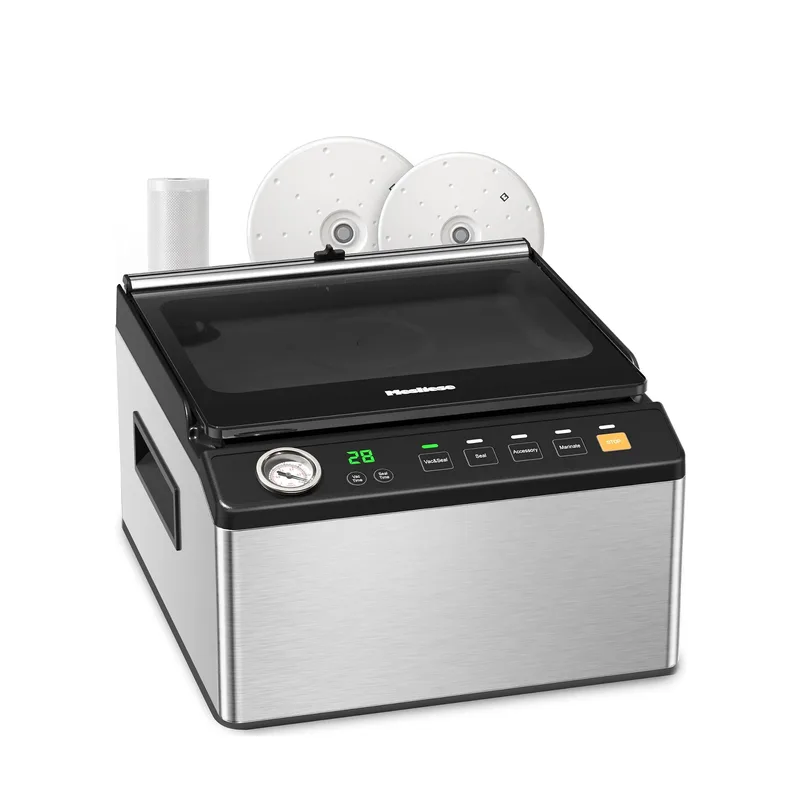
Where the air is removed from separates a chamber sealer from an external edge sealer, and everything else follows. A chamber sealer evacuates a rigid box with the whole pouch inside it, so package size is capped by the chamber — 8.5 in to 15.25 in on the horizontal axis each publisher lists second, across the eight chamber machines cited here that publish a full envelope, from the Avid Armor USV20 at the low end, where Avid Armor labels that axis L, to the VacMaster VP215 and VP210 at the high end, where VacMaster labels it D; VEVOR publishes its three numbers with no axis label at all. An external edge sealer evacuates through the bag mouth only, so bag length is not capped by an enclosure and the airflow runs the length of the bag, past the seal line.
Is a chamber vacuum sealer different from a regular vacuum sealer?
A chamber vacuum sealer differs from a "regular" vacuum sealer in one structural way: "regular" is the retail word for the external, edge or suction sealer that clamps the bag mouth and evacuates through it. Anova Culinary calls the edge sealer "the more common" of the two architectures and separates them by where the air is removed from — the entire chamber including the inside of the pouch, or the bag opening alone. Bag construction follows directly. Anova publishes that chamber pouches are "completely clear and smooth" while edge sealer bags "have a built-in mesh liner, running the length of the bag."
Scroll horizontally to see every column.
| Decision factor | Chamber machine (published records) | External edge machine (published records) |
|---|---|---|
| Where air is removed from | The entire chamber, including inside the pouch (Anova) | The bag opening only (Anova) |
| Wet food | Anova states equalized pressure keeps liquid where it was placed; VacMaster caps fill below the seal bar height | Gasbye, a chamber seller, states suction "can draw liquids and soft foods toward the seal" |
| Package length | Capped by the chamber: 8.5 in to 15.25 in on the horizontal axis each publisher lists second — Avid Armor labels it L, VacMaster labels it D, VEVOR publishes it with no axis label — across the eight machines here that publish a full envelope | Not capped by an enclosure; only the bag mouth enters the machine |
| Package thickness | Capped by chamber height: 2 in (VEVOR) to 5 in (VacMaster VP215, VP210, VP230) | Not capped by an enclosure |
| Bag construction | Smooth chamber pouches; Anova and Wevac state a chamber machine also accepts embossed bags | Embossed channel bags; Anova and Avid Armor state smooth chamber pouches do not work in one |
| Published film thickness | Avid Armor publishes 3 mil on its 8 × 10 pouch listing and 3.5 mil in the collection copy that carries the same pouch; VacMaster catalogs 3, 4 and 5 mil | FoodSaver publishes a 3 mil smooth side and an 11.5 mil textured side on one roll |
| Published vacuum level | Anova publishes -0.95 bar (product page) and 99.9 percent (support FAQ); VEVOR publishes "Max Relative Vacuum -100KPa"; VacMaster publishes none for the VP215, VP210 or VP230 | FoodSaver publishes no vacuum figure for the FM2000 |
| Counter footprint | VacMaster publishes VP215 machine dimensions of 20 × 14 × 15 in in the user guide, 14 × 20 × 15 in on the product page, and a weight of 84 lb on that same product page | FoodSaver publishes FM2000 dimensions of 4 in H × 16.3 in W × 3.9 in D |
| Vertical clearance | Avid Armor publishes 22.5 in to open the USV32 lid and 17 in for the USV20 | FoodSaver publishes no lid clearance; the FM2000 stands 4 in tall |
| Run-time limit | VacMaster publishes 70 s on, 10 s off, and cooling after 45 minutes for the VP215 and VP210 | No duty cycle published for the FM2000 |
| Freshness multiplier | VacMaster publishes "up to five times longer" and "3-5 times longer" in one manual | FoodSaver publishes "up to 5x longer" for its rolls; neither side publishes a test method |
Source basis[1] Anova Culinary: How do Chamber Vacuum Sealers Work? · [2] Anova Culinary: Anova Precision Chamber Vacuum Sealer · [3] Anova Culinary Support · [4] VacMaster: VP215 Chamber Vacuum Sealer User Guide (June 2024) · [5] VacMaster: VP210 Chamber Vacuum Sealer User Guide · [6] VacMaster: VacMaster VP215 Best Selling Commercial Chamber Vacuum Sealer · [7] VacMaster: VacMaster VP210 Maintenance-Free Chamber Vacuum Sealer · [8] VacMaster: VacMaster VP230 Commercial Chamber Vacuum Sealer · [10] Avid Armor: USV32 Chamber Vacuum Sealer | 11.5" Seal Bar, Pouches to 11" x 13" · [11] Avid Armor: USV20 Chamber Vacuum Sealer | 11.5" Seal Bar, Pouches to 11" x 10" · [13] Avid Armor: Avid Armor Chamber Vacuum Pouches, 8"×10" - 250 Count · [14] Avid Armor: Avid Armor Chamber Vacuum Pouches - Assorted Size Packs · [16] FoodSaver: FoodSaver 11" x 16' Vacuum Seal Roll, 3 Pack · [17] FoodSaver: FoodSaver FM2000 Vacuum Sealing System · [18] Wevac Technology Co., Limited · [19] VEVOR · [20] Gasbye
Bag construction is the architecture made physical
The bag is where the two architectures stop being a diagram and start being a purchase. Anova publishes the consequence and the asymmetry in one passage: "The chamber pouches are completely clear and smooth, while the edge sealer bags have a built-in mesh liner, running the length of the bag. Edge sealers require this mesh liner to directionally channel air as it is pulled out of the bag, for a quick and even sealing experience. Because chamber vacuums don't need to suck air directionally, they don't require these mesh liners to achieve an airtight seal. This effectively means you can use either style of bag to seal food with a chamber vacuum sealer, but chamber sealer pouches are not compatible with edge sealers." Anova's product page restates the same point in shorter form.
The compatibility runs one way, and most side-by-side comparisons flatten it into a symmetric rule. Wevac confirms the permissive direction from the chamber side, publishing the CV12 Pro as "Compatible with all vacuum bags, including embossed bags, flat bags and Mylar bags." Avid Armor confirms the restrictive direction from the pouch side, stating that its chamber pouches are "designed ONLY for chamber vacuum sealers" and "NOT compatible with Food Saver or other external vacuum sealers." Anova's support FAQ answers the substitution question in one word: asked whether the Precision Chamber Vacuum Sealer can be used as an edge sealer, Anova answers "No."
Film thickness is published on both sides of the aisle, and the two constructions are not built from the same amount of material. FoodSaver publishes two figures for the two sides of one roll — "Smooth side: 3mils thick. Textured side: 11.5mils thick" — so a channel bag carries 14.5 mil of film per package. Avid Armor publishes "Heavy-Duty 3 Mil Construction" on its 8 × 10 chamber pouch listing, which gives 6 mil across two uniform walls. The same company's chamber pouch collection, at a URL that reads 3-5-mil-chamber-vacuum-pouches, opens with "3.5-mil chamber vacuum pouches are the smooth, heavy-duty bags built for Avid Armor chamber vacuum sealers like the USV20, USV32, USVX and USV1" — and lists that same 8 × 10 250-count pouch among its products, which puts a listing published at 3 mil inside a description published at 3.5 mil. At 3.5 mil the two walls total 7 mil. Both totals are Chamber Bench calculations from published thicknesses, and they are the quantified version of Avid Armor's own unquantified statement that "smooth chamber pouches require less material than embossed bags." Avid Armor also publishes the conversion that makes the units readable: "A 3 mil (75 gauge) pouch measures 0.003 inches thick, while a 4 mil (100 gauge) pouch is 0.004 inches thick."
Film thickness is not barrier performance, and the published record does not bridge the two. No manufacturer checked for this page publishes a water vapor transmission rate or an oxygen transmission rate for any consumer chamber pouch or channel bag. FoodSaver states that "channels and multi-layer construction blocks moisture and oxygen" without publishing a rate. Avid Armor claims resistance to freezer burn for its pouches without publishing a rate. The absence is the finding, and no figure on this page should be read as a barrier number.
"Chamber pouch" also names a shape rather than a material specification. VacMaster's VP215 manual states that bag thickness is "available in standard 3mil or heavy duty 4mil," while the packaging table on the same page of the same manual lists a 5-mil chamber pouch item as well. Avid Armor stocks chamber pouches at more than one gauge and publishes two of them about the same 8 × 10 pouch: 3 mil on the product listing, 3.5 mil in the collection copy that carries it. VEVOR specifies its chamber machine's bag type as a "pressed edge bag," a term VEVOR defines nowhere on the page and that matches no term used by any other manufacturer cited here. A buyer standardizing on one pouch stock is choosing among several published gauges under a single category name, and none of those gauges tells them how the film performs.
Can chamber vacuum sealer pouches be used in a regular vacuum sealer?
Chamber vacuum sealer pouches do not work in a regular external sealer, and two manufacturers publish that limit directly. Anova Culinary's support FAQ asks whether the Precision Chamber Vacuum Sealer's pouches can be used as an edge sealer and answers: "No. Chamber-style pouches need to be inserted inside The Anova Precision Chamber Vacuum Sealer for you to achieve expected results." Avid Armor's chamber pouch listing states the pouches are "NOT compatible with Food Saver or other external vacuum sealers." The reason is mechanical rather than commercial: a smooth pouch has no channel to carry air along its length to the suction port, which is the path an edge sealer depends on.
Will a chamber vacuum sealer accept embossed channel bags?
A chamber vacuum sealer accepts embossed channel bags as well as smooth pouches, according to two chamber manufacturers. Anova Culinary states that "you can use either style of bag to seal food with a chamber vacuum sealer, but chamber sealer pouches are not compatible with edge sealers." Wevac publishes the CV12 Pro as "Compatible with all vacuum bags, including embossed bags, flat bags and Mylar bags." Bag compatibility therefore runs in one direction only, which matters for anyone switching architectures with channel bag stock already in the drawer.
Source basis[1] Anova Culinary: How do Chamber Vacuum Sealers Work? · [2] Anova Culinary: Anova Precision Chamber Vacuum Sealer · [3] Anova Culinary Support · [4] VacMaster: VP215 Chamber Vacuum Sealer User Guide (June 2024) · [13] Avid Armor: Avid Armor Chamber Vacuum Pouches, 8"×10" - 250 Count · [14] Avid Armor: Avid Armor Chamber Vacuum Pouches - Assorted Size Packs · [15] Avid Armor: 3 mil vs 4 mil Chamber Vacuum Pouches: What's the Difference? · [16] FoodSaver: FoodSaver 11" x 16' Vacuum Seal Roll, 3 Pack · [18] Wevac Technology Co., Limited · [19] VEVOR
Published geometry sets bag size, and the seal bar sets it first
VacMaster publishes the rule that decides pouch fit, and it names two constraints rather than one: "Make sure that the mouth of the pouch does not exceed the length of the seal bar and make sure the entire pouch fits inside the chamber. Allow 3" of extra headspace at the top of the pouch to ensure a quality, air-tight seal." The identical sentence appears in the VP210 user guide, so the rule is not model-specific. A separate note in the VP215 manual removes the last ambiguity: "The entire pouch, including the opening, must remain inside the chamber."
Applied to VacMaster's own published figures, that rule costs more than a third of the chamber. The VP215 manual publishes a chamber of 11.25 × 15.25 × 5 in, a maximum bag size of 10 × 13 in, and a 3-inch headspace deduction. Thirteen inches of pouch minus three inches of headspace leaves ten inches of pouch that can actually hold food, which is 65.6 percent of the chamber's longest published dimension. That is a Chamber Bench calculation from three figures inside one VacMaster document, and it is the reason a chamber dimension read off a product listing is not a fit test.
The VP230 publishes the same chain with different numbers, and this page previously recorded its pouch figure as unpublished. It is published: VacMaster's VP230 product page lists "Maximum chamber bag size: 12" x 15"" in the same specification block as its "12.25" removable seal bar with double seal wire," its "Chamber size: 12.5" W x 15" D x 5" H" and its "Weight: 89 pounds." Apply the three-inch headspace deduction VacMaster publishes in the VP215 and VP210 guides — the VP230 page publishes no headspace instruction of its own — and fifteen inches of pouch leaves twelve inches that can hold food, or 80 percent of the chamber's 15-inch published depth. That is a Chamber Bench calculation combining the VP230 product page with a rule VacMaster publishes for its other two chamber models, and the deduction is only as portable as VacMaster's own documentation makes it.
The seal bar, not the chamber, is the binding constraint on bag width across the machines cited here. On every chamber machine cited here that publishes a full interior envelope — the Avid Armor USV20 and USV32, the VacMaster VP210, VP215 and VP230, the Anova Precision, the Wevac CV12 Pro and the VEVOR — the published seal bar is shorter than the chamber's longest published interior dimension. That comparison is a Chamber Bench calculation across eight manufacturer records. Five of the nine machines publish a seal bar and a maximum pouch inside one specification block, and in all five the published pouch width sits at or inside the published bar. VacMaster's VP215 and VP210 user guide specification tables each publish a 10.25-inch seal bar beside a maximum bag or pouch size of 10 × 13 in, a quarter inch of published margin on the width; against the 10-inch bar the VP215 and VP210 product pages publish instead, that same 10-inch pouch mouth leaves no published margin at all, which is what the two-document seal bar costs a buyer in practice. VacMaster's VP230 product page publishes a 12.25-inch bar beside a published maximum chamber bag size of 12 x 15 in, another quarter inch. Avid Armor publishes an 11.5-inch bar beside a maximum pouch of 11 × 10 in on the USV20 and 11 × 13 in on the USV32, half an inch of published margin on each width. Those five pairings are the only places in this set where the width half of VacMaster's rule can be checked against a single publisher's own block without combining documents; Anova, Wevac, VEVOR and Gasbye publish a seal bar and no pouch maximum at all. Wevac publishes two chambers for the CV12 Pro on one page, 13.0 in and 12.8 in on the long axis, and its 12-inch seal bar is shorter than either. The Gasbye CV4520 inverts the pattern: Gasbye publishes an 11.5-inch seal bar and a 9.7-inch interior width in the same sentence about the same machine, and an 11.5-inch bar cannot sit inside a 9.7-inch width. Gasbye does not say which figure is wrong, and publishes no chamber depth and no chamber height to resolve it.
Chamber height varies more in proportion than any other dimension in the category, and it is the figure that decides package thickness. VEVOR publishes a chamber of 13 × 10.6 × 2 in. Avid Armor publishes 12.25 × 8.5 × 3 in for the USV20 and 11.5 × 12 × 3.5 in for the USV32. Anova publishes 305 × 220 × 75 mm, which the same page renders as 12 × 8.6 × 3 in. Wevac publishes 12.2" W × 13.0" D × 3.9" H in its specification table and 12.4" W × 12.8" L × 3.8" H further down the same page. VacMaster publishes 5 in of height for the VP215, VP210 and VP230. Two inches to five inches is a 2.5x spread, a Chamber Bench calculation across those eight records — so a roast that clears one machine sold as a chamber vacuum sealer will not clear another sold under the same category name.
Read those chamber figures in the publishers' own axis labels, because they do not agree on what the middle number means. VacMaster labels its chamber W x D x H. Avid Armor labels its chamber W x L x H. Wevac labels it W × D × H in the specification table and W × L × H in the section that publishes the second set of numbers, and repeats the first set in its hero copy with no axis labels on it at all. Anova labels its millimeter figures W, D and H directly. VEVOR publishes three numbers with no axis labels at all. Every publisher that labels its axes puts height last, which makes height the one dimension comparable across the set without anyone renaming anything; the first two numbers are only comparable if you accept a normalization the manufacturers never published. This page treats a silent relabel as the same class of disclosure problem as VacMaster publishing 20 × 14 × 15 in one document and 14 × 20 × 15 in another.
Two published pouch maximums exceed the chamber dimension they have to lie along, and the manufacturer reconciles neither. Avid Armor publishes a USV32 chamber of 11.5 × 12 × 3.5 in and a maximum pouch size of 11 × 13 in — a pouch length one inch longer than the chamber length. The same company publishes a USV20 chamber of 12.25 × 8.5 × 3 in, labeled W x L x H, and a maximum pouch of 11 × 10 in, so the pouch's 10-inch dimension is 1.5 inches longer than the 8.5-inch dimension Avid Armor labels L. Against VacMaster's published rule that the entire pouch must remain inside the chamber, both pairs are unresolved published inconsistencies rather than errors this page can settle. VacMaster's VP230 publishes the boundary case rather than an overhang: a maximum chamber bag of 12 × 15 in against a published chamber depth of 15 in leaves no published clearance in that axis for the pouch mouth the manuals require to stay inside. Avid Armor's own USV20-versus-USV32 article adds a third figure for the same machine, stating that "our current maximum pouch size we stock is 8"x10"" — smaller than the 11 × 10 in the product page publishes. For a package-mix audit, the pouch the manufacturer actually stocks is the constraint that binds.
Which published dimension actually limits bag size on a chamber vacuum sealer?
The seal bar limits bag width on a chamber vacuum sealer, not the chamber, and VacMaster publishes that rule in both the VP215 and VP210 user guides: "Make sure that the mouth of the pouch does not exceed the length of the seal bar and make sure the entire pouch fits inside the chamber. Allow 3" of extra headspace at the top of the pouch." On every chamber machine cited on this page that publishes a full interior envelope, the seal bar is shorter than the chamber's longest published interior dimension. A chamber figure quoted in a product listing therefore overstates the pouch a buyer can actually run, often by several inches — and on the VP210 and VP215 the seal bar itself has two published lengths, 10.25 in in the user guides and 10 in on the product pages.
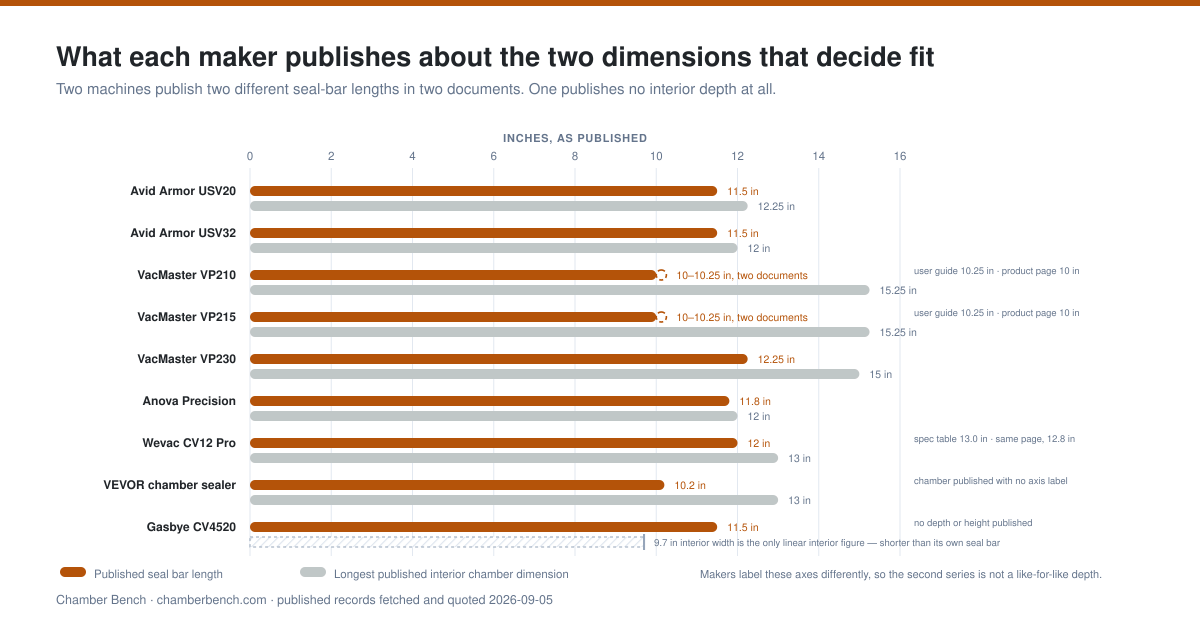
Scroll horizontally to see every column.
| Machine | Published seal bar | Published chamber, in the publisher's own axis labels (in) | Published maximum pouch |
|---|---|---|---|
| Avid Armor USV20 | 11.5 in | 12.25 × 8.5 × 3 (W x L x H) | 11 × 10 in on the product page; 8 × 10 in stocked, per Avid Armor's own comparison article |
| Avid Armor USV32 | 11.5 in | 11.5 × 12 × 3.5 (W x L x H) | 11 × 13 in |
| VacMaster VP210 | 10.25 in (user guide specification table); 10 in (product page) | 11.25 × 15.25 × 5 (W x D x H) | 10 × 13 in (user guide) |
| VacMaster VP215 | 10.25 in (user guide specification table); 10 in (product page) | 11.25 × 15.25 × 5 (W x D x H) | 10 × 13 in (user guide) |
| VacMaster VP230 | 12.25 in | 12.5 × 15 × 5 (W x D x H) | 12 × 15 in (product page) |
| Anova Precision | 300 mm | 11.8 in (product page); 30 mm (11.8 in) (support FAQ) | 305 × 220 × 75 mm | 12 × 8.6 × 3 (W x D x H) | No pouch maximum published |
| Wevac CV12 Pro | 12 in | 12.2 × 13.0 × 3.9 (W × D × H in the specification table; the same three numbers unlabeled in the hero copy); 12.4 × 12.8 × 3.8 (W × L × H, "Large Usable Chamber" section, same page) | No pouch maximum published; the page states all bag types are accepted |
| VEVOR chamber sealer | 10.2 in sealing length | 13 × 10.6 × 2 (published with no axis labels) | No pouch maximum published; bag type given as "pressed edge bag," undefined on the page |
| Gasbye CV4520 | 11.5 in | 9.7 in interior width and a 5.28 QT chamber volume; no depth or height published | No pouch maximum published |
Source basis[2] Anova Culinary: Anova Precision Chamber Vacuum Sealer · [3] Anova Culinary Support · [4] VacMaster: VP215 Chamber Vacuum Sealer User Guide (June 2024) · [5] VacMaster: VP210 Chamber Vacuum Sealer User Guide · [6] VacMaster: VacMaster VP215 Best Selling Commercial Chamber Vacuum Sealer · [7] VacMaster: VacMaster VP210 Maintenance-Free Chamber Vacuum Sealer · [8] VacMaster: VacMaster VP230 Commercial Chamber Vacuum Sealer · [10] Avid Armor: USV32 Chamber Vacuum Sealer | 11.5" Seal Bar, Pouches to 11" x 13" · [11] Avid Armor: USV20 Chamber Vacuum Sealer | 11.5" Seal Bar, Pouches to 11" x 10" · [12] Avid Armor: Side by Side Comparison of the USV20 to the USV32 · [18] Wevac Technology Co., Limited · [19] VEVOR · [20] Gasbye
Counter footprint, and the vertical space no listing warns about
Footprint is the difference a spec sheet shows and a kitchen feels. FoodSaver publishes the FM2000's specification block as model 2159372, dimensions of 4" H x 16.3" W x 3.9" D, and wattage of 120. FoodSaver publishes no weight in that block. VacMaster publishes VP215 machine dimensions of 20" x 14" x 15" in the user guide and 14" x 20" x 15" on the product page — the same three numbers in a different axis order, which is a small disclosure problem for anyone measuring counter depth before buying.
Weights sit in the same condition, and this page prints each one with the document it came from rather than as the category's answer. VacMaster publishes 84 lb for the VP215, 72 lb for the VP210 and 89 lb for the VP230 on the pages cited here; Chamber Bench's evidence record retains other published weights for the VP230 that this page does not cite, so 89 lb is the product page's figure rather than the only one in circulation. Avid Armor publishes 26.40 lb for the USV32 and 17.55 lb for the USV20 in its product-page specification tables, and the USV20 is the second machine whose weight the site's record holds published more than one way. VEVOR publishes "47 lbs / 21.3 kg (including all accessories)," which makes 47 lb a ceiling on the shipped kit rather than the mass of the machine on its own. Chamber Bench does not average published values, so where a figure has more than one publisher or more than one document behind it, the page keeps them apart.
The horizontal contrast is roughly fourfold. A 16.3 × 3.9 in external sealer occupies about 64 square inches of counter; a 20 × 14 in chamber machine occupies 280, about 4.4 times as much. That is a Chamber Bench calculation from the two manufacturers' published footprints, and it is the number most comparisons stop at.
The vertical axis is the one the category rarely publishes and almost never compares. Avid Armor publishes that the USV32 "needs 22.5 in of clearance to open the lid" and that the USV20 "needs 17 in of clearance to open lid." Avid Armor also publishes the benchmark those numbers sit against, in its own copy: "Standard kitchen upper cabinets sit 18 inches above the counter. The USV20 stands 17 inches tall with the lid fully open, so it opens in place instead of being dragged forward every time you use it." Avid Armor adds the correct caveat — "Measure your own gap first, since cabinets vary." Against that published 18-inch standard, the USV32's published requirement exceeds the gap by 4.5 inches, which means the machine gets pulled forward for every cycle. The FoodSaver FM2000 stands 4 inches tall and has no lid to open.
Chamber machines also publish a run-time limit that external listings do not frame the same way. VacMaster's VP215 manual states: "This appliance is designed for a maximum vacuum ON time of 70 seconds and a minimum OFF time of 10 seconds between cycles. Stop the appliance and allow it to cool to ambient temperature if the appliance has been in use for 45 minutes." The identical sentence appears in the VP210 manual. No equivalent duty cycle is published for the FoodSaver FM2000, so this is a published chamber-machine constraint rather than a measured difference between the architectures. Anyone planning a long butchering day should read it as a real limit on batch length.
Unused chamber volume is one cost the chamber architecture carries that the external architecture has no equivalent for, and the manufacturer publishes the remedy without publishing its size. VacMaster's manuals describe filler plates as parts "used to occupy space in the chamber. The plates allow for faster vacuum. When more space is occupied, there is less air to be removed from the chamber." That is a directional statement rather than a measurement. No manufacturer cited here publishes a cycle time as a function of chamber volume, load or fill level, so how much a larger chamber costs on a small package is unpublished, and this page does not estimate it. VacMaster does publish a cycle-time range per machine — 20 to 40 seconds for the VP215 and 20 to 60 seconds for the VP210 in their user guide specification tables, and an "Adjustable cycle time: 20-99 seconds" for the VP230 on its product page — but none of those figures is tied to what is in the chamber. The volume figure that would drive the calculation is itself contested: Anova's product page publishes chamber dimensions of 305 × 220 × 75 mm, which computes to 5.03 liters, while Anova's support FAQ publishes "Vacuum chamber volume (in liters): 4 liters."
How much counter space and overhead clearance does a chamber vacuum sealer need?
Chamber vacuum sealers occupy several times the counter area of an external sealer and, unlike an external sealer, require vertical clearance to open. VacMaster publishes VP215 machine dimensions of 20 × 14 × 15 in; FoodSaver publishes FM2000 dimensions of 4 in H × 16.3 in W × 3.9 in D. That works out to about 280 square inches of counter against about 64, a Chamber Bench calculation from the two published footprints. Avid Armor publishes a 22.5 in lid clearance requirement for the USV32 and 17 in for the USV20, against the 18-inch standard upper-cabinet gap Avid Armor itself publishes and tells buyers to measure.
Source basis[2] Anova Culinary: Anova Precision Chamber Vacuum Sealer · [3] Anova Culinary Support · [4] VacMaster: VP215 Chamber Vacuum Sealer User Guide (June 2024) · [5] VacMaster: VP210 Chamber Vacuum Sealer User Guide · [6] VacMaster: VacMaster VP215 Best Selling Commercial Chamber Vacuum Sealer · [7] VacMaster: VacMaster VP210 Maintenance-Free Chamber Vacuum Sealer · [8] VacMaster: VacMaster VP230 Commercial Chamber Vacuum Sealer · [10] Avid Armor: USV32 Chamber Vacuum Sealer | 11.5" Seal Bar, Pouches to 11" x 13" · [11] Avid Armor: USV20 Chamber Vacuum Sealer | 11.5" Seal Bar, Pouches to 11" x 10" · [17] FoodSaver: FoodSaver FM2000 Vacuum Sealing System · [19] VEVOR
Choose a chamber machine when
A chamber machine can still be a poor purchase if it stays stored because it is too heavy, or if your usual package misses the lid by half an inch. Workflow fit outranks feature count, and every element of workflow fit on this page traces to a figure a manufacturer published rather than to an opinion about the architecture.
Two manufacturers state a liquid-handling advantage for the chamber architecture, and neither quantifies it. Anova states that "equalized pressure within the chamber ensures that the food or liquid being sealed stays wherever you have placed it within the sealer pouch," and names fish, soups and marinades as the cases. VacMaster states that on a chamber system "liquids and liquid-rich foods can be effectively vacuum packaged." Both statements come from chamber sellers describing their own architecture, and neither publishes a test method, a fill level or a failure threshold behind it. Chamber Bench has run no test that could supply one.
The same VacMaster manual then publishes a limit that does carry a dimension: liquid or wet product must stay below the height of the seal bar. Inside a chamber VacMaster publishes as five inches tall, that caps fill depth at the seal bar rather than at the five inches a listing advertises — and neither the VP215 nor the VP210 guide publishes a seal bar height, so how far under five inches the ceiling actually sits is not in the record and this page does not estimate it. The manual states the rule for every wet package rather than for unusual ones. "Chamber machines handle liquids" is therefore not an unconditional statement even in the manufacturer's own documentation — it is a statement with a published ceiling attached, and the ceiling is set by a part of the machine most listings describe only by length.
Can a chamber vacuum sealer replace my external sealer entirely?
A chamber vacuum sealer replaces an external sealer only if every recurring package fits the chamber. A whole packer brisket or a bone-in leg longer than 15.25 inches — the longest interior dimension any machine cited here publishes, on the VacMaster VP215 and VP210 — has to be cut down or sealed on an external machine. VacMaster's own manual makes the constraint explicit: "The entire pouch, including the opening, must remain inside the chamber." Households that regularly package long cuts and also seal liquids usually keep both machines rather than choosing one, because the substitution fails in exactly one direction and it fails on the packages that recur.
- A meaningful share of your normal packages contain broth, marinade, sauce, or wet protein.
- Your recurring portions fit a known chamber envelope with clean seal-line clearance, checked against the published seal bar rather than the chamber.
- Wet packages can be filled below the seal bar height, which VacMaster publishes as a requirement: "Keep pouches that contain liquids or wet product below the height of the seal bar."
- You expect enough sealing volume for pouch economics and repeatability to matter.
- You have a level, ventilated place where a heavier machine can remain accessible, with the published lid clearance available above it.
- Your batch length fits the published duty cycle — 70 seconds on and 10 seconds off per cycle, with cooling after 45 minutes on the VacMaster VP215 and VP210.
Source basis[2] Anova Culinary: Anova Precision Chamber Vacuum Sealer · [4] VacMaster: VP215 Chamber Vacuum Sealer User Guide (June 2024) · [5] VacMaster: VP210 Chamber Vacuum Sealer User Guide · [10] Avid Armor: USV32 Chamber Vacuum Sealer | 11.5" Seal Bar, Pouches to 11" x 13" · [11] Avid Armor: USV20 Chamber Vacuum Sealer | 11.5" Seal Bar, Pouches to 11" x 10"
Choose an external machine when
An external machine buys its size freedom by giving up the equalized-pressure condition. Bags are cut from a roll, so length is chosen per package rather than capped by an enclosure, and thickness is limited by the clamp rather than by a lid. The cost is that every seal happens on a bag the airflow has just run through, which is why FoodSaver's own bag construction depends on channels and why a smooth chamber pouch will not evacuate in one.
Three things this page cannot tell you about external machines, because nobody publishes them. FoodSaver publishes no duty cycle or continuous-run limit for the FM2000, so the VacMaster 70-second-on figure has no counterpart to compare against and must not be read as an architecture difference. FoodSaver publishes no weight in the FM2000 specification block, so a cabinet-lifting comparison against a published 84 lb VacMaster VP215 or a published 17.55 lb Avid Armor USV20 is only half-sourced. FoodSaver also publishes no vacuum figure for the FM2000, so the two chamber-side pressure records on this page — Anova's and VEVOR's — have nothing on the external side to sit against. All three are recorded here as gaps rather than filled with an estimate.
What can an external edge sealer package that a chamber machine cannot?
An external edge sealer packages anything longer or thicker than a chamber interior, because only the bag mouth enters the machine and the bag is cut from a roll. Chamber interiors cited on this page run 8.5 in to 15.25 in on the horizontal axis each publisher lists second — Avid Armor labels it L, VacMaster labels it D, and VEVOR publishes it with no axis label — and 2 in to 5 in tall, height being the one axis every publisher that labels its axes puts last. VEVOR publishes a 2-inch chamber height, and VacMaster publishes 5 in for the VP215, VP210 and VP230, the tallest in the set. A filled package standing taller than five inches therefore has no chamber option among the machines cited here, regardless of how the machine performs on liquids.
- Your food is long, irregular, or larger than practical countertop chambers, since only the bag mouth enters an external machine.
- Your packages are thicker than the published chamber heights in this set, which run 2 in on the VEVOR to 5 in on the VacMaster VP215, VP210 and VP230.
- You seal a few mostly dry items and want the appliance to live in a cabinet; FoodSaver publishes the FM2000 at 4 in H × 16.3 in W × 3.9 in D.
- Up-front simplicity matters more than optimizing bag cost across many cycles.
- You can pre-freeze wet items or use another technique to keep liquid out of the suction path, which Gasbye describes as the failure mode: suction "can draw liquids and soft foods toward the seal."
Source basis[1] Anova Culinary: How do Chamber Vacuum Sealers Work? · [2] Anova Culinary: Anova Precision Chamber Vacuum Sealer · [3] Anova Culinary Support · [4] VacMaster: VP215 Chamber Vacuum Sealer User Guide (June 2024) · [5] VacMaster: VP210 Chamber Vacuum Sealer User Guide · [6] VacMaster: VacMaster VP215 Best Selling Commercial Chamber Vacuum Sealer · [7] VacMaster: VacMaster VP210 Maintenance-Free Chamber Vacuum Sealer · [8] VacMaster: VacMaster VP230 Commercial Chamber Vacuum Sealer · [11] Avid Armor: USV20 Chamber Vacuum Sealer | 11.5" Seal Bar, Pouches to 11" x 10" · [16] FoodSaver: FoodSaver 11" x 16' Vacuum Seal Roll, 3 Pack · [17] FoodSaver: FoodSaver FM2000 Vacuum Sealing System · [19] VEVOR · [20] Gasbye
Freezer burn is a packaging question, and the record does not settle it by architecture
The USDA Food Safety and Inspection Service defines freezer burn in terms that contradict most of the shopping advice written around it: "Freezer burn does not make food unsafe, merely dry in spots. It appears as grayish-brown leathery spots and is caused by air coming in contact with the surface of the food. Cut freezer-burned portions away either before or after cooking the food. Heavily freezer-burned foods may have to be discarded for quality reasons." That is a moisture and quality description, not a spoilage or safety one.
The same federal page assigns prevention to the package rather than to a machine: "Proper packaging helps maintain quality and prevent freezer burn. It is safe to freeze meat or poultry directly in its original packaging, however this type of wrap is permeable to air and quality may diminish over time." It also treats vacuum packages as ordinary freezer items — "Freeze unopened vacuum packages as is" — and draws no line anywhere in the document between chamber and external architectures. Freezer burn enters this comparison only through bag construction, which is where the architecture actually shows up.
The headline freshness multiplier distinguishes nothing, because both architectures publish the same one. VacMaster's VP215 manual states on its Welcome page that the machine "effectively removes air and extends freshness up to five times longer than traditional methods," and the Packaging Information page of the same manual states "keeps food fresh 3-5 times longer than conventional storage bags" — two figures in one document. FoodSaver publishes "keeping food fresh up to 5x longer" for its vacuum seal rolls, which run on the opposite architecture. None of the three publishes a comparison basis, a test method or a storage condition. USDA FSIS supplies the frame those numbers actually sit in: "Because freezing keeps food safe almost indefinitely, recommended storage times are for quality only."
The number that would settle the bag question does not exist in the published record. A water vapor transmission rate and an oxygen transmission rate are the measurements that describe how much moisture and oxygen a film passes, and they are what a freezer-burn comparison between a smooth chamber pouch and an embossed channel bag would need. Five of the ten manufacturer pages that could carry a film specification publish a film thickness in mils: Avid Armor's 8 × 10 chamber pouch listing at 3 mil, its collection page at 3.5 mil, its 3-mil-versus-4-mil article, the VacMaster VP215 user guide whose packaging information page carries 3-mil, 4-mil and 5-mil chamber pouch stock, and the FoodSaver roll page at 3 mil smooth and 11.5 mil textured. Four of the remaining five publish no film thickness anywhere on them — the Wevac CV12 Pro page, the Anova product page, the Anova support FAQ and the Gasbye page, each of which describes the bags its machine accepts without giving a gauge for any of them. The tenth, the VacMaster VP210 user guide, is cited on this page for its fit rule, duty cycle and specification table rather than for pouch stock. What all ten share is the absence rather than the thickness: not one publishes a water vapor transmission rate, an oxygen transmission rate, a barrier grade or a test standard for any film, on either architecture. Thickness and barrier performance are different properties, and nothing in the published record connects them. That is why the film totals earlier on this page are described as film totals and nothing else.
Does a chamber vacuum sealer prevent freezer burn better than a regular vacuum sealer?
No published record compares freezer-burn resistance between chamber and external vacuum sealers. USDA FSIS attributes prevention to the package rather than the appliance: "Proper packaging helps maintain quality and prevent freezer burn." Neither architecture's pouch makers publish a water vapor or oxygen transmission rate for their film. FoodSaver states that its channel bag's "channels and multi-layer construction blocks moisture and oxygen," and Avid Armor claims freezer-burn resistance for its chamber pouches, and neither publishes a figure or a test standard behind the claim. The comparison cannot be made on published evidence, which is the finding rather than a hedge.
Is freezer burn a food safety problem?
Freezer burn is a quality problem rather than a safety problem, according to the USDA Food Safety and Inspection Service: "Freezer burn does not make food unsafe, merely dry in spots. It appears as grayish-brown leathery spots and is caused by air coming in contact with the surface of the food." The same agency page states that recommended frozen storage times "are for quality only" because "freezing keeps food safe almost indefinitely." Any freshness multiplier a sealer manufacturer publishes therefore sits inside a quality frame, not a safety one, whichever architecture published it.
Source basis[2] Anova Culinary: Anova Precision Chamber Vacuum Sealer · [3] Anova Culinary Support · [4] VacMaster: VP215 Chamber Vacuum Sealer User Guide (June 2024) · [5] VacMaster: VP210 Chamber Vacuum Sealer User Guide · [13] Avid Armor: Avid Armor Chamber Vacuum Pouches, 8"×10" - 250 Count · [14] Avid Armor: Avid Armor Chamber Vacuum Pouches - Assorted Size Packs · [15] Avid Armor: 3 mil vs 4 mil Chamber Vacuum Pouches: What's the Difference? · [16] FoodSaver: FoodSaver 11" x 16' Vacuum Seal Roll, 3 Pack · [18] Wevac Technology Co., Limited · [20] Gasbye · [21] USDA Food Safety and Inspection Service: Freezing and Food Safety
Where the manufacturers disagree with themselves
Running a fit check is harder than it should be because the specifications conflict inside single brands, and sometimes inside single documents. Every figure below was read from the publisher's own page or manual. None of it is a defect claim about any machine; it is a disclosure problem that changes what a buyer can verify before purchase.
VacMaster publishes three horsepower figures for one pump across three documents. The VP215 user guide's specification table lists a ".2 HP Rotary Oil Pump." The VP215 product page lists a "1/5 hp oil pump," the same value written as a fraction. The VacMaster help center article comparing the VP210 and VP215 states that "the VP215 uses a powerful, 1/4 HP rotary oil pump" — a figure 25 percent larger than the other two.
The seal bar disagreement matters more than a quarter inch normally would, because VacMaster's own instruction ties pouch width to the seal bar. The VP215 user guide specification table publishes "Seal Bar Length: 10.25"," while the VP215 product page publishes a "10 Inch removable seal bar with double seal wire." The VP210 splits exactly the same way, and this page previously showed only one half of it: the VP210 user guide's specification table publishes "Seal Bar Length: 10.25"" and the VP210 product page publishes "10 Inch removable seal bar with double seal wire." Two machines, four documents, two answers, from one manufacturer, about the part that decides the fit. A buyer sizing pouch stock against the published maximum has to pick a document before they can pick a pouch.
Service intervals split the same way. The VP215 user guide publishes a "required oil change schedule: First Change: one week after use. Future Change: every 3 months or 250 cycles, which ever comes first" — four changes a year at the stated interval. The VacMaster help center states that the VP215 "requires oil changes approximately 2 times a year depending on use." The same 24-page manual also gives two fill quantities for the same pump: the front warning page states "approximately 9 to 9 1/2 ounces of oil," and the How to Use section states approximately 10 to 12 ounces.
Anova publishes four technical figures for one machine across two of its own documents, and three of them disagree. The product page publishes a seal bar of "300mm | 11.8 in"; the support FAQ publishes "Max. sealable width mm: 30mm (11.8in" — and 30 mm converts to 1.18 in, not 11.8 in, so the product page's 300 mm is the figure consistent with the shared inch value. The product page publishes a "70L/min" pump; the FAQ publishes 4.32 m³/h, which equals 72 L/min. The product page publishes chamber dimensions of 305 × 220 × 75 mm, which computes to 5.03 liters; the FAQ publishes "Vacuum chamber volume (in liters): 4 liters." The product page publishes "-0.95bar"; the FAQ publishes "Vacuum capacity what %: 99.9%." Which figure Anova intended in any of the four cases is not something this page can determine.
Wevac contradicts itself inside a single page. The CV12 Pro's specification table publishes a chamber of 12.2" W × 13.0" D × 3.9" H, and the page's hero copy repeats those same three numbers, 12.2 × 13.0 × 3.9, with no axis labels attached to any of them, so the W, D and H labels are the specification table's alone. A section further down the same page, headed "Large Usable Chamber," publishes "CV12 Pro has a chamber of 12.4" W × 12.8" L × 3.8" H." The two versions differ by 0.2 in on width, 0.2 in on the long axis and 0.1 in on height, and the label on the second axis changes from D to L between them. Nothing on the page says which measurement the machine was built to, so a fit check on a package close to the limit gets a different answer depending on which paragraph the buyer reads.
Pouch gauge is published two ways as well, in a case where one page's description covers the other page's product. Avid Armor's 8 × 10 chamber pouch listing publishes "Heavy-Duty 3 Mil Construction." Avid Armor's chamber pouch collection, whose URL reads 3-5-mil-chamber-vacuum-pouches, opens with "3.5-mil chamber vacuum pouches are the smooth, heavy-duty bags built for Avid Armor chamber vacuum sealers like the USV20, USV32, USVX and USV1" and lists that same 8 × 10 250-count pouch among its products. Avid Armor separately publishes an article comparing 3 mil and 4 mil pouch stock, so the company plainly sells more than one gauge; what it does not publish is which gauge the 8 × 10 pouch inside the 3.5-mil collection actually is. VacMaster's VP215 manual carries the same ambiguity in one document, naming "standard 3mil or heavy duty 4mil" in a sentence and cataloging a 5-mil chamber pouch item in the table beside it.
How much air any of these machines removes is claimed more confidently in marketing than in measurement. Anova's mechanism page states that "a powerful pump then removes all air from the entire chamber." Gasbye's product page states, in its own typography, "Commercial chamber Vacuum Sealer - Like Putting Foodin outer Space, Every Bit of Air ls Removed." USDA FSIS uses the hedge none of the marketing uses: "Vacuum packaging, for example, removes substantially all air from packages --rigid or flexible-before sealing and produces a vacuum inside." Two of the nine chamber machines cited here publish a pressure figure those claims can be read against. Anova publishes "-0.95bar" on the product page and "Vacuum capacity what %: 99.9%" in the support FAQ. VEVOR publishes "Max Relative Vacuum -100KPa" in its specification block — a deeper claim than Anova's, and a stated maximum rather than a per-cycle figure. Against a nominal sea-level atmosphere of about 101.3 kPa, a gauge reading of -95 kPa leaves roughly 6 kPa of air inside the chamber and -100 kPa leaves roughly 1.3 kPa, on the order of 94 percent and 99 percent of the air removed. Those are Chamber Bench calculations with the atmospheric assumption stated, and neither of them is every bit of the air. Finally, a positioning conflict worth one sentence, and it spans two machines rather than one: the VP215 user guide's safeguards state "this appliance is for commercial use only," while VacMaster's product page for the VP210, which publishes the same chamber and sits in the same line, describes it as suited to home kitchens. That is a documentation inconsistency across two models, not a self-contradiction about either one, and not a safety finding.
Scroll horizontally to see every column.
| Figure | One published value | Another published value |
|---|---|---|
| VacMaster VP215 pump | ".2 HP Rotary Oil Pump" (user guide); "1/5 hp oil pump" (product page) | "1/4 HP rotary oil pump" (help center) |
| VacMaster VP215 seal bar | 10.25 in (user guide specification table) | 10 in (product page) |
| VacMaster VP210 seal bar | 10.25 in (user guide specification table) | 10 in (product page) |
| VacMaster VP215 oil change interval | Every 3 months or 250 cycles (user guide) | About 2 times a year (help center) |
| VacMaster VP215 oil fill | 9 to 9 1/2 ounces (front warning page) | 10 to 12 ounces (How to Use section, same manual) |
| VacMaster VP215 machine dimensions | 20" x 14" x 15" (user guide) | 14" x 20" x 15" (product page) |
| Anova seal width | 300 mm | 11.8 in (product page) | 30 mm (11.8 in) (support FAQ) |
| Anova air removal | -0.95 bar (product page) | 99.9% (support FAQ) |
| Anova chamber volume | 305 × 220 × 75 mm, which computes to 5.03 liters (product page) | 4 liters (support FAQ) |
| Anova pump flow | 70 L/min (product page) | 4.32 m³/h, equal to 72 L/min (support FAQ) |
| Wevac CV12 Pro chamber | 12.2" W × 13.0" D × 3.9" H (specification table; hero copy repeats the three numbers unlabeled) | 12.4" W × 12.8" L × 3.8" H ("Large Usable Chamber" section, same page) |
| Avid Armor USV20 maximum pouch | 11 × 10 in (product page) | 8 × 10 in stocked (USV20-versus-USV32 article) |
| Avid Armor 8 × 10 chamber pouch film | "Heavy-Duty 3 Mil Construction" (8 × 10 250-count product listing) | "3.5-mil chamber vacuum pouches" (collection page that lists the same 8 × 10 250-count pouch) |
Source basis[1] Anova Culinary: How do Chamber Vacuum Sealers Work? · [2] Anova Culinary: Anova Precision Chamber Vacuum Sealer · [3] Anova Culinary Support · [4] VacMaster: VP215 Chamber Vacuum Sealer User Guide (June 2024) · [5] VacMaster: VP210 Chamber Vacuum Sealer User Guide · [6] VacMaster: VacMaster VP215 Best Selling Commercial Chamber Vacuum Sealer · [7] VacMaster: VacMaster VP210 Maintenance-Free Chamber Vacuum Sealer · [8] VacMaster: VacMaster VP230 Commercial Chamber Vacuum Sealer · [9] VacMaster: What is the difference between the VP210 and the VP215? · [11] Avid Armor: USV20 Chamber Vacuum Sealer | 11.5" Seal Bar, Pouches to 11" x 10" · [12] Avid Armor: Side by Side Comparison of the USV20 to the USV32 · [13] Avid Armor: Avid Armor Chamber Vacuum Pouches, 8"×10" - 250 Count · [14] Avid Armor: Avid Armor Chamber Vacuum Pouches - Assorted Size Packs · [15] Avid Armor: 3 mil vs 4 mil Chamber Vacuum Pouches: What's the Difference? · [18] Wevac Technology Co., Limited · [19] VEVOR · [20] Gasbye · [22] USDA Food Safety and Inspection Service: What is vacuum packaging?
Audit your package mix before choosing an architecture
List ten packages that represent normal use rather than rare edge cases. For each one, record whether it is wet or dry, its filled length and height, the pouch construction your current process requires, and whether the machine must be stored after use. The result should expose the dominant constraint without pretending that either architecture wins every category.
Classify each package as a physical pass, a workflow pass, or unresolved. A physical pass means the filled pouch and clean seal area fit the architecture. A workflow pass means the machine can be placed, loaded, cleaned, and stored in the way you will actually use it. Keep an unresolved result when a manufacturer dimension, pouch requirement, or operating instruction is missing; do not award the point by assumption. Compare the cost of only those options that pass the essential packages. This prevents an attractive feature from rescuing an architecture that fails the recurring work.
Run each physical check in the manufacturer's own sequence rather than against a single chamber number. VacMaster publishes the sequence in both the VP215 and VP210 user guides: the pouch mouth must not exceed the seal bar length, the entire pouch including the opening must remain inside the chamber, and three inches at the top of the pouch is reserved as headspace. Applied to the VP215's own published figures — an 11.25 × 15.25 × 5 in chamber, a 10 × 13 in maximum pouch and a 3 in headspace deduction — the pouch length left to hold food is 10 inches, or 65.6 percent of the chamber's longest published dimension. Applied to the VP230's published figures — a 12.5 × 15 × 5 in chamber and a 12 × 15 in maximum chamber bag — the same deduction leaves 12 inches, or 80 percent. Both are Chamber Bench calculations from published figures, and both are why the chamber number in a listing is not a fit test.
Run the seal-bar half of the check against both published lengths where two exist. On the VP210 and VP215 the user guides publish a 10.25-inch seal bar and the product pages publish a 10-inch seal bar, so a 10.25-inch pouch mouth passes one VacMaster document and fails another. Size the stock against the shorter published figure if you want the check to hold whichever document turns out to describe the machine on your counter — and record on the audit sheet that the constraint had two publishers' values behind it, not one.
Leave a row unresolved when the manufacturer has not published what the check needs. Gasbye publishes an 11.5-inch seal bar and a 9.7-inch interior width in one sentence about the same machine, and adds a 5.28 QT chamber volume and product dimensions of 13.6"L x 12.2"W x 8.1"H, but publishes no chamber depth, no chamber height and no machine weight. A volume is not a fit check: 5.28 US quarts is about 305 cubic inches at 57.75 cubic inches per quart, a Chamber Bench conversion, and one number cannot be resolved into the two linear dimensions VacMaster's published rule needs. Avid Armor publishes a USV32 maximum pouch of 11 × 13 in against a published chamber length of 12 in, and a USV20 maximum pouch of 11 × 10 in against a published 8.5-inch dimension the same table labels L, and reconciles neither pair. VacMaster's VP230 leaves a third kind of row: a published maximum chamber bag of 12 × 15 in against a published chamber depth of 15 in, with no published margin for the pouch mouth the manuals require to stay inside. Those rows stay unresolved until a manufacturer publishes the missing figure — the audit does not fill them with an estimate, and neither does this page.
Two package categories fail on both architectures and belong on the audit sheet anyway. VacMaster's manual states that "Vacuum packaging is NOT a substitute for canning," that "All perishables still need to be refrigerated or frozen," and that "Vacuum packaging cannot reverse the deterioration of foods." The same manual notes that "due to the risk of anaerobic bacteria, soft cheeses, fresh mushrooms, garlic and onions should never be vacuum packaged." If several of your ten recurring packages sit in those categories, no architecture decision changes the outcome.
How many of my packages have to fit before a chamber machine makes sense?
Treat any single recurring package that will not fit a chamber machine as disqualifying for that machine, rather than as an exception to work around. One weekly package that misses the lid by half an inch outweighs nine that fit, because the workaround stops being a workaround and becomes the routine. Run the check against the published seal bar and the three-inch headspace deduction VacMaster publishes, not against the chamber dimension in the listing, since the chamber figure overstates usable pouch length on every machine cited here that publishes the full chain.
- Mark any essential package that cannot fit a practical chamber; one recurring fit failure can decide the architecture.
- Check pouch width against the published seal bar length, not the published chamber width — the seal bar is shorter on every machine here that publishes both.
- Where a seal bar has two published lengths, as on the VacMaster VP210 and VP215, size the stock against the shorter one and note which document each figure came from.
- Subtract three inches of headspace from pouch length before deciding the package fits, as VacMaster's own guides instruct.
- Mark wet packages that regularly approach an external machine's suction path, and mark wet packages that would fill above a chamber machine's seal bar height.
- Measure the gap between counter and upper cabinet, then compare it against published lid clearance — 22.5 in on the Avid Armor USV32, 17 in on the USV20, against the 18 in Avid Armor publishes as the standard gap.
- Count realistic batches against the published duty cycle and the setup or storage work around them.
- Keep price out of the first pass; compare cost only after both workflows can accept the package.
- Record which source established each fit or pouch requirement, and which pouch size the manufacturer actually stocks rather than the maximum it advertises.
- Retain an unresolved state when the published evidence is incomplete.
Source basis[4] VacMaster: VP215 Chamber Vacuum Sealer User Guide (June 2024) · [5] VacMaster: VP210 Chamber Vacuum Sealer User Guide · [7] VacMaster: VacMaster VP210 Maintenance-Free Chamber Vacuum Sealer · [8] VacMaster: VacMaster VP230 Commercial Chamber Vacuum Sealer · [10] Avid Armor: USV32 Chamber Vacuum Sealer | 11.5" Seal Bar, Pouches to 11" x 13" · [11] Avid Armor: USV20 Chamber Vacuum Sealer | 11.5" Seal Bar, Pouches to 11" x 10" · [12] Avid Armor: Side by Side Comparison of the USV20 to the USV32 · [20] Gasbye
Questions readers still ask
Do the two architectures publish comparable vacuum levels?
No, and the comparison cannot be made on published evidence. Two of the nine chamber machines cited here publish a chamber pressure: Anova publishes "-0.95bar" on its product page and "Vacuum capacity what %: 99.9%" in its support FAQ, two figures that disagree, and VEVOR publishes "Max Relative Vacuum -100KPa" in the same specification block as its chamber and sealing length. VacMaster's VP215 manual states that "a much higher level of vacuum can be achieved" than on an external suction unit but publishes no pressure, no percentage and no comparison basis for the VP215, VP210 or VP230. FoodSaver publishes no vacuum figure for the FM2000, so nothing on the external side answers either chamber record. This page records that as a gap rather than ranking the architectures on an unpublished number.
Does an external sealer use more bag material than a chamber pouch?
By the manufacturers' own published film thicknesses, an external channel bag carries more film than a smooth chamber pouch. FoodSaver publishes a 3 mil smooth side and an 11.5 mil textured side on one roll, which totals 14.5 mil of film per package. Avid Armor publishes "Heavy-Duty 3 Mil Construction" on its 8 × 10 chamber pouch listing, which is 6 mil across two uniform walls, and 3.5 mil in the collection copy that carries that same pouch, which would be 7 mil. Those totals, Chamber Bench calculations from published specifications, quantify Avid Armor's own unquantified statement that smooth pouches "require less material than embossed bags." They describe material only, and say nothing about how either film performs as a barrier.
Can an external sealer handle liquid if I freeze it first?
Freezing liquid into a solid block removes the flow that the suction path pulls on, and it is the standard workaround on an external machine. Gasbye, a chamber seller, describes the failure mode being worked around: external sealers "pull air directly from the opening, which can draw liquids and soft foods toward the seal." The cost of the workaround is freezer time and an extra handling step for every package. Sealing the same liquid unfrozen is the specific capability that drives wet workflows toward the chamber architecture in the first place, though VacMaster's own manuals cap that capability by requiring wet product to stay below the seal bar height.
Which architecture is easier to put away between uses?
External sealers are built to live in a drawer; chamber machines are built to stay out. FoodSaver publishes FM2000 dimensions of 4 in H × 16.3 in W × 3.9 in D and publishes no weight in that specification block. The lightest chamber machine cited on this page, of the machines that publish one, is the Avid Armor USV20, published at 17.55 lb in its product-page specification table, followed by the USV32 at 26.40 lb. VEVOR publishes "47 lbs / 21.3 kg (including all accessories)," so that figure covers the shipped kit rather than the machine alone. VacMaster publishes 72 lb for the VP210, 84 lb for the VP215 and 89 lb for the VP230 on the pages cited here, and Chamber Bench's evidence record retains other published weights for the VP230 and the USV20, so each of those is a document's figure rather than the category's. Only a machine near the bottom of that spread is realistically lifted in and out of a cabinet, and lid clearance decides whether it can be used where it sits.
Does the published duty cycle mean a chamber machine cannot run continuously?
VacMaster publishes an explicit run-time limit for the VP215 and VP210: "This appliance is designed for a maximum vacuum ON time of 70 seconds and a minimum OFF time of 10 seconds between cycles. Stop the appliance and allow it to cool to ambient temperature if the appliance has been in use for 45 minutes." That is a constraint on batch length that anyone planning a long processing day should read before buying. It is not a chamber-versus-external difference, because no equivalent duty cycle is published for the FoodSaver FM2000, so there is nothing on the external side to compare it against.
What does a published "keeps food fresh 5x longer" claim establish?
It establishes nothing about either architecture, because both architectures publish it. VacMaster's VP215 manual publishes that the machine "effectively removes air and extends freshness up to five times longer than traditional methods" on its Welcome page, and "keeps food fresh 3-5 times longer than conventional storage bags" on the Packaging Information page of the same document. FoodSaver publishes "keeping food fresh up to 5x longer" for the vacuum seal rolls that run on the opposite architecture. None of the three publishes a comparison basis, a test method or a storage condition, and USDA FSIS supplies the frame they sit in: because freezing keeps food safe almost indefinitely, recommended storage times "are for quality only." The multiplier is a claim both sides make, not a difference between them.
Sources
Each record carries its own access date. Manufacturer statements are attributed; they are not treated as Chamber Bench test results.
- How do Chamber Vacuum Sealers Work?Anova Culinary — Manufacturer statement of the architecture split, the mesh-liner bag difference, the one-way bag compatibility rule, and the separate "removes all air from the entire chamber" pump sentence. · Accessed
- Anova Precision Chamber Vacuum SealerAnova Culinary — Product-page specifications: chamber 305 × 220 × 75 mm, 300 mm seal bar, 70 L/min pump, -0.95 bar, plus the liquid-handling statement. · Accessed
- Chamber Vacuum Sealer frequently asked questionsAnova Culinary Support — Support-page specifications that disagree with the product page on seal width, chamber volume, pump flow and air removal; also the edge-sealer substitution answer. · Accessed
- VP215 Chamber Vacuum Sealer User Guide (June 2024)VacMaster — 24-page manual: pouch fit rule and 3-inch headspace, chamber, 10.25-inch seal bar and 10" x 13" maximum bag size in one specification table, 20-40 second cycle time, duty cycle, filler plates, oil schedule, liquid fill limit, 3-mil/4-mil/5-mil pouch stock, packaging guidelines including the canning, perishables and deterioration lines. · Accessed
- VP210 Chamber Vacuum Sealer User GuideVacMaster — 22-page manual publishing the identical pouch fit rule, 3-inch headspace deduction and duty cycle as the VP215 guide, plus a specification table giving a 10.25-inch seal bar, an 11.25" x 15.25" x 5" chamber, a 10" x 13" maximum pouch and a 20-60 second cycle time. · Accessed
- VacMaster VP215 Best Selling Commercial Chamber Vacuum SealerVacMaster — Product-page specification block publishing a 10-inch seal bar, 1/5 hp pump and machine dimensions in a different axis order from the manual. · Accessed
- VacMaster VP210 Maintenance-Free Chamber Vacuum SealerVacMaster — Product-page chamber, 10-inch seal bar that disagrees with the VP210 manual's 10.25 inches, machine dimensions, 72 lb weight, and the home-kitchen positioning for the line. · Accessed
- VacMaster VP230 Commercial Chamber Vacuum SealerVacMaster — Product-page specification block: 12.25-inch seal bar, "Maximum chamber bag size: 12" x 15"", 12.5" W x 15" D x 5" H chamber, adjustable 20-99 second cycle time, 1/2 hp rotary oil pump and 89 lb weight. · Accessed
- What is the difference between the VP210 and the VP215?VacMaster — Help-center article publishing a third horsepower figure and a second oil-change interval for the VP215. · Accessed
- USV32 Chamber Vacuum Sealer | 11.5" Seal Bar, Pouches to 11" x 13"Avid Armor — Specification table: 11.5 in seal bar, 11.5 × 12 × 3.5 in chamber labeled W x L x H, 11 × 13 in maximum pouch, 26.40 lb, and 22.5 in of required lid clearance. · Accessed
- USV20 Chamber Vacuum Sealer | 11.5" Seal Bar, Pouches to 11" x 10"Avid Armor — Specification table labeled W x L x H with an 11.5 in seal bar beside an 11 × 10 in maximum pouch, a published 17.55 lb weight, plus the manufacturer's own 18-inch standard upper-cabinet gap and 17 in lid clearance statement. · Accessed
- Side by Side Comparison of the USV20 to the USV32Avid Armor — Manufacturer comparison stating the shared pump and seal bar, and a stocked maximum pouch size smaller than the USV20 product page publishes. · Accessed
- Avid Armor Chamber Vacuum Pouches, 8"×10" - 250 CountAvid Armor — Chamber-only compatibility statement naming FoodSaver, a "Heavy-Duty 3 Mil Construction" figure, and the material-use claim against embossed bags. · Accessed
- Avid Armor Chamber Vacuum Pouches - Assorted Size PacksAvid Armor — Collection page whose copy describes the line as 3.5-mil while listing the same 8"×10" 250-count pouch the product page publishes at 3 mil. · Accessed
- 3 mil vs 4 mil Chamber Vacuum Pouches: What's the Difference?Avid Armor — Manufacturer article confirming that more than one chamber pouch gauge is sold, with the mil-to-inch conversion for pouch stock and a freezer-burn resistance claim with no transmission rate attached. · Accessed
- FoodSaver 11" x 16' Vacuum Seal Roll, 3 PackFoodSaver — Published 3 mil smooth side and 11.5 mil textured side, the channel construction description, and the 5x freshness claim with no test method. · Accessed
- FoodSaver FM2000 Vacuum Sealing SystemFoodSaver — External-sealer specification block: model number, 4" H x 16.3" W x 3.9" D and wattage. No weight, no duty cycle and no vacuum figure published. · Accessed
- Wevac CV12 Pro Chamber Vacuum SealerWevac Technology Co., Limited — 12 in seal bar, two chamber figures on one page — 12.2" W × 13.0" D × 3.9" H in the specification table, repeated unlabeled in the hero copy, and 12.4" W × 12.8" L × 3.8" H under "Large Usable Chamber" — and the statement that the machine accepts embossed, flat and Mylar bags. No film thickness published anywhere on the page. · Accessed
- VEVOR Chamber Vacuum Sealer, 260W Sealing Power, 10.2 in Sealing LengthVEVOR — The shallowest published chamber in this set at 2 in, a 10.2 in sealing length, a published "Max Relative Vacuum -100KPa," a weight of "47 lbs / 21.3 kg (including all accessories)" and an undefined "pressed edge bag" requirement. · Accessed
- Gasbye Chamber Vacuum SealerGasbye — Manufacturer description of the external-sealer failure mode, an 11.5-inch seal bar published against a 9.7-inch interior width, a 5.28 QT chamber volume with no chamber depth or height, an absolute air-removal claim, and no film thickness of any kind. · Accessed
- Freezing and Food SafetyUSDA Food Safety and Inspection Service — Federal definition of freezer burn, the packaging attribution, the quality-not-safety framing of storage times, and the treatment of vacuum packages. · Accessed
- What is vacuum packaging?USDA Food Safety and Inspection Service — Government definition of vacuum packaging, using the hedge "substantially all air" that no manufacturer marketing uses. · Accessed