Bigger is a direction, not a measurement. Two machines from the same maker, sold one tier apart, can each be larger than the other depending on which axis the tape lands on, and the axis that decides your purchase is set by the shape of the package you seal rather than by the model number on the front panel.
VacMaster publishes enough on this pair to make the trade legible, which is unusual in this category. The figure that appears in neither headline: the VP215 chamber measures 15.25 in front to back, and the VP230 chamber measures 15 in.
Both machines run oil pumps, both give five inches of lid clearance, and both state support for 3 to 7 mil Mylar and retort pouches. What actually separates them is bag width, pump size, mass, and how much of VacMaster's own published data survives a second look.
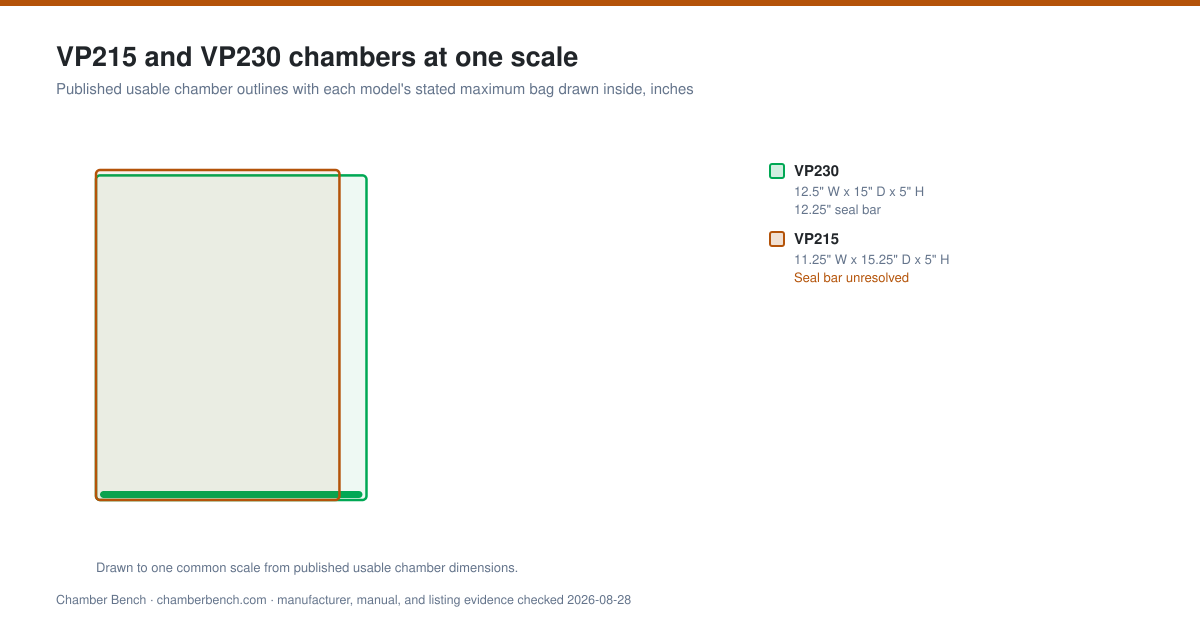
Larger in three directions, smaller in one
Depth reverses it. The VP215 chamber is 15.25 in front to back against the VP230's 15 in. The gap is a quarter of an inch, small enough to ignore on a spec sheet and large enough to matter at the only moment it is ever tested, which is the moment you lay a long package inside and try to keep its open mouth flat on the bar.
Height settles nothing. Both chambers are 5 in tall, so a bone-in cut that will not close under one will not close under the other. The published records do not support a taller-package distinction.
Scroll horizontally to see every column.
| Measurement | VP215 | VP230 | What the difference does |
|---|---|---|---|
| Stated maximum bag | 10 x 13 in | 12 x 15 in | 130 sq in of pouch face against 180 sq in |
| Chamber width | 11.25 in | 12.5 in | VP230 wider by 1.25 in |
| Chamber depth, front to back | 15.25 in | 15 in | VP215 deeper by 0.25 in, the only larger published dimension |
| Chamber height | 5 in | 5 in | Identical, so tall portions are decided elsewhere |
| Pump | Rotary oil, .2 HP or 1/4 HP depending on source | 1/2 HP rotary oil | Both carry an oil schedule; only the VP230 rating is settled |
| Stated pouch materials | 3 to 7 mil Mylar, retort | 3 to 7 mil Mylar, retort | No separation here |
The 15-inch bag in the 15-inch chamber
Run VacMaster's two published numbers for the VP230 against each other and something falls out that neither listing states. The largest bag VacMaster says the VP230 accepts is 15 in long. The chamber VacMaster says it has is 15 in deep. At the machine's own stated maximum, the pouch is the chamber.
- VP230 at maximum: a 15 in bag inside a 15 in chamber. On the published figures there is no slack front to back at all.
- VP215 at maximum: a 13 in bag inside a 15.25 in chamber, leaving 2.25 in to position the package and flatten the mouth before the lid comes down.
- VacMaster publishes no recommended clearance for either machine, so we do not turn this into a rule or a percentage. We do not estimate what the maker has not stated.
The VP230 publishes additional bag width, not additional chamber depth. A 12 by 15 pouch is the stated ceiling; a 12 by 13 pouch leaves handling margin. For long, narrow packages, the VP215 publishes more front-to-back room.
Specifications compared
Scroll horizontally to see every column.
| Model | Seal bar | Chamber | Pump | Weight | Analysis |
|---|---|---|---|---|---|
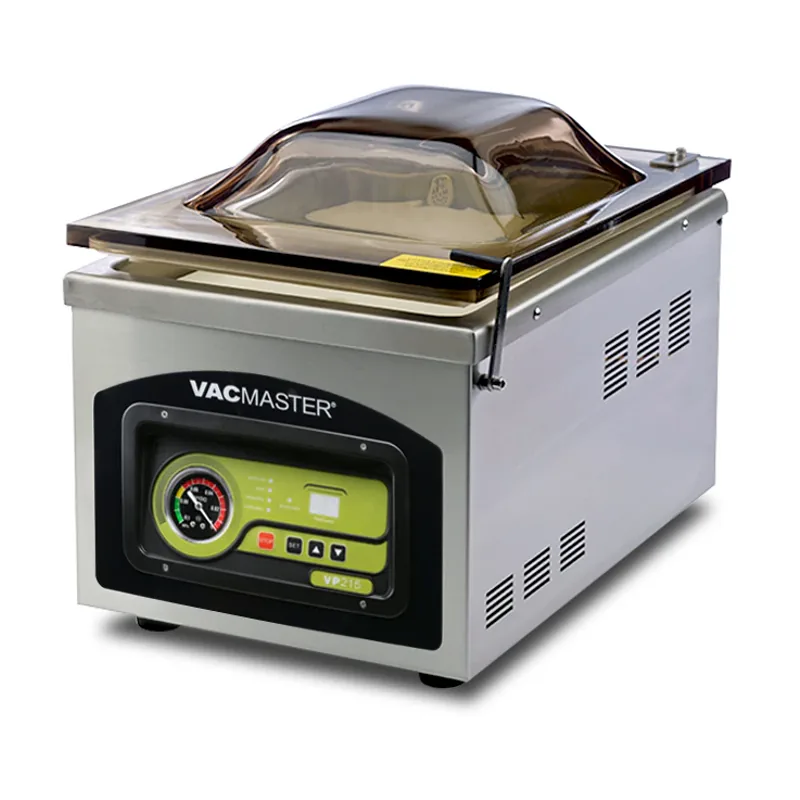 VacMaster VP215 VacMaster VP215 | Conflicting published values: 10 Inch removable seal bar with double seal wire / 10.25 in — Conflicting published record — VacMaster product page · VacMaster manual | Conflicting published values: 1/5 HP (.2 HP) rotary oil pump / 1/4 HP rotary oil pump — Conflicting published record — VacMaster manual · VacMaster support note | Open analysis | ||
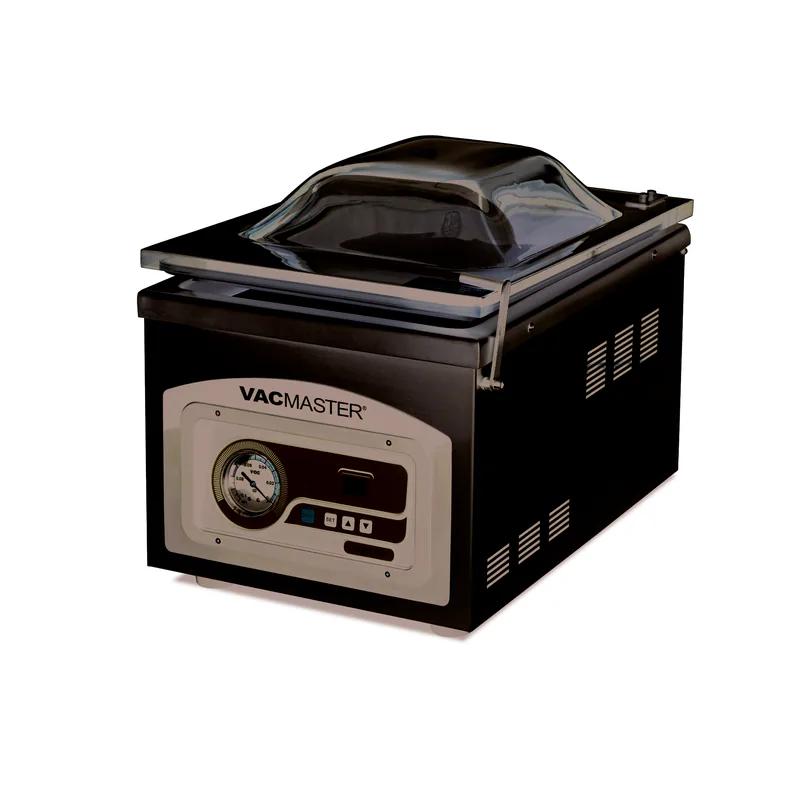 VacMaster VP230 VacMaster VP230 | 1/2 HP rotary oil pump — Verified published record — VacMaster product page · VacMaster support note | Conflicting published values: 89 Pounds / 82 lbs / 96.8 lbs — Conflicting published record — VacMaster product page · VacMaster support note · Amazon listing | Open analysis |
Cells reading “Not stated” mean the manufacturer does not publish that figure. We have not substituted an estimate.
Model analyses
Why it fits
- Chamber:
- Weight:
Unanswered or conflicting specifications
- Seal bar: Conflicting published values: 10 Inch removable seal bar with double seal wire / 10.25 in — Conflicting published record — VacMaster product page · VacMaster manual
- Pump: Conflicting published values: 1/5 HP (.2 HP) rotary oil pump / 1/4 HP rotary oil pump — Conflicting published record — VacMaster manual · VacMaster support note
- Power: Conflicting published values: 110 watts at 110 volts / 110V, 60Hz, 4 Amps / Single Phase 110 V, 20 Amp — Conflicting published record — Amazon listing · VacMaster product page · VacMaster manual
Published specifications
- Seal bar: Conflicting published values: 10 Inch removable seal bar with double seal wire / 10.25 in — Conflicting published record — VacMaster product page · VacMaster manual
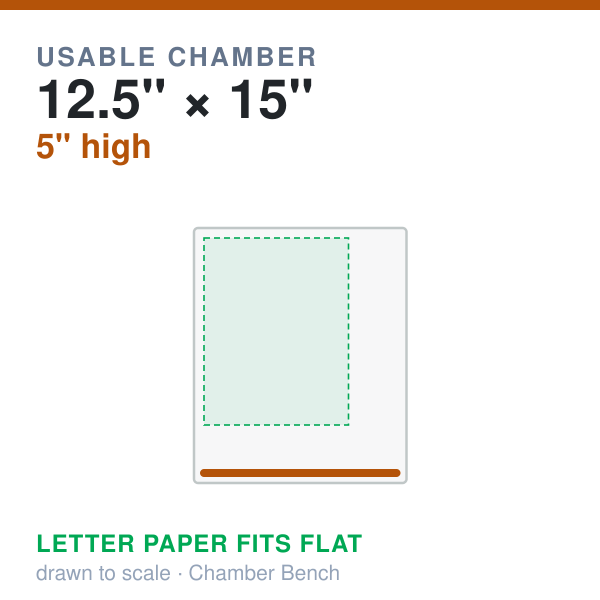
- Chamber:
- Pump: Conflicting published values: 1/5 HP (.2 HP) rotary oil pump / 1/4 HP rotary oil pump — Conflicting published record — VacMaster manual · VacMaster support note
- Power: Conflicting published values: 110 watts at 110 volts / 110V, 60Hz, 4 Amps / Single Phase 110 V, 20 Amp — Conflicting published record — Amazon listing · VacMaster product page · VacMaster manual
- Weight:
View chamber sizing diagram

Why it fits
- Seal bar:
- Chamber:
- Pump: 1/2 HP rotary oil pump — Verified published record — VacMaster product page · VacMaster support note
- Power: 370 W; 110 V, 60 Hz, 4 A — Verified published record — Amazon listing · VacMaster product page · VacMaster support note
Unanswered or conflicting specifications
- Weight: Conflicting published values: 89 Pounds / 82 lbs / 96.8 lbs — Conflicting published record — VacMaster product page · VacMaster support note · Amazon listing
Published specifications
- Seal bar:
- Chamber:
- Pump: 1/2 HP rotary oil pump — Verified published record — VacMaster product page · VacMaster support note
- Power: 370 W; 110 V, 60 Hz, 4 A — Verified published record — Amazon listing · VacMaster product page · VacMaster support note
- Weight: Conflicting published values: 89 Pounds / 82 lbs / 96.8 lbs — Conflicting published record — VacMaster product page · VacMaster support note · Amazon listing
View chamber sizing diagram
Data quality note: Current official and listing sources publish 82 lb, 89 lb, and 96.8 lb. We retain all three and select none.
Decide it with a tape measure, in this order
Measure the package, not the machine. Bag the largest portion you seal repeatedly, seal nothing, and measure the finished parcel at its widest, its longest and its tallest point. That single measurement resolves this comparison faster than any feature list, and it is the same method our sizing guide applies across the whole catalog.
- Widest point under 10 in and longest point under 13 in: both machines fit, and the VP215 fits with room to spare.
- Longest point between 13 in and 15 in: the VP230 is the only one of the two, and you are working at its published depth limit rather than inside it.
- Taller than 5 in: neither. Chamber height is identical, and no amount of extra bar width recovers it.
Fit summary
The VP215 and VP230 both publish a 5-inch chamber height.
Packages wider than 10 inches exceed the VP215's stated 10-inch bag limit. The VP230 publishes a 12.25-inch bar, 12-by-15-inch bag limit, and 1/2 HP oil pump. Those are package and pump specifications, not tested throughput evidence.
This analysis compares published manufacturer records, not Chamber Bench physical tests. The VP230 weight contradiction remains visible and unresolved rather than being converted into a preferred figure.
Open the VacMaster VP215 analysis · Return to the specifications
Frequently asked questions
Is the VP230 just a bigger VP215?
Not uniformly. The VP230 publishes a verified 1/2 HP rotary oil pump, while the VP215 horsepower is printed two ways, .2 HP in its June 2024 manual and 1/4 HP by VacMaster support, so the step between the two pumps cannot be stated as one multiple. The VP230 chamber also runs 15 inches front to back against the VP215's 15.25 inches, and chamber height is 5 inches on both.
Can the VP215 seal a 12 by 15 inch bag?
No. Turning the bag diagonally does not help, because the seal has to run straight along the bar.
How much heavier is the VP230?
The VP230 has no single published weight, so this question has a range for an answer and not a figure. VacMaster states 84 lb for the VP215 on both its product page and the June 2024 user guide, which is why that one is carried here as a verified record. The retained sources for the VP230 — VacMaster's product page, the VP230 specification sheet and the Amazon listing — carry 82 lb, 89 lb and 96.8 lb between them. Measured against the VP215's 84 lb, the VP230 is therefore anywhere from 2 lb lighter to 12.8 lb heavier, a 14.8 lb spread across the three retained sources. All three values stay in the record and none of them is chosen; if a bench, a shelf or a two-person lift has to take the machine, size it for 96.8 lb rather than for an average nobody publishes.
Do both machines need oil changes?
Yes. Both machines run rotary oil pumps, so neither is maintenance-free and scheduled oil changes are not optional on either. The VP230 rating is a verified 1/2 HP; the VP215 horsepower is disputed between .2 HP and 1/4 HP, which changes the size of the pump and not the obligation.
What this page covers, and what it does not
This comparison covers two of the eight chamber vacuum sealers we verified against live Amazon listing data on 2026-08-26, and every figure on it is a published manufacturer specification rather than a bench measurement. Machines we could not verify are excluded, which is why the Anova chamber sealer is not compared here or listed in the catalogue.
How published evidence is evaluated
Chamber Bench compares manufacturer and listing evidence for the eight machines in this comparison. The current analysis covers usable chamber geometry, seal-bar length, pump type, serviceability, and other published ownership constraints.
Where a manufacturer publishes nothing, we say so rather than filling the gap:
- We record which specifications a manufacturer declines to publish.
- We flag contradictions inside a listing rather than quietly picking one figure.
- We keep partial records distinct from complete published dimensions.
- We do not reproduce retailer ratings or prices as editorial fact.
What we have not done: we have not physically run these machines. No cycle times, seal-strength figures, or noise measurements on this site come from our own bench, and none are presented as if they do. Our test protocol documents the measurements required before any model can carry a tested performance conclusion.