The six-measure fit card
Which measurement decides whether a machine takes my food?
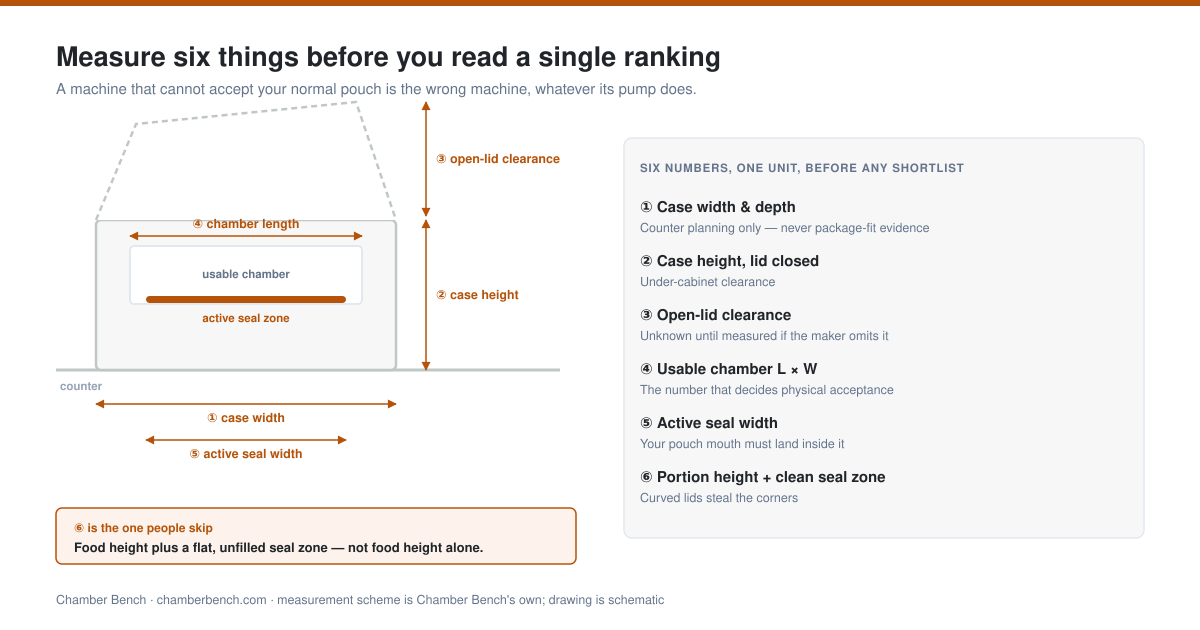
Filled package height against usable chamber height decides it more often than length does, because lids curve and the corners of a chamber are shallower than its center. Published chamber heights among the machines tracked here are 2 inches on the VEVOR DZ-260S, 3 inches on the Avid Armor USV20, 3.5 inches on the USV32, and 5 inches on all three VacMaster VP units.
Scroll horizontally to see every column.
| Measure | How to capture it | Why it matters |
|---|---|---|
| Portion length | Longest recurring food package | Sets minimum internal length |
| Portion height | Highest point after bagging | Curved lids can reduce usable corners |
| Pouch mouth | Flat open edge | Must fit the active seal zone |
| Clean seal zone | Unfilled, wrinkle-free pouch above food | Protects seal consistency |
| Chamber envelope | Usable L × W × profile, not exterior case | Determines physical acceptance |
| Counter envelope | Machine plus open lid and service access | Determines whether it will actually be used |
Source basis[1] Anova Culinary Support · [2] Avid Armor · [3] VacMaster: VP215 user manual
Build a zero-cost paper chamber
Tape paper or cardboard to the manufacturer’s published chamber length and width. Mark the seal bar and any clamp position. If the lid is curved, note the published maximum depth as a best-case center measurement, not a promise that the entire rectangle has that height.
Set a real, bagged portion on the template. Smooth the pouch mouth across the seal line. If the package only fits diagonally, check that the entire mouth still crosses the active seal bar without a fold.
How do I check a chamber fits my food before buying the machine?
Cut paper to the manufacturer's published chamber length and width, draw the seal-bar line on it, and set your largest real bagged portion on that outline. The template proves a length-or-width mismatch for nothing but the cost of paper. It cannot prove lid clearance, so a candidate stays unresolved until the maker publishes a height or you measure one on a display unit.
- Repeat with your widest and tallest normal portions, not a one-off holiday item.
- Photograph the template with a ruler so your shortlist remains comparable.
- Add a margin for placement error; a theoretical edge-to-edge fit is fragile in daily use.
Source basis[1] Anova Culinary Support · [2] Avid Armor · [3] VacMaster: VP215 user manual
Plan for the lid, ventilation, weight, and service
A closed exterior dimension does not show the working envelope. Measure the lid at full opening, nearby cabinets, the path to the outlet, and the space needed to clean the chamber. For an oil-pump machine, consult the exact manual for level placement, oil access, transport, and ventilation requirements.
If the machine must be moved for every use, compare its weight with your actual storage route. A smaller chamber that stays ready can be more useful than a larger one that never leaves a low cabinet.
Do I need to leave room above the machine for the lid?
The working envelope is the case footprint, plus the lid at full opening, plus reach-in room to clean the chamber. VacMaster publishes a 20 by 14 by 15 inch machine for the VP215 with an 11.25 by 15.25 by 5 inch chamber inside it, and the 15 inch closed height is not the height the lid needs once it is raised. Overhead cabinets are where this goes wrong.
Source basis[3] VacMaster: VP215 user manual · [4] VacMaster Help Center · [5] VacMaster: VP215 Chamber Vacuum Sealer User Guide (June 2024)
Resolve dimensions on one evidence sheet
Product pages can mix exterior width, chamber width, seal-bar length, maximum depth, and pouch size. Those measures are not interchangeable. Copy each value with its exact label and source URL, then mark any dimension the manufacturer does not publish. A missing lid profile or usable corner height remains an uncertainty; do not silently replace it with the chamber’s maximum center depth.
Normalize units on a separate calculation line while preserving the manufacturer’s original value and wording. Do not round a near-fit dimension upward or treat a drawing’s outer case line as usable chamber space. Record the document revision or access date, because a retailer listing and a current model manual can describe different revisions. If two official sources disagree, keep both values visible and ask the manufacturer which applies to the exact model code.
Use the paper template only to eliminate obvious mismatches. A template cannot reproduce a curved lid, clamp, seal-bar hardware, or the way a filled pouch settles under vacuum. Mark a candidate ‘fit unresolved’ until the open-lid clearance and the recurring filled package have been measured together or confirmed by model-specific documentation.
Scroll horizontally to see every column.
| Evidence field | Record | Release rule |
|---|---|---|
| Exterior case | Closed L × W × H | Counter planning only |
| Usable chamber | Internal L × W × stated profile | Package-fit evidence |
| Active seal zone | Published usable width | Pouch-mouth limit |
| Open-lid envelope | Measured or explicitly published clearance | Unknown until verified if absent |
Source basis[1] Anova Culinary Support · [2] Avid Armor · [3] VacMaster: VP215 user manual · [4] VacMaster Help Center
Questions readers still ask
What size chamber vacuum sealer do I need?
Size from the food outward rather than from the machine inward: the chamber has to take your largest recurring portion inside its pouch and still leave a flat, unfilled strip of film for the seal bar. Chamber floors published by the machines tracked here run from 12.25 by 8.5 inches on the Avid Armor USV20 to 12.5 by 15 inches on the VacMaster VP230.
Is the seal bar length the same as the chamber width?
Not always, and where the two differ the smaller number is the real limit. Gasbye publishes an 11.5 inch seal bar on the CV4520 alongside a 9.7 inch interior chamber width, so 9.7 inches caps pouch width on that machine — a bar cannot seal a pouch the chamber will not admit in the first place.
Can I load a bag diagonally to make it fit?
A diagonal load works only if the entire pouch mouth still crosses the seal bar without a fold, and a fold in the mouth is the most common cause of a failed seal. Where the diagonal is what makes a package fit at all, treat the machine as too small rather than as a tight fit.
Why is the maximum bag size smaller than the chamber?
Because the pouch mouth has to lie flat on the bar with the food behind it. The VP215 is a clean example: a chamber floor of 11.25 by 15.25 inches, against a maximum pouch VacMaster states as 10 by 13 inches. Over two inches of that depth is working room, not package space, and the same margin exists on every machine whether or not the maker states it.
What if the manufacturer never publishes the chamber height?
Then the fit is unresolved and it should stay unresolved. Gasbye publishes a 5.28 quart volume and a 9.7 inch width for the CV4520 and no height at all, and no arithmetic recovers lid clearance from a volume — ask the manufacturer for the missing dimension before ordering rather than inferring it from the case.
Sources
Each record carries its own access date. Manufacturer statements are attributed; they are not treated as Chamber Bench test results.
- Chamber Vacuum Sealer frequently asked questionsAnova Culinary Support — Official pouch, pump, chamber-volume, seal-width, and operating specifications. · Accessed
- USV20 and USV32 side-by-side comparisonAvid Armor — Manufacturer comparison showing how chamber volume affects pouch fit and cycle behavior. · Accessed
- VP215 user manualVacMaster — Primary manual for oil-pump setup, operation, cleaning, and maintenance. · Accessed
- VP215 manuals, specifications, and technical supportVacMaster Help Center — Official model support index, including oil and troubleshooting guidance. · Accessed
- VP215 Chamber Vacuum Sealer User Guide (June 2024)VacMaster — Current 24-page guide: oil schedule and quantity, duty-cycle safeguard, seal-appearance rule, troubleshooting, and the full specification table. · Accessed