Two machines from the same maker can share every dimension on their spec sheets and still be different purchases. Once capability is held constant, the comparison stops being about what the machine does and becomes about what it asks of you: a recurring chore with a consumable attached, or nothing at all. That is a question about the household or the kitchen, not about the hardware.
The published records differ only on pump architecture and weight. The VP210 removes the oil-service obligation and weighs 12 lb less; the source set provides no comparable physical-test result for either model.
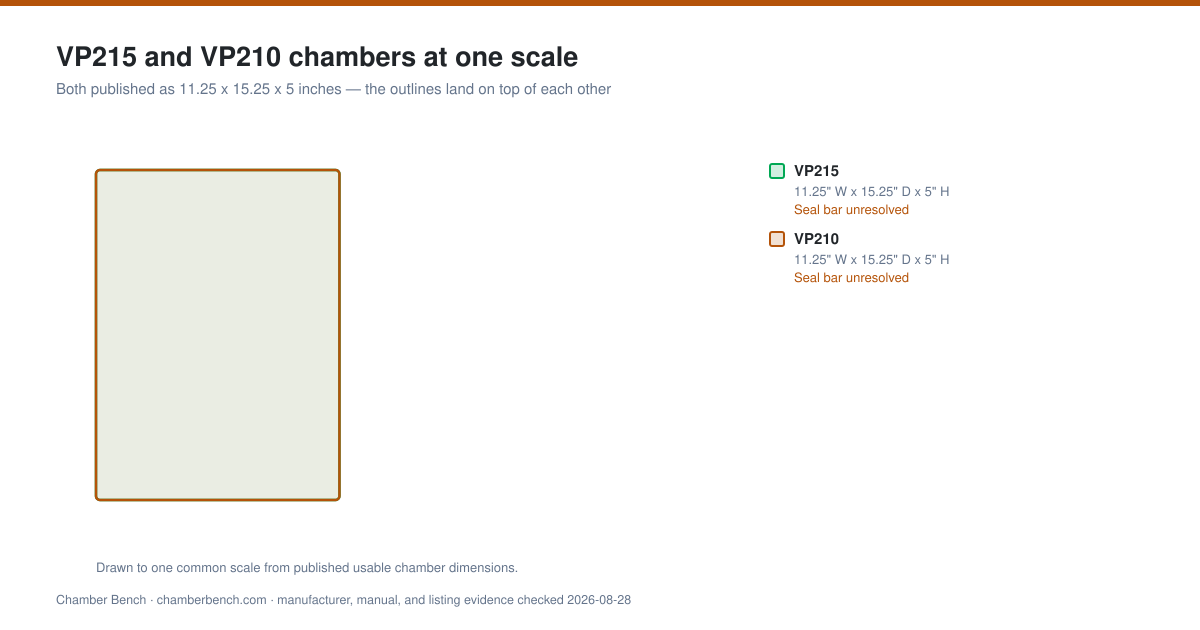
The published differences stop at pump and weight
The VP210 record drops the oil pump, its service routine, and 12 pounds of published mass; VacMaster rates that dry pump at 1/4 HP and calls it maintenance-free.
The VP215 record puts a rotary oil pump in its place, and VacMaster publishes two different ratings for it. The specification table in the June 2024 user guide reads '.2 HP Rotary Oil Pump'. The Help Center article comparing these two models, dated April 13 2020, calls it a 1/4 HP rotary oil pump.
Taken at the Help Center's figure, the VP215 pump and the VP210 pump carry the same 1/4 HP rating, and horsepower stops separating these two machines. Architecture still does: one is rotary and oil-lubricated, the other is dry.
Final vacuum is where the record genuinely stops. Neither VacMaster record we retrieved states a vacuum depth, in torr or in inches of mercury, so no depth ordering can be drawn from them.
Duty cycle is not one of those gaps. Safeguard 14 of the June 2024 VP215 guide sets a maximum vacuum on-time of 70 seconds, a minimum of 10 seconds off between cycles, and a stop to cool to ambient temperature once the machine has been in use for 45 minutes. Those figures come from the VP215 guide and are stated for the VP215 only; the equivalent VP210 wording has not been checked for this page, so it is not offered here as a difference between the two.
The decision boundary is maintenance: one record requires scheduled oil service and the other does not.
Three published intervals, one pump
Three VacMaster documents answer the VP215 oil-change question, and no two of them answer it in the same unit. The June 2024 user guide counts calendar months and pump cycles. A Help Center article dated April 13 2020 counts running hours: 25 to the first change, then 60 between changes. A second article published the same day counts changes per year, and puts it at about two.
The distance between those units is not small. The June 2024 guide's specification table publishes a 20 to 40 second cycle time, which puts 250 cycles between 83 and 167 minutes of running, under three hours either way. Sixty hours of use is a different order of magnitude, and VacMaster does not say whether its hours count pump running time or machine-on time. Chamber Bench prints all three intervals with their dates and reconciles none of them; the June 2024 guide is the most recent.
Specifications compared
Scroll horizontally to see every column.
| Model | Seal bar | Chamber | Pump | Weight | Analysis |
|---|---|---|---|---|---|
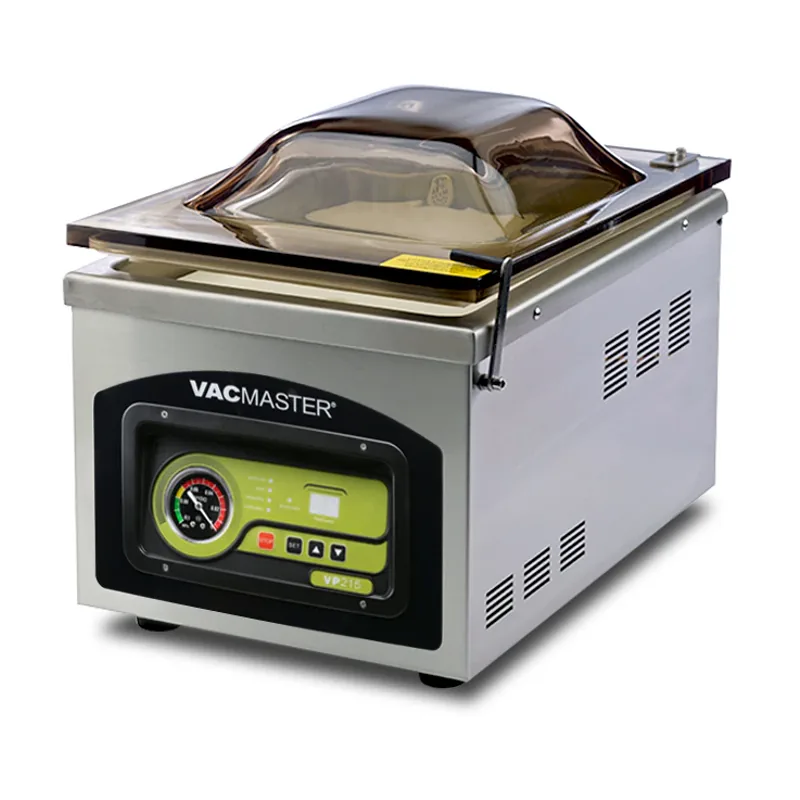 VacMaster VP215 VacMaster VP215 | Conflicting published values: 10 Inch removable seal bar with double seal wire / 10.25 in — Conflicting published record — VacMaster product page · VacMaster manual | Conflicting published values: 1/5 HP (.2 HP) rotary oil pump / 1/4 HP rotary oil pump — Conflicting published record — VacMaster manual · VacMaster support note | Open analysis | ||
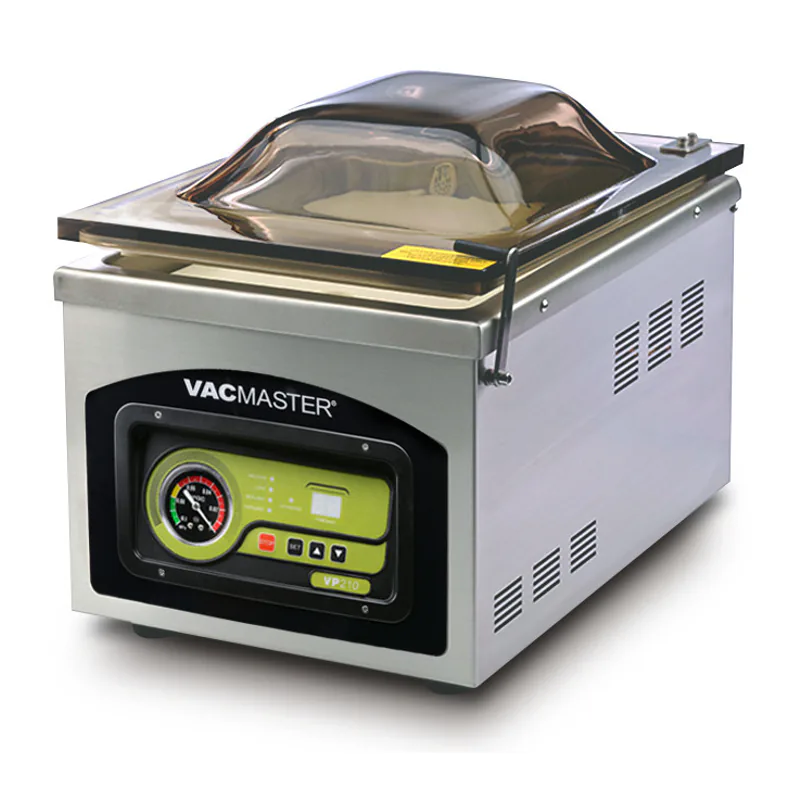 VacMaster VP210 VacMaster VP210 | Conflicting published values: 10 Inch removable seal bar with double seal wire / 10.25 in — Conflicting published record — VacMaster product page · VacMaster manual | 1/4 HP dry, maintenance-free pump — Verified published record — VacMaster product page · VacMaster manual | Open analysis |
Cells reading “Not stated” mean the manufacturer does not publish that figure. We have not substituted an estimate.
Model analyses
Why it fits
- Chamber:
- Weight:
Unanswered or conflicting specifications
- Seal bar: Conflicting published values: 10 Inch removable seal bar with double seal wire / 10.25 in — Conflicting published record — VacMaster product page · VacMaster manual
- Pump: Conflicting published values: 1/5 HP (.2 HP) rotary oil pump / 1/4 HP rotary oil pump — Conflicting published record — VacMaster manual · VacMaster support note
- Power: Conflicting published values: 110 watts at 110 volts / 110V, 60Hz, 4 Amps / Single Phase 110 V, 20 Amp — Conflicting published record — Amazon listing · VacMaster product page · VacMaster manual
Published specifications
- Seal bar: Conflicting published values: 10 Inch removable seal bar with double seal wire / 10.25 in — Conflicting published record — VacMaster product page · VacMaster manual
- Chamber:
- Pump: Conflicting published values: 1/5 HP (.2 HP) rotary oil pump / 1/4 HP rotary oil pump — Conflicting published record — VacMaster manual · VacMaster support note
- Power: Conflicting published values: 110 watts at 110 volts / 110V, 60Hz, 4 Amps / Single Phase 110 V, 20 Amp — Conflicting published record — Amazon listing · VacMaster product page · VacMaster manual
- Weight:
View chamber sizing diagram

Why it fits
- Chamber:
- Pump: 1/4 HP dry, maintenance-free pump — Verified published record — VacMaster product page · VacMaster manual
- Weight:
Unanswered or conflicting specifications
- Seal bar: Conflicting published values: 10 Inch removable seal bar with double seal wire / 10.25 in — Conflicting published record — VacMaster product page · VacMaster manual
- Power: Conflicting published values: 110 watts at 110 volts / 110V, 60Hz, 4.2 Amps / Single phase 110 V, 20 AMP — Conflicting published record — Amazon listing · VacMaster product page · VacMaster manual
Published specifications
- Seal bar: Conflicting published values: 10 Inch removable seal bar with double seal wire / 10.25 in — Conflicting published record — VacMaster product page · VacMaster manual
- Chamber:
- Pump: 1/4 HP dry, maintenance-free pump — Verified published record — VacMaster product page · VacMaster manual
- Power: Conflicting published values: 110 watts at 110 volts / 110V, 60Hz, 4.2 Amps / Single phase 110 V, 20 AMP — Conflicting published record — Amazon listing · VacMaster product page · VacMaster manual
- Weight:
View chamber sizing diagram

One question decides it
Ask whether scheduled pump-oil service fits the intended workflow. The VP215 record includes that obligation; the VP210 record does not.
Everything people usually argue about in this matchup is already settled by the spec sheet. Chamber height is the same 5 inches, so tall bone-in portions fit or do not fit identically on both. Maximum bag size is 10 by 13 inches on both, so pouch inventory is interchangeable. There is no configuration of your cooking that makes one of these fit and the other not.
Fit summary
The VP215 carries a rotary oil pump, and VacMaster publishes two ratings for it: '.2 HP' in the June 2024 user guide, '1/4 HP' in its Help Center. The architecture is not in dispute, and the architecture is what carries the oil schedule.
The VP210 carries a pump VacMaster publishes as dry, 1/4 HP and maintenance-free, in a machine of 72 lb against the VP215's 84 lb.
No final-vacuum figure appears in either retained record, so no vacuum-depth order exists here. Duty cycle is published for the VP215: 70 seconds of vacuum on-time at most, 10 seconds off between cycles, and a cool-down to ambient after 45 minutes in use.
This analysis compares published manufacturer figures and live listing data. Chamber Bench has not bench-tested either machine and publishes no pull-down time or vacuum depth of its own.
Open the VacMaster VP215 analysis · Return to the specifications
Frequently asked questions
Does the dry pump pull a weaker vacuum?
Neither the VP215 record nor the VP210 record we retrieved states a vacuum depth, so there is no figure to compare and Chamber Bench will not supply one. The June 2024 VP215 guide gets as close as the published record comes: at high elevation the gauge may not reach the green zone, and the guide says vacuum time may need another 5 to 10 seconds there.
How often does the VP215 need an oil change?
VacMaster publishes three answers, and they do not agree. The current user guide, dated June 2024, requires a first change one week after use and then every 3 months or 250 cycles, whichever comes first. A Help Center article dated April 13 2020 sets it at 25 hours of use for the first change and every 60 hours after that. A second article from the same date, comparing the VP210 with the VP215, says approximately 2 times a year. Months, cycles and running hours are three different units, and nothing in these sources converts one into another.
How long can the VP215 run without stopping?
Forty-five minutes is the published ceiling. Safeguard 14 of the June 2024 VP215 user guide caps vacuum on-time at 70 seconds per cycle, requires at least 10 seconds between cycles, and then tells the operator to halt and let the appliance return to ambient temperature after 45 minutes of use. At the guide's own cycle time of 20 to 40 seconds, the per-cycle limits are not what a long packing session runs into first — the 45-minute rule is.
How does the VP210 simplify pump maintenance?
The VP210 pump is published as dry, 1/4 HP and maintenance-free, so no oil, no oil grade and no drain interval enter the ownership. VacMaster's Help Center states that its chamber machines take 10W non-detergent hydraulic oil. The June 2024 VP215 guide then asks for approximately 9 to 9 1/2 ounces in one section and 10 to 12 ounces in another, and does not reconcile the two.
Can both machines seal thick Mylar and retort pouches?
VacMaster states 3-7 mil Mylar and retort pouch support for the VP215. It publishes no equivalent statement for the VP210.
Which published fields differ between the two models?
Pump architecture and weight, and nothing else in the core record. The VP215 pump is rotary and oil-lubricated; the VP210 pump is dry and maintenance-free. Weight runs 84 lb against 72 lb. Horsepower does not settle it: VacMaster rates the VP215 pump at .2 HP in the June 2024 guide and at 1/4 HP in its Help Center, and 1/4 HP is also the figure it publishes for the VP210 dry pump.
Is the 12-pound weight difference worth anything in practice?
Very little. Seventy-two pounds and eighty-four pounds are both two-person lifts and both demand permanent bench space.
Does the oil pump preserve food better than the dry pump?
No, and neither pump preserves anything. Vacuum packaging removes oxygen from the package, which slows freezer burn and oxidation; it does not sterilise the contents, and USDA guidance is explicit that vacuum-packed perishable food still requires refrigeration or freezing. Since neither VacMaster listing publishes a final vacuum figure, there is not even a number here to argue over — and a deeper vacuum would not change the answer if there were.
What this page covers, and what it does not
This comparison covers the eight chamber vacuum sealers we verified against live Amazon listing data on 2026-08-26, of which the VP215 and VP210 are two. The Anova chamber sealer is not included because we could not verify its listing, and we do not compare machines whose specifications we have not retrieved ourselves.
How published evidence is evaluated
Chamber Bench compares manufacturer and listing evidence for the eight machines in this comparison. The current analysis covers usable chamber geometry, seal-bar length, pump type, serviceability, and other published ownership constraints.
Where a manufacturer publishes nothing, we say so rather than filling the gap:
- We record which specifications a manufacturer declines to publish.
- We flag contradictions inside a listing rather than quietly picking one figure.
- We keep partial records distinct from complete published dimensions.
- We do not reproduce retailer ratings or prices as editorial fact.
What we have not done: we have not physically run these machines. No cycle times, seal-strength figures, or noise measurements on this site come from our own bench, and none are presented as if they do. Our test protocol documents the measurements required before any model can carry a tested performance conclusion.