The four-stage cycle
Controls vary by machine. Some expose vacuum and seal time; others use presets or a sensor. A longer timer is not automatically a stronger or safer vacuum, and seal settings should follow the machine and pouch instructions.
Anova Culinary publishes the same ordering in its own words: a pump "removes all air from the entire chamber, including inside the pouch, creating an equally pressurized environment, both inside and outside of the bag. Once all of the air is removed, the sealer bar heats up and seals the pouch shut, void of any excess air. Once sealed, the chamber releases the vacuum and returns to normal atmospheric pressure." The phrase "removes all air" is stronger than the federal definition of the same operation. USDA FSIS writes that vacuum packaging "removes substantially all air from packages --rigid or flexible-before sealing and produces a vacuum inside," quoted here exactly as published including the run-together punctuation. A manufacturer says all; the government says substantially all. Chamber Bench prints both and picks neither.
VacMaster's June 2024 VP215 guide states the practical limit in its own troubleshooting language, quoted here as published: "High elevation may cause the gauge to not go all the way into the green. You may have to increase the vacuum time by 5-10 seconds in higher elevation." That is a manufacturer conceding, in a maintenance note rather than a specification, that the depth of vacuum a machine reaches depends on where the machine is standing. The same two sentences appear twice in that document, on its troubleshooting page and again under cleaning and storage, and in neither place are they attached to the vacuum figures on the Specs page.
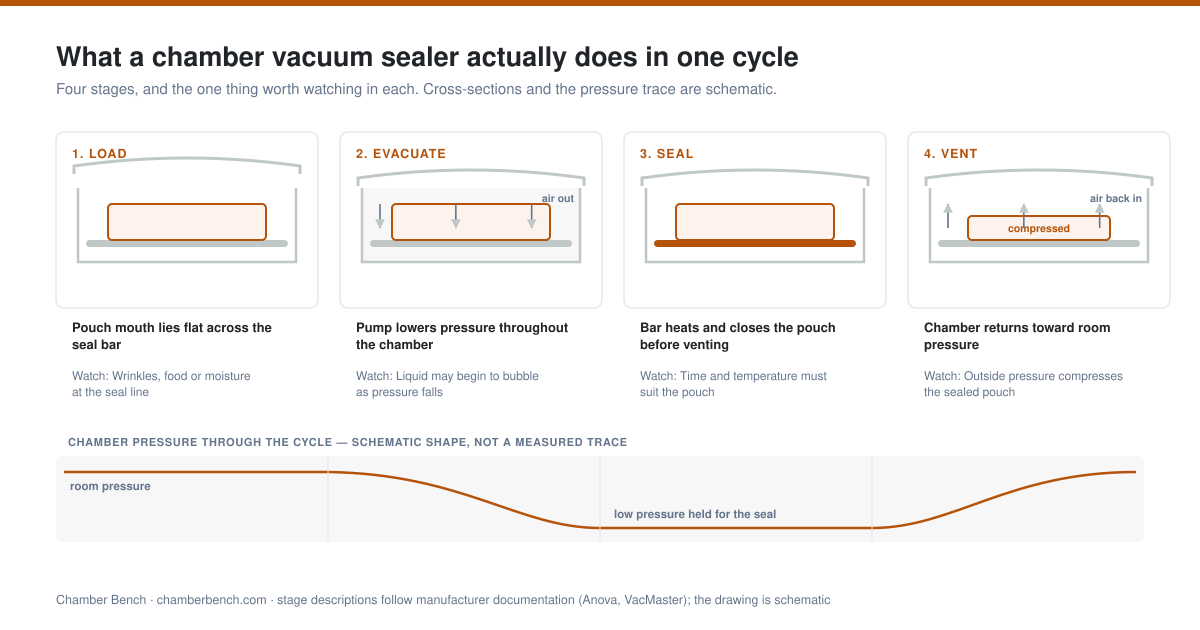
The sequence matters more than any single setting, because the seal is made before the chamber vents. While the chamber is held at reduced pressure, the film hangs loose around the food, since pressure inside and outside the pouch is equal. The pouch only tightens after the bar has closed it and room pressure returns to press the film onto the contents. That two-part order — reduce pressure, then restore it — is the same order the peer-reviewed vacuum-impregnation literature calls stage one and stage two, which is why one machine performs both packaging and compression work.
The VP215 guide also contradicts itself about how long that sequence takes, and the contradiction is checkable from two pages of one document. The Specs page prints "Cycle Time: 20-40 Seconds." The Set Up page prints "For initial testing, the time settings should be: Vacuum Time - 40 seconds / Sealing Time - 1.2 seconds / Cooling Time - 2.2 seconds," which add to 43.4 seconds. A 43.4-second sequence of published initial settings does not fit inside a published 20-to-40-second cycle. Chamber Bench does not choose between them, and does not present either figure as the complete cycle for this machine.
One term needs pinning before the rest of this page. On this page "vacuum" names the pressure condition inside the chamber, not the appliance. When a manufacturer publishes a vacuum figure it is describing that pressure condition, and when the research literature publishes a figure in millibar or kilopascal it is describing the same condition on a stated scale. The two are not currently expressed on a common basis, which the pressure section below documents in detail.
How does a chamber vacuum sealer work?
A chamber vacuum sealer works in four stages. The open pouch is laid flat inside a rigid chamber; a pump lowers the pressure of chamber and pouch at the same time; a heated bar closes the pouch while that low pressure is still held; then the chamber is vented and returning room pressure squeezes the package onto the food. Because air leaves from around the pouch rather than through its mouth, there is no directional flow dragging the contents toward the seal line.
Scroll horizontally to see every column.
| Stage | What the machine does | What to watch |
|---|---|---|
| 1. Load | Pouch mouth lies flat across the seal bar | Wrinkles, food, or moisture at the seal line |
| 2. Evacuate | Pump lowers pressure throughout the chamber | Liquids may begin to bubble as pressure falls |
| 3. Seal | Bar heats and closes the pouch before venting | Time/temperature must suit the pouch |
| 4. Vent | Chamber returns toward room pressure | Outside pressure compresses the sealed pouch |
Source basis[2] USDA Food Safety and Inspection Service: What is vacuum packaging? · [4] VacMaster · [5] Anova Culinary: How the Precision™ Chamber Vacuum Sealer Works · [9] Heliyon (Elsevier), 2024 Mar 28;10(7):e28023; doi 10.1016/j.heliyon.2024.e28023; PMCID PMC10990961; authors Vinod BR, Asrey R, Sethi S, Menaka M, Meena NK, Shivaswamy G
Why liquid usually stays in the pouch
An external machine pulls air toward a narrow outlet at the bag mouth, which can pull liquid toward the seal. In a chamber, pressure drops inside and outside the open pouch together, so there is less directional pull toward the seal bar. Anova states the consequence directly: "the equal pressure ensures that the food or liquid being sealed stays wherever you have placed it within the sealer pouch, and will never be sucked into the vacuum mechanism of the sealer."
That does not make liquids motionless. As pressure falls, a liquid can boil at a lower temperature and rise in the pouch. A clear lid and a manual stop control are useful because the operator can seal before the liquid reaches the pouch mouth. The VacMaster VP215 guide gives the stop control its own entry: the STOP button is described as "press to stop the cycle and immediately seal the pouch," and it "will only work when the machine is in the vacuum process." It is a control for exactly this situation, and the guide attaches no timing advice to it.
The bags themselves carry physical evidence for the difference. Anova states that "edge sealers require this mesh liner to directionally channel air as it is pulled out of the bag, for a quick and even sealing experience. Because chamber vacuums don't need to suck air directionally, they don't require these mesh liners to achieve an airtight seal." An edge-sealer bag is built around a flow path that runs the length of the bag and exits past the seal line. A chamber pouch has no such path because it needs none.
The compatibility that follows from this is asymmetric, and Anova publishes the asymmetry on the same page as the physics: "this effectively means you can use either style of bag to seal food with a chamber vacuum sealer, but chamber sealer pouches are not compatible with edge sealers." Anova's support page repeats the second half from the machine's side. Asked whether the chamber sealer can be used as an edge sealer, it answers "No. Chamber-style pouches need to be inserted inside The Anova Precision Chamber Vacuum Sealer for you to achieve expected results," and elsewhere notes that "other chamber-style pouches can be used" in the machine. The mesh liner is a requirement edge sealers place on their bags, not a feature chamber machines reject. This page states the direction of travel because getting it backwards is the common error.
Anova also publishes a reason a manufacturer might deliberately limit how far pressure falls. Describing chamber cooling, the company states that "under pressure within the chamber, the boiling point of moisture within hot food lowers drastically, pulling the moisture out, and encouraging rapid cooling," and that "periodically, the program allows fresh air to enter the chamber so that the vacuum pressure is never drawn too low, causing unwanted expansion of trapped air bubbles." That is a rare published case of a maker arguing against the assumption that deeper vacuum is always better.
The bubbling that accompanies all of this is also a published observation rather than a Chamber Bench one. Anova writes of its infusion program that "while this is actively happening, it's perfectly normal to see bubbling, as the air escapes out of the food," and of its pickling program that "the liquid will bubble quite vigorously." No one on this site has watched a chamber run, so the manufacturer's description is the record, and it is quoted rather than paraphrased for that reason.
Why can a chamber machine seal liquid when an external suction sealer cannot?
An external suction sealer removes air through the open mouth of the bag, and that flow path runs straight past the seal line, so broth travels with it. A chamber machine drops the pressure inside and outside the open pouch at the same rate, which leaves no directional flow across the bar. Anova states that the equal pressure means liquid "will never be sucked into the vacuum mechanism of the sealer." Liquid in a chamber can still rise as it boils under falling pressure, but nothing is pulling it out.
Do chamber vacuum sealer bags need texture or embossing?
Chamber vacuum sealer pouches do not require the embossed or mesh liner that edge-sealer bags use. Anova states that edge sealers "require this mesh liner to directionally channel air as it is pulled out of the bag," while chamber machines "don't need to suck air directionally." The same page states that the compatibility runs one way only: "you can use either style of bag to seal food with a chamber vacuum sealer, but chamber sealer pouches are not compatible with edge sealers." Follow the machine's own instructions for permitted pouches.
Source basis[1] Anova Culinary Support · [3] USDA Food Safety and Inspection Service: Can Clostridium botulinum be in vacuum-packaged foods? · [4] VacMaster · [5] Anova Culinary: How the Precision™ Chamber Vacuum Sealer Works · [6] Anova Culinary: What is a Chamber Vacuum Sealer?
The pressure cycle that drives liquid into food
Vacuum impregnation names a pressure cycle, not a liquid. Mújica-Paz and colleagues define it in the Journal of Food Engineering as "the application of a reduced pressure to a solid–liquid system, followed by restoration of atmospheric pressure (Fito, 1994)." Nothing in that definition requires a salt, a syrup, or any hypertonic solution. It requires a porous solid, a surrounding liquid, and a pressure change. A chamber vacuum sealer supplies the pressure change around free liquid inside the package it seals; an edge sealer does not, because it evacuates through the bag mouth rather than lowering the pressure around the bag. The one edge-sealer route to reduced pressure around free liquid in this page's sources is an accessory rather than the sealer's own package: FoodSaver's Quick Marinator, a canister on a hose driven by a suction sealer, described later on this page. That is the structural reason the capability does not transfer to the sealed pouch itself.
Pedro Fito proposed the hydrodynamic mechanism in 1994 because the older explanations did not account for what he observed. His abstract states that "this effect of vacuum application cannot be explained only on the basis of diffusional and osmotic transport mechanisms. So, a hydrodynamic mechanism has been proposed and experimentally analysed." The full text sits behind a paywall, so the only wording Chamber Bench can cite from that paper is the abstract quoted here. No figure, equation or experimental detail from Fito 1994 appears on this page.
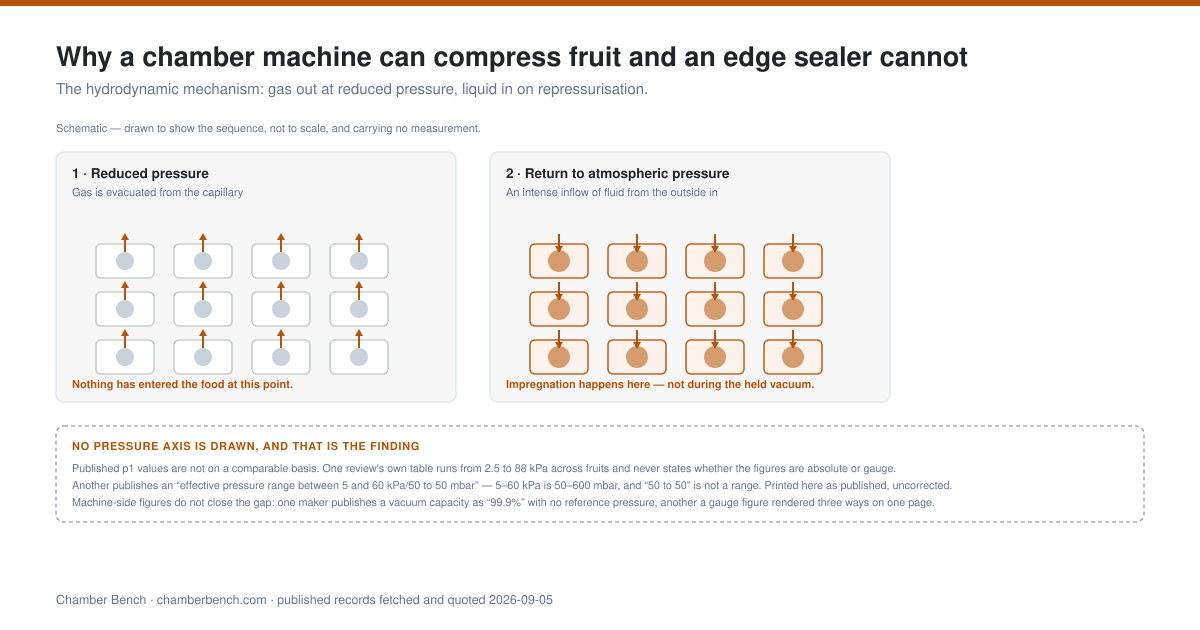
The 2024 Heliyon review sets out stage one directly: "the pressure is lowered in the first phase of the process (p1 <pat). The gas is evacuated from the capillary as a result of the pressure differential." Gas leaves the intercellular spaces because pressure outside the tissue is lower than pressure inside it. Nothing has entered the food yet at this point in the cycle.
Stage two is where the transfer happens. The same review states that "in the second phase of vacuum impregnation, the pressure returns to atmospheric norms. This leads the DRP to enter the relaxation phase. The capillary shrinks even more than it did before the process began. Simultaneously, as a result of capillary pressure and decompression, an intense inflow of fluid from the outside to the inside of the capillary is noticed." The 2014 International Journal of Molecular Sciences review states the practical consequence in one sentence: "the relaxation phase is particularly important from the practical point of view, since tissue impregnation occurs at this stage." The held vacuum does not impregnate. The vent does.
Two phenomena divide the cycle between them. The Heliyon review states that "DRP dominates the first stage while HDM dominates the second stage of the process when the impregnating solution penetrates the material's structure." DRP is the deformation-relaxation phenomenon of the solid matrix; HDM is the hydrodynamic mechanism Fito proposed. Fito and colleagues reported in 1996 that the two are not independent: "the first experimental results affirm that HDM and DRP couple during the pressure changes in porous solid-liquid systems, and that the coupling itself has an important influence on the final values of mass transferred by HDM and permanent deformations in the solid food." That 1996 paper is also paywalled, and only its abstract wording is cited here.
This is a different mechanism from marinating, not a faster version of it. The 2014 review draws the distinction explicitly: "in the case of vacuum impregnation, the mass transfer occurs as a result of mechanically induced difference in pressures, while osmotic dehydration is based on the difference in concentrations between the intracellular liquid in the food material and the solution." A soak moves molecules down a concentration gradient. A pressure cycle moves bulk liquid into space that gas has vacated. Confusing the two is what produces the claim that a chamber machine simply speeds a marinade up.
Food type sets the ceiling on the effect. The Heliyon review states that "fruits and vegetables, in general, have a higher porosity proportion than meats, fish, and cheeses, thus, making them ideal for VI methods." That single sentence draws the honest boundary of the chamber-exclusive argument: the produce case is structural, and the steak case is weaker for a physical reason that has nothing to do with the machine.
Both peer-reviewed reviews on this page warn against venting fast, and it is worth being precise about what that agreement is and is not. Heliyon 2024 states that "quick vacuum removal should be avoided because too rapid pressure equalization may cause capillary channel closure and hinder the hydrodynamic mechanism." The 2014 review states the caution in its own words: "removal of vacuum should not be too rapid, since the excessively fast pressure equalization may lead to closure of the capillary vessels and inhibition of the hydrodynamic mechanism." These are not two independent confirmations. The 2024 Heliyon review lists the 2014 review in its own bibliography as reference 9, so the later paper had the earlier one in front of it. More to the point, neither review claims the finding as its own. Heliyon's venting sentence carries citations 1, 4, 18 and 22, which its reference list gives as Fito 1994, Tiwari and Thakur 2016, Fito and colleagues 1996, and Salvatori, Andrés, Chiralt and Fito 1998. The 2014 review's venting sentence carries citations 6 and 7, which its reference list gives as Fito and colleagues 1996 and Salvatori, Andrés, Chiralt and Fito 1999. Both reviews trace the caution to the same two upstream groups. What looks like two reviews agreeing is one lineage restated twice, and a reader counting sources should count it once.
The gap is on the hardware side either way: no chamber-sealer manufacturer checked here publishes a vent or repressurization rate, and none exposes a vent-speed control, so this published caution currently maps onto no purchasable setting.
Published impregnation cycles are also far longer than a sealing cycle, and the ratio is small enough to state exactly rather than gesture at. The Heliyon review's own table of process factors states that "the vacuum time varies approximately between 2 and 30 min and relaxation time varies from a few minutes to several hours." Two minutes is 120 seconds. VacMaster's June 2024 VP215 Specs page puts a complete cycle for that machine at 20 to 40 seconds, so 120 divided by 40 is three and 120 divided by 20 is six: the packaging cycle is roughly three to six times shorter than the shortest published impregnation vacuum time, not an order of magnitude shorter. Mújica-Paz and colleagues used a shortest vacuum time of 3 minutes, which widens the same comparison to about four and a half times at the 40-second end.
The sharper limit is not the cycle time at all but the duty cycle, and it comes from the same VacMaster document. Its safeguards page states that the appliance "is designed for a maximum vacuum ON time of 70 seconds and a minimum OFF time of 10 seconds between cycles," and that the machine should be stopped and allowed to cool after 45 minutes of use. A 70-second published ceiling on vacuum time cannot reach the 2-to-30-minute vacuum times the impregnation literature reports, whatever the operator sets. That is a manufacturer-published constraint sitting directly across a peer-reviewed process window, and no source located in this research addresses the two together.
What is vacuum impregnation?
Vacuum impregnation is the application of a reduced pressure to a solid immersed in liquid, followed by restoration of atmospheric pressure — the definition Mújica-Paz and colleagues give in the Journal of Food Engineering, citing Fito 1994. During the reduced-pressure stage, gas leaves the food's capillaries and intercellular spaces. On repressurization, surrounding liquid flows into the emptied spaces. The technique is defined by the pressure cycle alone, and does not require the liquid to be a brine, a syrup, or any hypertonic solution.
Does the vacuum or the venting do the work?
The venting stage does the impregnation work, not the held vacuum. The 2014 International Journal of Molecular Sciences review states that "the relaxation phase is particularly important from the practical point of view, since tissue impregnation occurs at this stage," and the 2024 Heliyon review describes "an intense inflow of fluid from the outside to the inside of the capillary" only once pressure returns to atmospheric. Holding a deeper vacuum for longer therefore addresses the wrong half of the cycle.
Source basis[4] VacMaster · [7] Journal of Food Engineering (Elsevier), vol. 22, issues 1-4, pp. 313-328, 1994; doi 10.1016/0260-8774(94)90037-X; author P. Fito · [8] Journal of Food Engineering (Elsevier), vol. 27, issue 3, pp. 229-240, 1996; doi 10.1016/0260-8774(95)00005-4; authors P. Fito, A. Andrés, A. Chiralt, P. Pardo · [9] Heliyon (Elsevier), 2024 Mar 28;10(7):e28023; doi 10.1016/j.heliyon.2024.e28023; PMCID PMC10990961; authors Vinod BR, Asrey R, Sethi S, Menaka M, Meena NK, Shivaswamy G · [10] International Journal of Molecular Sciences (MDPI), 2014 Sep 17;15(9):16577-16610; doi 10.3390/ijms150916577; authors Radziejewska-Kubzdela E, Biegańska-Marecik R, Kidoń M · [11] Journal of Food Engineering (Elsevier), March 2003, vol. 56, issue 4, pp. 307-314; doi 10.1016/S0260-8774(02)00155-3; authors H. Mújica-Paz, A. Valdez-Fragoso, A. López-Malo, E. Palou, J. Welti-Chanes
Compressing fruit and vegetables, and the mechanism nobody agrees on
Anova publishes an itemized list of what a chamber machine does that an edge sealer cannot: "sealing aside, the Anova Precision™ Chamber Vacuum can be used to create rapid infusions and extractions, compress fruits and vegetables, make ultra-quick pickles, and even cool freshly baked bread in a matter of minutes. This is all thanks to the physics of low-pressure environments." That list is the commercial argument for buying a chamber machine, stated by a seller. It is not the only such list in this page's sources. Avid Armor's comparison page runs seven numbered entries under the heading "Enhancing Your Lifestyle with Chamber Vacuum Sealers" — "Extend Freshness," "Batch Cooking and Meal Prep," "Marination Made Perfect," "Pickling and Flavorful Infusions," "Mylar Mastery," "Sous Vide Success" and "Cost-Effective Buying" — and attaches no time, pressure or cycle count to any of the seven. What separates the two lists is not which maker states its case more plainly but what each list contains: no marination speed claim appears anywhere in Anova's, and Avid Armor's third entry is a marination claim with no number in it.
Four published explanations of what happens to the plant tissue do not agree, and the disagreement is the substance of this section. Anova states that "fruits and vegetables are generally easy to compress under pressure because their cells contain tiny air pockets. The air in these pockets is removed in the same way that the air in the chamber is removed. The cell walls and plant tissue that hold the air in place then collapse, creating dense, unique textures in the food." Sous-Vide Magazine states that "bags go in a vacuum chamber, and the changing pressure inside the sealer ruptures the cell walls of plant foods, forcing out water and air." The Heliyon review defines the treatment as one that "aims to modify the composition of food material by partially removing water and air and impregnating it with physiologically active compounds without affecting the structural integrity of food matrix." Fito and colleagues in 1996 describe "permanent deformations in the solid food" arising from the coupling of the hydrodynamic mechanism with matrix deformation and relaxation.
Anova's own page holds two of these positions at once, which is worth saying plainly because it changes what the disagreement is. On its Compress and Pickle program the company writes that cell walls "collapse." On its Infuse and Extract program, on the same page, it writes that "the pressure of the vacuum will pop the pockets of air and water in the food, and when that vacuum is released, the flavor molecules surrounding the food will fill those opened pockets." Popping is rupture language and collapse is not. One manufacturer page carries both, and reconciles them nowhere.
The Heliyon review is likewise not a clean pole. Its abstract names structural integrity as the aim of the technique, but its body reports the opposite condition being reached in practice: "it is to be noted that, higher vacuum pressure may damage the microstructure of the matrix as observed in mango cubes." Quoting only the abstract would produce a tidier table and a less accurate one, so both sentences appear in the row below.
Chamber Bench does not adjudicate between these positions, because adjudicating would require measurement this site has not performed. What can be reported is where the residual agreement actually holds. Two of the four sources state the full two-stage sequence — gas out at reduced pressure, liquid in on repressurization: Anova, in its Infuse and Extract wording, and the Heliyon review, in its stage-one and stage-two description. The other two do not. Sous-Vide Magazine's published sentence describes outflow only, "forcing out water and air," and adds that the process "helps ingredients soak in marinades or other flavor-enhancers in a hurry" without tying that uptake to the repressurization stage. The Fito 1996 abstract is a modeling paper about "the expansion and compression of the gas occluded into the porous structure" and about mass transferred by the hydrodynamic mechanism; it does not describe gas leaving plant tissue or liquid entering it in those terms, and it does not address cell rupture either way. A reader deciding whether the effect suits a delicate ingredient is deciding between four descriptions, and no consumer-facing page found in this research names the conflict at all.
Compression is not one behavior across produce, because porosity is not one number. Mújica-Paz and colleagues measured effective porosity across seven fruits and reported that "under the studied conditions, the effective porosity values of the fruits varied from 0.016 for mamey to 0.330 for apple." That is roughly a twentyfold spread within a single study using a single method. The fruits studied were mango, apple, papaya, banana, peach, melon and mamey.
Compressed watermelon has no published figure behind it, and this page will not supply one. No peer-reviewed effective-porosity, impregnation or compression figure for watermelon, Citrullus lanatus, was located in this research. Watermelon is not among the seven fruits in the Mújica-Paz study, and the melon that study does cover is a different fruit, so neither the 0.016 value for mamey nor the 0.330 value for apple at the ends of that range can stand in for it, and nothing between them can be interpolated to it either. Chamber Bench will not present a figure for one fruit as a figure for another. The one trade-press article cited on this page is built entirely on the operation — Sous-Vide Magazine's "Compressed Watermelon, Three Ways" — which leaves compressed watermelon as a named demonstration with a published procedure and no published measurement anywhere behind it, and one of the thinnest quantitative records on this page.
The same study reports which variable actually moved the result. Its authors state that "VP had a significant effect (p⩽0.10) on the volume of IS impregnated in fruit slices of all the studied fruits. The impregnation also depended significantly (p⩽0.10) on the VI time, except for apple." The significance threshold there is p less than or equal to 0.10, which is looser than the conventional 0.05, and Chamber Bench reports the threshold as published rather than calling the result simply significant. Read as published, pressure level mattered for every fruit tested, and elapsed time mattered for every fruit except apple.
Manufacturer and literature converge on one application. Anova states that "we can harness both of these capabilities to quick-pickle — once air moves out of the plant cells, pickling brine can move in, saturating the plant cells with added flavor." That is the two-stage sequence the reviews describe, in a manufacturer's own words. Anova also advises to "try adding multiple cycles of pressurizing and venting to encourage higher flavor intensity – until you've reached the exact level you had in mind," which has a counterpart in the literature: the Heliyon review names pulsed vacuum osmotic dehydration among the three recognized osmotic treatments. Anova attaches no cycle count and no duration to that advice, and no manufacturer checked here publishes a compression time, pressure or cycle count for fruit and vegetable compression.
Even the trade-press demonstration carries a duration rather than an instant. The Sous-Vide Magazine article that describes compression as cell-wall rupture compresses watermelon in the refrigerator for two hours in one of its own recipes. Whatever the mechanism turns out to be, the published procedure is a chilled hold, not a single button press.
What is compressed watermelon?
Compressed watermelon is watermelon that has been through a chamber vacuum sealer's pressure cycle, which removes gas from the fruit's intercellular spaces and allows surrounding liquid to flow into those spaces when pressure returns to atmospheric. Anova describes the result as "dense, unique textures"; Sous-Vide Magazine attributes it to ruptured cell walls; the peer-reviewed vacuum-impregnation literature describes matrix deformation and relaxation, with structural integrity named as the aim and microstructure damage reported at higher pressure. No peer-reviewed porosity or impregnation figure for watermelon, Citrullus lanatus, was located in this research.
How do you compress watermelon in a chamber vacuum sealer?
No manufacturer checked in this research publishes a compression time, pressure or cycle count for watermelon or for any other fruit. Anova advises "multiple cycles of pressurizing and venting" without attaching a number to either. Sous-Vide Magazine's own published recipe holds compressed watermelon in the refrigerator for two hours. Follow the machine's own instructions for permitted pouches and settings, because the published record on this specific operation is a procedure without figures rather than a specification.
Scroll horizontally to see every column.
| Publisher | Published wording | Fate of the cell wall |
|---|---|---|
| Anova Culinary (manufacturer) | Compress and Pickle: "The cell walls and plant tissue that hold the air in place then collapse, creating dense, unique textures in the food." Infuse and Extract, same page: "The pressure of the vacuum will pop the pockets of air and water in the food." | Collapsed in one passage, popped in another — unreconciled on one page |
| Sous-Vide Magazine (trade press) | "The changing pressure inside the sealer ruptures the cell walls of plant foods, forcing out water and air." | Ruptured |
| Heliyon 2024 review (peer-reviewed) | Abstract: the treatment aims to modify composition "without affecting the structural integrity of food matrix." Body: "higher vacuum pressure may damage the microstructure of the matrix as observed in mango cubes." | Intact as an aim; damage reported at higher pressure |
| Fito et al. 1996 (peer-reviewed) | "HDM and DRP couple during the pressure changes ... and permanent deformations in the solid food." | Deformed, described as matrix deformation; the abstract does not address cell rupture either way |
| Where the sources actually agree | Anova (Infuse and Extract) and the Heliyon review both state the full sequence: gas leaves at reduced pressure, liquid enters on repressurization. | Two of four; the trade-press wording covers outflow only, and the 1996 modeling abstract does not address it |
Source basis[6] Anova Culinary: What is a Chamber Vacuum Sealer? · [8] Journal of Food Engineering (Elsevier), vol. 27, issue 3, pp. 229-240, 1996; doi 10.1016/0260-8774(95)00005-4; authors P. Fito, A. Andrés, A. Chiralt, P. Pardo · [9] Heliyon (Elsevier), 2024 Mar 28;10(7):e28023; doi 10.1016/j.heliyon.2024.e28023; PMCID PMC10990961; authors Vinod BR, Asrey R, Sethi S, Menaka M, Meena NK, Shivaswamy G · [11] Journal of Food Engineering (Elsevier), March 2003, vol. 56, issue 4, pp. 307-314; doi 10.1016/S0260-8774(02)00155-3; authors H. Mújica-Paz, A. Valdez-Fragoso, A. López-Malo, E. Palou, J. Welti-Chanes · [18] Sous-Vide Magazine (Cuisine Solutions); explanation attributed in the article to writer Morgan Fecto · [19] Avid Armor
Claim check: does a vacuum marinate meat in minutes?
The marination speed claim is worth tracing to its publishers, because the trail is more tangled than the claim's popularity suggests, and because a version of this page previously got one half of it wrong. FoodSaver, an edge-sealer brand, publishes a page titled "How to Quickly Marinate with a Vacuum Sealer" whose actual instruction reads: "after your bag is completely closed, place it in the refrigerator for at least 30 minutes. The longer you leave it in the fridge, the longer the meat or vegetables will be able to soak in the marinade. If you're trying to get the process done quickly, the food can be removed after a half-hour. For more tender meat, keep it stored for one to two hours." The headline promises speed; the instruction attributes the result to refrigerated soaking time. The equipment the post names in its body text is "your FoodSaver® 2-In-1 Vacuum Sealing Kit"; the product that name links to is the 4800 Series V4840, which appears in the link address rather than in any sentence a reader sees.
The same brand publishes a different figure elsewhere. FoodSaver's Quick Marinator support FAQ instructs the reader to "let meat marinate for a total of 15 to 20 minutes in the refrigerator." One brand, two live pages, two ranges: 15 to 20 minutes on one, at least 30 minutes and one to two hours on the other. Chamber Bench prints both ranges rather than a ratio between them, because the two pages measure from different starting points and no single multiplier between them is defensible. Neither page describes a chamber machine. The Quick Marinator is an accessory canister on a hose driven by a suction sealer.
The chamber-machine side is not silent, and saying that it was is the specific error this section corrects. Wevac publishes a Marinate program for the CV12 Pro chamber sealer whose operating instruction reads "press Marinate/Accessories to select the Marinate option. The default is 18 minutes," with arrow buttons to adjust it. The same page states that the function "accelerates flavor infusion by pulling marinades deep into food fibers, delivering gourmet results in minutes instead of hours," and that the machine "allows for marinating directly in containers or on the tray, offering maximum convenience with zero bags needed." That is a chamber-machine manufacturer publishing both a minutes-scale duration and an explicit minutes-instead-of-hours claim. What it does not publish is the vessel those figures apply to: "zero bags needed" states that bags are not required, not that a sealed pouch is excluded, and the Marinate step list names no vessel at all, opening only "place the food in the chamber and close the lid." Whether the preset is intended for a sealed pouch is unstated. The figure carries no measurement, no comparison arm and no description of the test that produced 18 rather than any other number, and the step list ends at "press the Start/Stop button to begin the vacuum marination cycles" without stating how many cycles run inside the 18 minutes or how deep each one pulls.
Two other chamber brands answer the same question two other ways. Avid Armor's comparison page states that "chamber vacuum sealers enhance marination by infusing flavors deep into the food, resulting in more flavorful and tender meats" and attaches no duration, pressure or cycle count to that claim. Anova's list of what a chamber machine does — rapid infusions and extractions, compressing fruits and vegetables, quick pickles, cooling bread — contains no marination speed claim of any kind. Three chamber brands, three different treatments of one question: a published preset duration, a qualitative claim carrying no number, and an absence. That spread is the finding, and it is a different finding from the one a reader gets from any single brand's page. The three remaining chamber records this page cites — VacMaster's VP215 guide, VEVOR's DZ-260S-V1 page and Gasbye's CV4520 page — are read here for specifications rather than for marination, and no marination duration from any of the three appears anywhere in this research.
The federal baseline sits in hours. USDA FSIS states that "most recipes for marinating meat and poultry recommend anywhere from six to 24 hours." FSIS also sets the safety condition — "always marinate meat and poultry in the refrigerator, not on the counter" — and a ceiling for poultry: "poultry can be refrigerated for up to 2 days in a marinade." Beyond that, FSIS frames the limit as quality rather than safety: "it is safe to keep the food in the marinade longer, but after two days it is possible that the marinade can start to break down the fibers of the meat, causing it to become mushy."
When FSIS names methods for getting marinade further into poultry, it names two, and vacuum is not among them: "to help infuse the marinade into the poultry, you may use a fork to make random holes in the meat. A needle-like injector may also be used." That is a description of what the federal document contains, not a finding that vacuum has no effect. The absence is worth stating precisely because so much consumer copy implies the opposite.
The peer-reviewed study this research found cited for vacuum marination did not compare minutes against hours. Ge and colleagues, publishing in Frontiers in Nutrition in 2022, ran vacuum tumbling for ten hours against static immersion for fifteen hours: "the marination time was set for 10 h at a speed of seven revolutions per min. The vacuum was set for −0.06 MPa, in a cycle of 20 min on and 10 min off at 4°C. The chicken by immersion marinating was immersed in the marinade for 15 h at 4°C." Both arms were refrigerated, and both ran overnight. The comparison was hours against hours.
That study's headline result is real and large, and it still does not transfer to a chamber pouch. Table 1 reports marinade absorptivity of 4.91 ± 0.21 percent for immersion against 28.92 ± 0.81 percent for tumbling, with a reported P-value below 0.001, across 30 whole chicken carcasses split 15 per treatment in three batches with tests in triplicate. Three conditions limit what a home reader can take from it. The treatment was vacuum tumbling in a rotating drum at seven revolutions per minute, and a chamber sealer holds the pouch motionless with no tumbling action. The liquid was a cure-style brine containing 6.41 percent sodium chloride and 0.42 percent sodium tripolyphosphate, not a household marinade. And the authors attribute the speed to mechanical damage rather than to the reduced pressure alone: "the mechanical action of tumbling marination promoted relaxation of the muscle tissue, and the fascia tissue was partially destroyed, allowing the marinade to penetrate into the meat more quickly." The same table reports that the faster route raised cooking loss, 9.44 ± 0.47 percent for immersion against 11.32 ± 0.53 percent for tumbling, at a P-value published as below 0.01.
The fair counterweight is that reduced pressure does accelerate salt uptake in meat, fish and cheese, on a baseline measured in days. Chiralt and colleagues state in the Journal of Food Engineering that "salting processes of big food pieces are usually slow, and may take several days, due to the low values of salt diffusivity at the low temperatures required to assure food safety during the operation," and that "in general, BVI processes imply a notable reduction of salting time, increasing the process yields in line with the greater values of the ratio salt gain to water loss." Brine vacuum impregnation is doing genuine work in ham, tasajo, salmon, cod and Manchego-type cheese. The paper reports no minutes-scale figure anywhere in its accessible text. It also names the same mechanism as the fruit case: "the salt uptake is accelerated by the coupling of hydrodynamic mechanisms (HDM) with the diffusional phenomena promoted by concentration gradients." One mechanism, two food classes, and very different magnitudes because of the porosity difference already noted.
The honest conclusion is narrower than either side of the argument wants. Every minutes-scale marination figure located in this research is a manufacturer figure with no published measurement behind it: FoodSaver's 15 to 20 minutes and its 30 minutes to two hours on the edge-sealer side, and Wevac's 18-minute preset default on the chamber side. No peer-reviewed study located in this research measured marinade uptake in minutes at all; the one comparison found ran ten hours against fifteen with a tumbling drum and a curing brine, and the federal guidance is six to 24 hours in a refrigerator. The single largest evidence gap on this question is that no study was found testing marinade uptake under static, untumbled reduced pressure in a chamber machine at all — neither in a sealed pouch nor in an open container — and those two are the only configurations a reader of this page can actually reproduce. Wevac's 18-minute default does not close that gap and does not sit squarely inside it either: the company publishes the preset for marinating "directly in containers or on the tray" with "zero bags needed," so the one chamber-side minute count in this record describes a vessel no located study has tested, and does not state whether it applies to a sealed pouch.
Can a chamber vacuum sealer marinate meat in minutes?
Every minutes-scale figure located in this research comes from a manufacturer and carries no published measurement. On the chamber side, Wevac publishes an 18-minute default for the CV12 Pro's Marinate preset and states it delivers "results in minutes instead of hours"; on the edge-sealer side, FoodSaver publishes "15 to 20 minutes" on one page and "at least 30 minutes ... one to two hours" on another. Anova and Avid Armor publish no marination duration at all. USDA FSIS states that most recipes recommend six to 24 hours, and the peer-reviewed comparison, Ge et al. 2022, ran ten hours of vacuum tumbling against fifteen hours of immersion.
Is it safe to marinate meat at room temperature in a vacuum pouch?
USDA FSIS instructs that marinating happens under refrigeration regardless of packaging: "always marinate meat and poultry in the refrigerator, not on the counter." A vacuum pouch changes the oxygen level around the food; it does not change that instruction, and FSIS states elsewhere that vacuum packaging "is not a substitute for safely processing perishable foods to be stored at room temperature." FSIS sets a two-day refrigerated ceiling for poultry held in marinade and notes that beyond two days the marinade can begin breaking down the meat's fibers.
Scroll horizontally to see every column.
| Source | Published duration | Configuration | What the source does not state |
|---|---|---|---|
| FoodSaver, "How to Quickly Marinate with a Vacuum Sealer" | "At least 30 minutes"; "one to two hours" for more tender meat | Edge/suction sealer, refrigerated; body text names the "FoodSaver 2-In-1 Vacuum Sealing Kit" | Any chamber machine; any measured comparison; why it differs from the same brand's Quick Marinator page |
| FoodSaver, Quick Marinator FAQ | "15 to 20 minutes in the refrigerator" | Accessory canister on a hose, driven by a suction sealer | Any measured comparison; why it differs from the same brand's blog post |
| Wevac, CV12 Pro product page | Marinate preset, "the default is 18 minutes"; "results in minutes instead of hours" | Chamber sealer; Wevac's own wording is marinating "directly in containers or on the tray" with "zero bags needed," and the step list names no vessel | Any measurement, comparison arm or test method behind either the 18 minutes or the minutes-instead-of-hours claim |
| Avid Armor, suction versus chamber comparison | No figure published | Chamber sealer | Any time, pressure or cycle count |
| Anova, "What is a Chamber Vacuum Sealer?" | No figure published | Chamber sealer | Marination speed is absent from its capability list |
| USDA FSIS, Grilling and Food Safety | "Six to 24 hours" | Refrigerated marinating, no vacuum named | Any vacuum method |
| USDA FSIS, Poultry: Basting, Brining, and Marinating | "Up to 2 days" ceiling for poultry | Refrigerated | Vacuum; it names a fork and a needle-like injector instead |
| Ge et al., Frontiers in Nutrition 2022 | 10 h tumbling against 15 h immersion, both at 4 °C | Rotating drum at 7 rpm, pulsed vacuum, cure-style brine | Any static-pouch result; any minutes-scale result |
| Chiralt et al., J. Food Engineering 2001 | Baseline salting "may take several days" | Brine vacuum impregnation of ham, tasajo, salmon, cod, cheese | Any minutes-scale figure in the accessible text |
Source basis[3] USDA Food Safety and Inspection Service: Can Clostridium botulinum be in vacuum-packaged foods? · [6] Anova Culinary: What is a Chamber Vacuum Sealer? · [12] Journal of Food Engineering (Elsevier), August 2001, vol. 49, issues 2-3, pp. 141-151; doi 10.1016/S0260-8774(00)00219-3; authors A. Chiralt, P. Fito, J.M. Barat, A. Andrés, C. González-Martínez, I. Escriche, M.M. Camacho · [13] Frontiers in Nutrition, 2022 Nov 23;9:1064521; doi 10.3389/fnut.2022.1064521; PMCID PMC9727197; authors Ge Q. et al. · [14] USDA Food Safety and Inspection Service: Grilling and Food Safety · [15] USDA Food Safety and Inspection Service: Poultry: Basting, Brining, and Marinating · [16] FoodSaver (Newell Brands): How to Quickly Marinate with a Vacuum Sealer · [17] FoodSaver (Newell Brands): Quick Marinator | FAQs · [19] Avid Armor · [22] Wevac Technology Co., Limited
Why published vacuum figures cannot be compared with each other
Vacuum figures for this technique are published on incompatible bases, and the incompatibility is documentable rather than a matter of opinion. Mújica-Paz and colleagues state that "VI times between 3 and 45 min and vacuum pressures (VP) between 135 and 674 mbar were applied." Those are millibar figures from laboratory equipment rather than from a countertop machine. This page does not set them against any home machine's advertised vacuum, because the rest of this section is the reason it cannot: the two are not published on a basis that permits the comparison, and performing the conversion anyway would put this site's arithmetic where a published figure ought to be.
The Heliyon review's own summary table contradicts itself on this point. It states an "effective pressure range between 5 and 60 kPa/50 to 50 mbar for minimally processed fruits and vegetables." That is quoted exactly as published. Five to 60 kPa converts to 50 to 600 mbar, not to "50 to 50 mbar," and "50 to 50" is not a range at all. Chamber Bench reports the contradiction rather than silently publishing a corrected figure, because a corrected figure would be this site's arithmetic presented as the source's claim.
Individual studies in the 2014 review's Table 1 disagree even within a single material, which is stronger evidence than any pair of extremes taken from opposite ends of the table. Zucchini appears twice: one entry, impregnating with a lactic acid solution, records p1 of 20 and 40 kPa; a separate entry, impregnating with maltodextrine, sodium chloride and calcium chloride solutions, records p1 of 2.5 kPa. Granny Smith apple appears in five separate entries, four of them carrying a single p1 value — 5 kPa, 6.6 kPa, 10 kPa and 50 kPa — and the fifth carrying two, 9.3 and 59.9 kPa, for six values across five entries. Papaya appears at 5 kPa and rabbiteye blueberries at 88 kPa. The review's only footnote on the column reads "p1—vacuum pressure in the Vacuum impregnation (VI) process," which does not state whether these are absolute or gauge pressures. An 88 kPa entry and a 2.5 kPa entry may therefore not be measured on the same scale, and neither may two entries for the same cultivar. This page does not attempt to reconcile any of them.
Manufacturer figures add further incompatible bases, and they do not even agree on what kind of quantity to publish. Anova's support page publishes "Vacuum capacity what %: 99.9%" for the Precision Chamber Vacuum Sealer, quoted here exactly as published including the malformed label. A percentage with no stated reference pressure, no measurement standard and no load condition cannot be converted to an absolute pressure with confidence.
VEVOR publishes a pressure instead of a percentage, on a stated but different basis again. Its DZ-260S-V1 specification list gives "Max Relative Vacuum -100KPa," and the same page's feature list opens with "-100KPa Vacuum Power," while a description block on the page renders it as "a 100KPa vacuum." Relative vacuum is a gauge quantity, measured downward from ambient pressure rather than upward from zero, so minus 100 kPa relative against a standard atmosphere of about 101.3 kPa would leave roughly 1.3 kPa absolute — and the same figure written without its sign, as the description block writes it, does not say the same thing. Chamber Bench prints the three renderings and resolves none of them, and notes that the review literature's own p1 column has exactly this absolute-or-gauge ambiguity unstated.
The practical consequence for a reader is direct. A percentage with no reference pressure, a relative kilopascal figure whose sign survives in two of its three renderings on one page and not in the third, laboratory millibar figures, a self-contradicting kilopascal-and-millibar range, and a review table of kilopascal values whose absolute-or-gauge convention is never declared are five different kinds of number. Published vacuum figures for this technique cannot currently be compared with each other, or with any home machine's specification, on a common basis.
The Anova support page carries a second, checkable contradiction inside a single line: "Max. sealable width mm: 30mm (11.8in". Thirty millimeters is 1.18 inches, and 11.8 inches is 300 millimeters, so the two halves of one specification differ by a factor of ten. Chamber Bench does not guess which half is correct. The record contradicts itself, and that is the finding.
What vacuum pressure does vacuum impregnation need?
Published vacuum-impregnation pressures do not agree on a common basis. Mújica-Paz and colleagues applied 135 to 674 mbar across seven fruits. The 2014 International Journal of Molecular Sciences review lists individual studies from 2.5 kPa for one zucchini entry to 88 kPa for rabbiteye blueberries, with the same cultivar appearing at several pressures and no statement of whether the values are absolute or gauge. The 2024 Heliyon review states an effective range of "5 and 60 kPa/50 to 50 mbar," a figure that contradicts itself. No single required pressure can be quoted from this record.
Scroll horizontally to see every column.
| Source | Published figure | Stated basis and what is missing |
|---|---|---|
| Mújica-Paz et al., J. Food Engineering 2003 | "Vacuum pressures (VP) between 135 and 674 mbar were applied" | Millibar; seven fruits; VI times 3 to 45 min; laboratory equipment, not a countertop machine |
| Heliyon 2024 review, Table 2 | "Effective pressure range between 5 and 60 kPa/50 to 50 mbar" | Two units given that do not agree: 5-60 kPa is 50-600 mbar, and "50 to 50 mbar" is not a range |
| Int. J. Molecular Sciences 2014, Table 1 | p1 of 2.5 kPa and of 20 and 40 kPa (two separate zucchini entries); 5, 6.6, 10 and 50 kPa in four Granny Smith apple entries and 9.3 and 59.9 kPa together in a fifth; 5 kPa (papaya); 88 kPa (rabbiteye blueberries) | Entries labeled p1 with the footnote "vacuum pressure in the Vacuum impregnation (VI) process" and no statement of absolute or gauge |
| Anova Culinary Support | "Vacuum capacity what %: 99.9%" | Percentage with no reference pressure, measurement standard or load condition |
| VEVOR, DZ-260S-V1 product page | Specification list: "Max Relative Vacuum -100KPa". Feature list: "-100KPa Vacuum Power". Description block: "a 100KPa vacuum" | Relative, that is gauge, kilopascal; the sign is dropped in one of the three renderings on the same page, and no reference pressure or measurement standard is given |
| Anova Culinary Support | "Max. sealable width mm: 30mm (11.8in" | 30 mm is 1.18 in; 11.8 in is 300 mm; one line, two figures, a factor of ten apart |
Source basis[1] Anova Culinary Support · [9] Heliyon (Elsevier), 2024 Mar 28;10(7):e28023; doi 10.1016/j.heliyon.2024.e28023; PMCID PMC10990961; authors Vinod BR, Asrey R, Sethi S, Menaka M, Meena NK, Shivaswamy G · [10] International Journal of Molecular Sciences (MDPI), 2014 Sep 17;15(9):16577-16610; doi 10.3390/ijms150916577; authors Radziejewska-Kubzdela E, Biegańska-Marecik R, Kidoń M · [11] Journal of Food Engineering (Elsevier), March 2003, vol. 56, issue 4, pp. 307-314; doi 10.1016/S0260-8774(02)00155-3; authors H. Mújica-Paz, A. Valdez-Fragoso, A. López-Malo, E. Palou, J. Welti-Chanes · [20] VEVOR
What the specification sheet does not prove
Pump flow, stated vacuum percentage, chamber volume, and seal-bar length help define a machine. They do not reveal warm-cycle slowdown, seal consistency, actual clearance under the lid, noise at your counter, or how much liquid is lost in a repeatable test.
That is why Chamber Bench treats manufacturer data as shortlist evidence, not a finished review. Performance claims wait for controlled, cross-model tests that this site has not run.
Specification sheets also fail their own internal arithmetic often enough that checking is worthwhile, and every example below was found by reading one published document against itself rather than by measuring anything. Anova's support page states a maximum sealable width as "30mm (11.8in" — two figures a factor of ten apart inside one line. VEVOR's DZ-260S-V1 page states in its feature list that "a 120W vacuum pump works with a stainless steel chamber" and in its description that the machine is "crafted with 201 stainless steel and a 180W vacuum pump"; both sentences are on the page at once, and the specification table resolves neither, listing only Maximum Power 950W and Seal Power 260W. Wevac's CV12 Pro page gives the chamber as 12.2 by 13.0 by 3.9 inches in its model-comparison table and as 12.4 by 12.8 by 3.8 inches in the block headed Large Usable Chamber, and switches which dimension it calls depth and which it calls length between the two. VacMaster's June 2024 VP215 guide tells the owner to fill the pump until the sight glass reads half to three-quarters full, then quantifies that as "approximately 9 to 9 1/2 ounces of oil" on its opening oil page and "approximately 10 to 12 ounces of oil" in its How To section — a spread of up to three ounces, in one document, for the same operation.
Missing fields matter as much as contradictory ones, and pump architecture is the field most consistently absent. Of the five machine records this page cites, exactly one states it: VacMaster's VP215 Specs page lists a ".2 HP Rotary Oil Pump." The other four each publish a different kind of pump number and no architecture at all. Anova's support page gives a displacement, "Vacuum pump m3/h: 4.32 m3/h." Wevac's CV12 Pro page gives a flow rate, "a powerful 85 L/min (5,187 in³/min) pump," and calls it commercial-grade and heavy-duty without saying what kind of pump it is. VEVOR gives a wattage, and gives it at two values on one page, as quoted above. Gasbye's published tech specs for the CV4520 list color, product dimensions, operation mode, wattage, voltage and cord length and name no pump at all, while the marketing copy on the same page says the machine "removes all air for perfect seals" without publishing a pump architecture, a flow rate or a vacuum figure to support it. Oil-sealed or dry is the field that decides the maintenance schedule, and four of the five records leave it unstated. Five makers, five different ideas of what belongs on a specification sheet.
Does a higher vacuum percentage mean a better machine?
A stated vacuum percentage describes what a machine aims for, not a result measured against another machine under the same load. Anova's published "99.9%" carries no reference pressure, measurement standard or load condition, so it cannot be converted to an absolute pressure or compared with a research figure in millibar, or with VEVOR's "Max Relative Vacuum -100KPa," which is a gauge figure on a different basis again. Pump architecture is missing more often than it is present: of the five machine records this page cites, only VacMaster states one, a ".2 HP Rotary Oil Pump." Anova publishes a displacement in cubic meters per hour, Wevac an 85 L/min flow rate, VEVOR a wattage published at two different values, and Gasbye no pump figure at all — and none of those four says whether the pump is oil-sealed or dry.
Source basis[1] Anova Culinary Support · [4] VacMaster · [20] VEVOR · [21] Gasbye · [22] Wevac Technology Co., Limited
Use the controls as stage settings, not scores
Vacuum time, seal time or strength, presets, and a manual stop control affect different parts of the cycle. They are machine-specific settings, not universal performance grades. Begin with the official instructions for the machine and permitted pouch, then change one variable at a time. A short log makes the result interpretable instead of turning one successful package into a general claim.
Do not compare two machines by reading timer values as if they measure the same thing. One display may expose only evacuation time, while another preset can bundle evacuation, sealing, and a machine-defined sequence. The VP215 exposes three separate timers through a SET button — vacuum, sealing and cooling — and its guide is explicit that "the VP215 settings will always default to the most recently used settings on the machine." Wevac's CV12 Pro publishes the opposite arrangement for the same job: its Smart Vac mode "automatically controls the vacuum time based on food volume," and its manual mode offers "1-second pressure increments." A timer value from one and an automatic cycle from the other are not the same quantity, and no published figure converts between them.
Record both the named setting and the elapsed cycle you observe under the same package conditions. Note any manual intervention separately. After the chamber vents, inspect visible air, pouch position, and the cooled seal instead of treating completion of the program as proof of a successful package. The VP215 guide supplies a published inspection rule worth borrowing: "a positive seal will appear clear upon inspection. If the seal is spotty or incomplete, increase the seal time by 0.1 second. If the seal appears white or milky, decrease the seal time by 0.1 second." If a load, pouch, or setting changes, start a new record rather than combining unlike runs. The machine and pouch instructions remain the authority for permitted settings.
The same VacMaster guide does not agree with itself about one of those settings, which is a useful reminder that a factory default is not automatically consistent with the advice printed beside it. The guide ships the VP215 with initial test settings of 40 seconds vacuum, 1.2 seconds sealing and 2.2 seconds cooling. A tip a few pages later reads: "to prolong the life of your seal bar, set the cooling time to twice the sealing time." Twice 1.2 seconds is 2.4 seconds, so the guide's own initial cooling setting is 1.83 times its sealing time, not the two times its tip advises. Chamber Bench reports both numbers and does not recommend either.
One control the research literature calls important does not exist on the panel. Both peer-reviewed reviews cited on this page warn that venting too fast can close the capillary channels and inhibit the hydrodynamic mechanism, which means vent rate belongs in the same list as vacuum time and seal time. Those two reviews are not independent confirmations of each other — the 2024 review cites the 2014 review as its reference 9, and both attribute the caution to the same upstream work by Fito and by Salvatori and colleagues — but the caution is published, twice, and no maker answers it. No chamber-sealer manufacturer checked here publishes a vent or repressurization rate, and none exposes a vent-speed control, so there is no setting to name in a log and no figure to compare between machines. Anova's cooling program, which "allows fresh air to enter the chamber so that the vacuum pressure is never drawn too low," is the closest published manufacturer analogue, and it manages vacuum depth rather than vent speed.
Can you control how fast a chamber vacuum sealer vents?
No chamber vacuum sealer checked in this research publishes a vent or repressurization rate, and none exposes a vent-speed control on its panel. That matters because two peer-reviewed reviews, Heliyon 2024 and International Journal of Molecular Sciences 2014, both warn that overly rapid pressure equalization can close capillary channels and inhibit the hydrodynamic mechanism. The two are not independent sources: the 2024 review lists the 2014 review in its own bibliography, and both attribute the caution to earlier work by Fito and by Salvatori and colleagues. The published caution therefore has no purchasable setting to map onto, and Chamber Bench reports it as an evidence gap rather than as advice to vent slowly.
Scroll horizontally to see every column.
| Control | Cycle stage | Observation to record |
|---|---|---|
| Vacuum setting | Evacuation | Load, pouch, liquid rise, and visible air |
| Seal setting | Pouch closure | Pouch construction and cooled-seal condition |
| Cooling setting | Weld set after the bar opens | Whether the machine's default matches the ratio its own guide advises |
| Stop or seal control | Vacuum-to-seal transition | Why it was pressed and liquid position |
| Preset or automatic mode | Machine-defined sequence | Preset name, package, and result; whether the machine chose the vacuum time itself |
| Vent rate | Repressurization | Not exposed as a control on any machine checked here |
Source basis[4] VacMaster · [6] Anova Culinary: What is a Chamber Vacuum Sealer? · [9] Heliyon (Elsevier), 2024 Mar 28;10(7):e28023; doi 10.1016/j.heliyon.2024.e28023; PMCID PMC10990961; authors Vinod BR, Asrey R, Sethi S, Menaka M, Meena NK, Shivaswamy G · [10] International Journal of Molecular Sciences (MDPI), 2014 Sep 17;15(9):16577-16610; doi 10.3390/ijms150916577; authors Radziejewska-Kubzdela E, Biegańska-Marecik R, Kidoń M · [22] Wevac Technology Co., Limited
What nobody has published about this
Chamber Bench owns no test bench, and this page contains no first-hand result. Every figure above traces to a manufacturer document, a government guidance page, or a peer-reviewed paper listed in the sources below. The gaps are as much a part of the record as the figures, and listing them is the point of the page rather than a disclaimer at the end of it.
The largest gap is the distance between the laboratory and the countertop. Every quantitative impregnation figure on this page that came out of a study — porosity values, millibar and kilopascal pressures, the 2-to-30-minute and minutes-to-hours durations, absorptivity percentages — was produced on laboratory equipment operated under stated conditions. None came from a countertop chamber sealer. A reader translating any of it to a domestic machine is making an extrapolation, and the extrapolation has not been tested by anyone whose work this research located.
A second kind of gap runs the other way: figures that exist on manufacturer pages with nothing published behind them. Wevac's 18-minute Marinate default is a number a buyer can act on today, and no test, comparison arm or method appears anywhere alongside it. Anova's 99.9 percent is a number a buyer can compare against nothing. A published figure without a published method is not the same as no figure, and this page tries to keep the two kinds of absence distinct.
- No published figure exists for how much liquid a chamber vacuum sealer drives into fruit, at what pressure, in what time, for any consumer machine.
- No peer-reviewed porosity or impregnation figure was located for watermelon, Citrullus lanatus; watermelon is not among the seven fruits in the Mújica-Paz study, the melon in that study is a different fruit, and no value in that study's 0.016-to-0.330 porosity range may be read across to it.
- No manufacturer checked here publishes a compression time, pressure or cycle count for fruit and vegetable compression; Anova's "multiple cycles of pressurizing and venting" carries no number. On the separate question of marination, Wevac's Marinate step list names "vacuum marination cycles" without stating how many run inside its 18-minute default.
- No manufacturer checked here publishes a vent or repressurization rate, so the literature's warning against rapid venting maps onto no available setting.
- No study was located testing marinade uptake under static, untumbled reduced pressure in a chamber machine — neither in a sealed pouch nor in an open container on the tray — and those are the configurations a home reader can reproduce. Wevac publishes its 18-minute Marinate preset for marinating "directly in containers or on the tray" with "zero bags needed," so the one published chamber-side minute count names containers and the tray and leaves the sealed-pouch case unstated.
- Wevac publishes an 18-minute Marinate default and a "results in minutes instead of hours" claim with no measurement, comparison arm or method attached to either.
- Anova's "99.9%" vacuum capacity carries no reference pressure, measurement standard or load condition, so it cannot be converted or compared; VEVOR's "Max Relative Vacuum -100KPa" states a basis but appears on the same page with and without its sign.
- The 2024 Heliyon and 2014 International Journal of Molecular Sciences reviews are not independent on the venting caution: the later review cites the earlier one, and both attribute the caution to Fito and to Salvatori and colleagues.
- Full texts of Fito 1994 and Fito et al. 1996 are paywalled; only their abstract wording is quoted on this page, and no figure or equation from either is cited. Neither abstract addresses cell rupture.
- VacMaster's June 2024 VP215 guide does not reconcile its own 20-to-40-second published cycle time with initial settings totaling 43.4 seconds, its 2.2-second cooling default with its two-times-sealing tip, or its 9-to-9.5-ounce oil figure with its 10-to-12-ounce one.
- No cross-model cycle time, seal consistency or liquid-loss measurement exists on this site, because no machine here has been run on a bench.
Source basis[1] Anova Culinary Support · [4] VacMaster · [6] Anova Culinary: What is a Chamber Vacuum Sealer? · [7] Journal of Food Engineering (Elsevier), vol. 22, issues 1-4, pp. 313-328, 1994; doi 10.1016/0260-8774(94)90037-X; author P. Fito · [8] Journal of Food Engineering (Elsevier), vol. 27, issue 3, pp. 229-240, 1996; doi 10.1016/0260-8774(95)00005-4; authors P. Fito, A. Andrés, A. Chiralt, P. Pardo · [9] Heliyon (Elsevier), 2024 Mar 28;10(7):e28023; doi 10.1016/j.heliyon.2024.e28023; PMCID PMC10990961; authors Vinod BR, Asrey R, Sethi S, Menaka M, Meena NK, Shivaswamy G · [10] International Journal of Molecular Sciences (MDPI), 2014 Sep 17;15(9):16577-16610; doi 10.3390/ijms150916577; authors Radziejewska-Kubzdela E, Biegańska-Marecik R, Kidoń M · [11] Journal of Food Engineering (Elsevier), March 2003, vol. 56, issue 4, pp. 307-314; doi 10.1016/S0260-8774(02)00155-3; authors H. Mújica-Paz, A. Valdez-Fragoso, A. López-Malo, E. Palou, J. Welti-Chanes · [13] Frontiers in Nutrition, 2022 Nov 23;9:1064521; doi 10.3389/fnut.2022.1064521; PMCID PMC9727197; authors Ge Q. et al. · [20] VEVOR · [22] Wevac Technology Co., Limited
Questions readers still ask
How long does one chamber vacuum sealer cycle take?
Cycle length is published by only some makers, and at least one publishes two answers. VacMaster's June 2024 VP215 guide gives "Cycle Time: 20-40 Seconds" on its Specs page, while its Set Up page gives initial settings of 40 seconds vacuum, 1.2 seconds sealing and 2.2 seconds cooling, which total 43.4 seconds. The same document does not reconcile them. Both are manufacturer figures rather than Chamber Bench measurements — no machine on this site has been timed.
What is the difference between vacuum time and seal time?
Vacuum time sets how long the pump runs before the bar fires; seal time sets how long the bar is energized to melt the pouch closed; cooling time holds the closed bar while the weld sets. VacMaster ships the VP215 with initial settings of 40 seconds vacuum, 1.2 seconds sealing and 2.2 seconds cooling, and the same guide advises setting cooling time to twice the sealing time. Twice 1.2 seconds is 2.4, so the shipped default is 1.83 times the sealing time rather than the two times the tip recommends.
Can a chamber vacuum sealer pull a complete vacuum?
No chamber machine removes every molecule of air. Anova writes that its pump "removes all air from the entire chamber"; USDA FSIS describes the same operation as removing "substantially all air." Altitude moves the limit further, and VacMaster's June 2024 VP215 guide says so in its troubleshooting notes, quoted here as published: "High elevation may cause the gauge to not go all the way into the green. You may have to increase the vacuum time by 5-10 seconds in higher elevation." What the guide offers as compensation is extra vacuum time, not a different vacuum figure.
Does the whole pouch have to go inside the chamber?
The whole pouch sits inside the chamber with only its open mouth laid flat across the seal bar. VacMaster's VP215 guide gives the governing instruction: "make sure that the mouth of the pouch does not exceed the length of the seal bar and make sure the entire pouch fits inside the chamber." Its Specs page lists a seal bar length of 10.25 inches, a maximum pouch of 10 by 13 inches and a chamber of 11.25 by 15.25 by 5 inches, so it is the 10.25-inch bar rather than the chamber footprint that caps pouch width.
Why does the pouch only tighten at the end of the cycle?
The pouch tightens at the vent stage. While the chamber is evacuated, pressure inside and outside the film is equal, so the pouch hangs loose around the food; once the pouch is sealed and the chamber returns to room pressure, the atmosphere outside has nothing to push back against and presses the film onto the contents.
Can marinade from a vacuum pouch be reused as a sauce?
USDA FSIS does not instruct that used marinade be discarded outright; it sets a condition. FSIS states that "whenever marinade used on raw meat or poultry is to be reused, make sure to let it come to a boil for a few minutes to destroy any harmful bacteria," and its poultry guidance adds that marinade from raw poultry must not be used as a sauce unless boiled first. The instruction is the same whether the marinade came out of a vacuum pouch or a bowl.
Sources
Each record carries its own access date. Manufacturer statements are attributed; they are not treated as Chamber Bench test results.
- Chamber Vacuum Sealer frequently asked questionsAnova Culinary Support — Official pouch, pump, chamber-volume and seal-width specifications. Source of the "Vacuum capacity what %: 99.9%" figure, of the "Vacuum pump m3/h: 4.32 m3/h" displacement published with no pump architecture, and of the self-contradicting "Max. sealable width mm: 30mm (11.8in" line, all quoted as published, plus the answers that other chamber-style pouches may be used and that the machine cannot be used as an edge sealer. · Accessed
- What is vacuum packaging?USDA Food Safety and Inspection Service — Page states Last Updated: Apr 3, 2024. Government definition of vacuum packaging, quoted for its "removes substantially all air from packages" wording, which is weaker than the manufacturer wording quoted beside it. · Accessed
- Can Clostridium botulinum be in vacuum-packaged foods?USDA Food Safety and Inspection Service — Page states Last Updated: Jul 3, 2024. Source of the statement that vacuum packaging "is not a substitute for safely processing perishable foods to be stored at room temperature" and of the 40 °F refrigerated and 0 °F frozen storage requirements. Cited in the liquids callout and in the marination section's room-temperature answer. · Accessed
- VP215 Chamber Vacuum Sealer User Guide (June 2024)VacMaster — Current 24-page guide. Specs page: Cycle Time 20-40 Seconds, Seal Bar Length 10.25 in, Chamber Size 11.25 x 15.25 x 5 in, Maximum Bag/Pouch Size 10 x 13 in, .2 HP Rotary Oil Pump. Set Up page: initial settings 40 s vacuum, 1.2 s sealing, 2.2 s cooling. Also the seal-bar tip, the seal-appearance rule, the STOP-button description, the 70-second maximum vacuum ON time, two different oil quantities (9 to 9 1/2 ounces and 10 to 12 ounces) for the same fill, and the altitude note quoted verbatim on this page — "High elevation may cause the gauge to not go all the way into the green. You may have to increase the vacuum time by 5-10 seconds in higher elevation." — which appears on the troubleshooting page and again under cleaning and storage. · Accessed
- How the Precision™ Chamber Vacuum Sealer WorksAnova Culinary — Manufacturer statement of the seal-then-vent order, of why edge-sealer bags require a mesh liner while chamber pouches do not, of the one-way bag compatibility ("you can use either style of bag to seal food with a chamber vacuum sealer, but chamber sealer pouches are not compatible with edge sealers"), and of the equal-pressure reason liquid is not drawn into the pump. · Accessed
- What is a Chamber Vacuum Sealer?Anova Culinary — Manufacturer list of chamber-exclusive capabilities, the "cell walls ... collapse" explanation on the Compress and Pickle program, the different "pop the pockets of air and water" explanation on the Infuse and Extract program, the published bubbling descriptions, the multiple-cycle advice, and the reason its Dry and Cool program deliberately limits vacuum depth. The capability list contains no marination speed claim. · Accessed
- Modelling of vacuum osmotic dehydration of foodJournal of Food Engineering (Elsevier), vol. 22, issues 1-4, pp. 313-328, 1994; doi 10.1016/0260-8774(94)90037-X; author P. Fito — Abstract only — full text paywalled. Source of the statement that vacuum effects "cannot be explained only on the basis of diffusional and osmotic transport mechanisms," which is why the hydrodynamic mechanism was proposed. Cited as reference 1 by the Heliyon 2024 review's rapid-venting sentence. No figure or equation from this paper is cited on this page. · Accessed
- Coupling of hydrodynamic mechanism and deformation-relaxation phenomena during vacuum treatments in solid porous food-liquid systemsJournal of Food Engineering (Elsevier), vol. 27, issue 3, pp. 229-240, 1996; doi 10.1016/0260-8774(95)00005-4; authors P. Fito, A. Andrés, A. Chiralt, P. Pardo — Abstract only — full text paywalled. A modeling paper extending HDM analysis to "the expansion and compression of the gas occluded into the porous structure"; establishes that HDM and the deformation-relaxation phenomenon couple during pressure changes and that "permanent deformations in the solid food" result. The abstract does not mention cell rupture. Cited on the rapid-venting sentence by both reviews on this page (Heliyon reference 18, IJMS reference 6). · Accessed
- Recent advances in vacuum impregnation of fruits and vegetables processing: A concise reviewHeliyon (Elsevier), 2024 Mar 28;10(7):e28023; doi 10.1016/j.heliyon.2024.e28023; PMCID PMC10990961; authors Vinod BR, Asrey R, Sethi S, Menaka M, Meena NK, Shivaswamy G — Open access. Source of the two-stage description, the DRP/HDM split, the abstract's aim of impregnating "without affecting the structural integrity of food matrix" and the body's report that "higher vacuum pressure may damage the microstructure of the matrix as observed in mango cubes," the porosity comparison against meats and cheeses, the 2-30 minute and minutes-to-hours cycle durations, the PVOD naming, the self-contradicting "5 and 60 kPa/50 to 50 mbar" range, and the rapid-venting caution, whose citations 1, 4, 18 and 22 are Fito 1994, Tiwari and Thakur 2016, Fito et al. 1996 and Salvatori et al. 1998. This review lists the 2014 IJMS review as its own reference 9. · Accessed
- Applicability of Vacuum Impregnation to Modify Physico–Chemical, Sensory and Nutritive Characteristics of Plant Origin Products—A ReviewInternational Journal of Molecular Sciences (MDPI), 2014 Sep 17;15(9):16577-16610; doi 10.3390/ijms150916577; authors Radziejewska-Kubzdela E, Biegańska-Marecik R, Kidoń M — Open access. States that tissue impregnation occurs during the relaxation phase, distinguishes pressure-driven impregnation from concentration-driven osmotic transfer, and carries a rapid-venting caution whose citations 6 and 7 are Fito et al. 1996 and Salvatori et al. 1999 — the same upstream lineage the Heliyon review cites. Table 1 p1 values read directly: zucchini at 2.5 kPa and at 20 and 40 kPa in separate entries; Granny Smith apple across five entries, four carrying one value each (5, 6.6, 10 and 50 kPa) and a fifth carrying 9.3 and 59.9 kPa; papaya 5 kPa; rabbiteye blueberries 88 kPa. The table's only footnote on the column is "p1—vacuum pressure in the Vacuum impregnation (VI) process," with no absolute-or-gauge convention stated. · Accessed
- Impregnation properties of some fruits at vacuum pressureJournal of Food Engineering (Elsevier), March 2003, vol. 56, issue 4, pp. 307-314; doi 10.1016/S0260-8774(02)00155-3; authors H. Mújica-Paz, A. Valdez-Fragoso, A. López-Malo, E. Palou, J. Welti-Chanes — Abstract and introduction read; body paywalled. Source of the one-line definition of vacuum impregnation citing Fito 1994, the effective-porosity spread from 0.016 (mamey) to 0.330 (apple), the 135-674 mbar applied pressures, the 3-to-45-minute VI times, and the p⩽0.10 significance results. The seven fruits are mango, apple, papaya, banana, peach, melon and mamey; watermelon is not among them. · Accessed
- Use of vacuum impregnation in food salting processJournal of Food Engineering (Elsevier), August 2001, vol. 49, issues 2-3, pp. 141-151; doi 10.1016/S0260-8774(00)00219-3; authors A. Chiralt, P. Fito, J.M. Barat, A. Andrés, C. González-Martínez, I. Escriche, M.M. Camacho — Abstract and full introduction read; body sections paywalled. Establishes that conventional salting of large pieces "may take several days," that brine vacuum impregnation gives "a notable reduction of salting time," and that HDM coupled with diffusion is the named reason. Products studied: ham, tasajo, salmon, cod, Manchego-type cheese. No minutes-scale figure appears in the accessible text. · Accessed
- A comparative study of vacuum tumbling and immersion marination on quality, microstructure, and protein changes of Xueshan chickenFrontiers in Nutrition, 2022 Nov 23;9:1064521; doi 10.3389/fnut.2022.1064521; PMCID PMC9727197; authors Ge Q. et al. — Open access. 10 h tumbling at 7 rpm with pulsed vacuum at −0.06 MPa against 15 h static immersion, both at 4 °C, in a 6.41% NaCl plus 0.42% sodium tripolyphosphate brine, across 30 whole carcasses split 15 per treatment in three batches. Table 1 as published: absorptivity 4.91 ± 0.21% versus 28.92 ± 0.81%, P<0.001; cooking loss 9.44 ± 0.47% versus 11.32 ± 0.53%, P<0.01. Authors attribute the speed to mechanical destruction of fascia tissue, not to reduced pressure alone. · Accessed
- Grilling and Food SafetyUSDA Food Safety and Inspection Service — Page footer states Last Updated: Mar 21, 2022. Source of the six-to-24-hour marinating baseline, the refrigerator-not-the-counter instruction, the two-day texture caveat, and the conditional instruction to boil reused marinade. · Accessed
- Poultry: Basting, Brining, and MarinatingUSDA Food Safety and Inspection Service — Page footer states Last Updated: May 20, 2024. Sets a two-day refrigerated ceiling for poultry in marinade, and names a fork and a needle-like injector as ways to help marinade penetrate. The document does not mention vacuum among those methods. · Accessed
- How to Quickly Marinate with a Vacuum SealerFoodSaver (Newell Brands) — Edge-sealer brand page whose headline promises speed and whose instruction is "at least 30 minutes" in the refrigerator, or one to two hours for more tender meat. The body text names "your FoodSaver® 2-In-1 Vacuum Sealing Kit"; the link behind that name resolves to the 4800 Series V4840 suction sealer, a model number that appears in the link address and in no sentence on the page. · Accessed
- Quick Marinator | FAQsFoodSaver (Newell Brands) — Same brand, different figure: "let meat marinate for a total of 15 to 20 minutes in the refrigerator." Describes an accessory canister on a hose driven by a suction sealer. · Accessed
- Compressed Watermelon, Three WaysSous-Vide Magazine (Cuisine Solutions); explanation attributed in the article to writer Morgan Fecto — Article by Sara Johnson, modified 2019-07-16. The one trade-press source on this page, and it is built entirely on compressed watermelon. Trade-press position that chamber pressure "ruptures the cell walls of plant foods, forcing out water and air" and that the process "helps ingredients soak in marinades or other flavor-enhancers in a hurry" — outflow described directly, uptake not tied to the repressurization stage. One of its own recipes compresses watermelon in the refrigerator for two hours. It publishes no porosity, pressure or impregnation figure. · Accessed
- Suction vs Chamber Vacuum Sealers: Which Should You Buy?Avid Armor — Chamber-sealer brand page. Carries seven numbered entries under the heading "Enhancing Your Lifestyle with Chamber Vacuum Sealers" — "Extend Freshness", "Batch Cooking and Meal Prep", "Marination Made Perfect", "Pickling and Flavorful Infusions", "Mylar Mastery", "Sous Vide Success", "Cost-Effective Buying" — with no time, pressure or cycle count attached to any of them. The marination entry reads "chamber vacuum sealers enhance marination by infusing flavors deep into the food, resulting in more flavorful and tender meats." · Accessed
- VEVOR Chamber Vacuum Sealer, 260W Sealing Power, 10.2 in Sealing Length (DZ-260S-V1)VEVOR — Manufacturer product page. Specification list gives "Max Relative Vacuum -100KPa," Maximum Power 950W and Seal Power 260W; the feature list writes the same vacuum figure as "-100KPa Vacuum Power" and the description block as "a 100KPa vacuum." The same page states "a 120W vacuum pump" in its feature list and "a 180W vacuum pump" in its description, the specification table resolves neither, and no pump architecture is published anywhere on the page. · Accessed
- Gasbye Chamber Vacuum Sealer (CV4520)Gasbye — Manufacturer product page. Published tech specs list color, product dimensions, operation mode, wattage (300 W), voltage (115 V) and cord length, together with a 5.28 QT chamber, an 11.5-inch seal bar and a 9.7-inch interior width in the body copy. No pump type, pump flow rate or vacuum figure is published anywhere on the page. · Accessed
- Wevac CV12 Pro Chamber Vacuum SealerWevac Technology Co., Limited — Manufacturer product page. Source of the Marinate preset whose "default is 18 minutes" and the claim of "results in minutes instead of hours"; of the vessel wording published alongside that preset — "allows for marinating directly in containers or on the tray, offering maximum convenience with zero bags needed" — and of the step list that ends "press the Start/Stop button to begin the vacuum marination cycles" without a cycle count; of the "85 L/min (5,187 in³/min) pump" flow rate published without a pump architecture; of the Smart Vac mode that "automatically controls the vacuum time based on food volume" and the 1-second manual increments; and of two different chamber dimensions on one page, 12.2 in W x 13.0 in D x 3.9 in H in the model-comparison table and 12.4 in W x 12.8 in L x 3.8 in H under Large Usable Chamber. · Accessed