How long is deer meat good in the freezer?
Deer meat in a freezer runs on two different clocks, and page-one results for this query collapse them into one. USDA FSIS states the safety clock plainly: "Food stored constantly at 0 °F will always be safe. Only the quality suffers with lengthy freezer storage" [1]. The agency prints the same rule directly above its own months table: "Note: Freezer storage is for quality only. Frozen foods remain safe indefinitely" [1], and states it a third time in the body text: "Because freezing keeps food safe almost indefinitely, recommended storage times are for quality only" [1]. Four federal storage charts are quoted on this page — three published by FSIS, the Freezing and Food Safety chart [1], the Game from Farm to Table table read in a Cornell Cooperative Extension mirror [2] and the Mail Order Food Safety chart [18], plus the Cold Food Storage Chart published by FoodSafety.gov at the Department of Health and Human Services [4] — and every one of them states the rule in its own words. Mail Order Food Safety prints it above its chart: "Because freezing keeps food safe indefinitely, recommended storage times are for quality only" [18]. Game from Farm to Table states it for game specifically: "If kept frozen continuously, it will be safe indefinitely" [2]. FoodSafety.gov repeats it in its Cold Food Storage Chart: "The guidelines for freezer storage are for quality only—frozen foods stored continuously at 0°F (-18°C) or below can be kept indefinitely" [4]. Every month figure on this page is therefore a quality window. None of them is a date after which venison becomes unsafe.
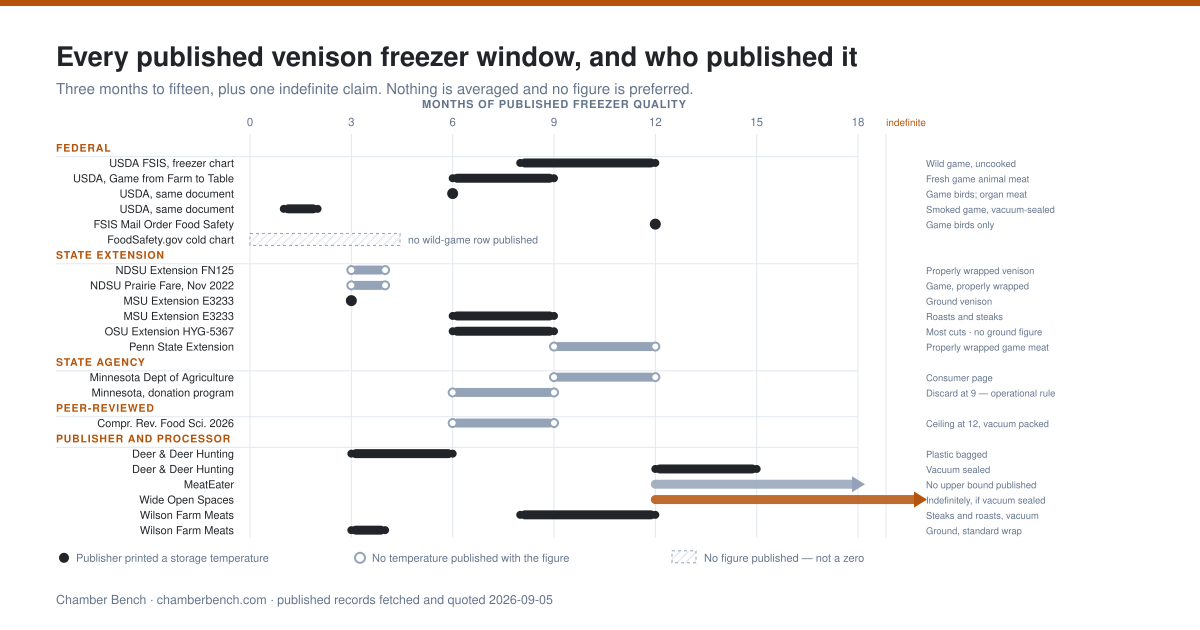
The quality windows for venison do not agree with each other, and the spread is not small. North Dakota State University Extension publishes three to four months for properly wrapped venison [7]. Michigan State University Extension publishes no longer than three months for ground venison and six to nine months for roasts and steaks [6]. Ohio State University Extension publishes six to nine months for most cuts [5]. Penn State Extension publishes 9 to 12 months for properly wrapped game meat [9]. The Minnesota Department of Agriculture publishes 9 to 12 months [10]. The USDA FSIS freezer storage chart lists "Wild game, uncooked | 8 to 12" months [1], while USDA's game document lists "Fresh game animal meat | 3 to 5 days | 6 to 9 months" [2]. Publisher-tier figures run further out: Deer & Deer Hunting publishes 1 year to 15 months for vacuum-sealed venison [12] and MeatEater publishes "well over a year" [13]. Wide Open Spaces publishes four separate positions in one article — "uncooked, frozen venison can be eaten up to 12 months after it is frozen", ground venison "at its best quality if eaten before three months", roasts and steaks "tastiest before they reach the six-to-nine-month mark", and, for vacuum-sealed meat, "can last indefinitely" [14].
For venison as a whole category, the shortest published window is three to four months from NDSU Extension [7] and the longest is 1 year to 15 months from Deer & Deer Hunting [12] — three months against fifteen at the extremes, a factor of five, with no overlap between the two ranges at any point, and that is before the indefinite claim is counted at all. Michigan State University Extension's three-month figure is shorter still, but it covers ground venison alone rather than the category [6]. The conditions attached to those numbers do not match either. Nine sources print a storage temperature next to their freezer months: USDA FSIS [1], USDA's game document [2], FSIS Mail Order Food Safety [18], FoodSafety.gov [4], Ohio State University Extension [5], Michigan State University Extension [6], Deer & Deer Hunting [12], Wide Open Spaces [14] and Wilson Farm Meats [15]. Seven documents publish a months figure with no temperature attached to it: NDSU FN125 [7], the NDSU Prairie Fare column [8], Penn State Extension [9], the Minnesota Department of Agriculture's consumer page [10], the same agency's Venison Donation Program rule [11], MeatEater [13] and the 2026 systematic review [16]. Chamber Bench has frozen nothing and measured nothing. What follows compares what these organizations published, names the tier each figure sits in, records whether the source stated a temperature, and marks the places where no figure has been published at all. Where two documents from the same institution disagree, both are printed.
Is frozen venison ever unsafe to eat because of time alone?
Frozen venison is not made unsafe by elapsed freezer time, provided the freezer holds 0 degrees Fahrenheit or below. USDA FSIS states "Food stored constantly at 0 °F will always be safe" [1], and USDA's game document states "If kept frozen continuously, it will be safe indefinitely" [2]. FoodSafety.gov states that frozen food held at 0°F or below "can be kept indefinitely" [4], and FSIS Mail Order Food Safety states "freezing keeps food safe indefinitely" [18]. The published months describe quality, and Michigan State University Extension words the split the same way: "Although frozen meat is safe as long as it stays frozen, meat quality and flavor will deteriorate in the freezer over time" [6].
Which sources actually print a freezer temperature next to their months?
Nine sources in this ledger print a storage temperature next to their freezer months, and seven publish a venison or game months figure with none. Ohio State University Extension publishes "six to nine months in a freezer with the temperature at 0 F or below" [5]. Michigan State University Extension publishes "in a freezer at 0 degrees F or colder for no longer than three months" for ground venison [6]. Deer & Deer Hunting prefaces its packaging table with "Given a 0 degree F freezer" [12]. USDA's two game tables and the Mail Order chart head their columns 0 °F [1][2][18], as does FoodSafety.gov [4]. NDSU Extension [7][8], Penn State Extension [9], the Minnesota Department of Agriculture in both its consumer page [10] and its Venison Donation Program rule [11], MeatEater [13] and the 2026 review [16] attach no temperature to their figures, so nothing on this page adds one for them.
- 0 degrees Fahrenheit is stated alongside the months in nine documents: USDA FSIS [1][18], USDA's game document [2], FoodSafety.gov [4], Ohio State University Extension [5], Michigan State University Extension [6], Deer & Deer Hunting [12], Wide Open Spaces [14] and Wilson Farm Meats [15]. It is stated in none of the other seven that publish a months figure: NDSU Extension in either document [7][8], Penn State Extension [9], the Minnesota Department of Agriculture's consumer page [10] and its Venison Donation Program rule [11], MeatEater [13] and the 2026 review [16]. None of those figures is repeated here with a temperature added to it.
- Safety does not expire in a working freezer, and six separate documents state it independently: USDA FSIS Freezing and Food Safety [1], USDA Game from Farm to Table [2], FSIS Mail Order Food Safety [18], FoodSafety.gov [4], Michigan State University Extension [6] and Wilson Farm Meats [15].
- The months describe texture, moisture, color and flavor. USDA attributes the loss to air contact with the surface of the food and to ice-crystal damage, not to elapsed time by itself [1].
- No source quoted on this page reports a measurement of its own. The one peer-reviewed paper in this ledger attributes its six-to-nine-month figure to "Anonymous 2010" and its one-year ceiling to Sauvala et al. 2023, so even the literature is passing figures forward rather than generating them [16].
Source basis[1] USDA Food Safety and Inspection Service: Freezing and Food Safety · [2] USDA Food Safety and Inspection Service: Game from Farm to Table (revised May 2011), printed under the banner Food Safety of Farm-Raised Game, read via a Cornell Cooperative Extension PDF mirror · [4] FoodSafety.gov (US Department of Health and Human Services) · [5] Ohio State University Extension / Ohioline · [6] Michigan State University Extension · [7] North Dakota State University Extension · [8] North Dakota State University Extension (Extension and Ag Research News) · [9] Penn State Extension · [10] Minnesota Department of Agriculture: Proper Handling and Cooking of Venison · [11] Minnesota Department of Agriculture: Charitable Organizations Participating Requirements — Venison Donation Program · [12] Deer & Deer Hunting · [13] MeatEater · [14] Wide Open Spaces · [15] Wilson Farm Meats, Elkhorn, Wisconsin · [16] Comprehensive Reviews in Food Science and Food Safety, vol. 25 issue 2, e70420 (Ayaz, Aydin, Bilska-Zajac et al.), DOI 10.1111/1541-4337.70420 · [18] USDA Food Safety and Inspection Service: Mail Order Food Safety
Why do the published numbers disagree?
Five causes account for most of the spread between three months and fifteen, and each one can be read directly off the documents. The sources describe different cuts, assume different wrapping, state different storage temperatures or none at all, emphasize different failure mechanisms, and pass figures forward without a traceable measurement behind them. A sixth difference is not a cause of the spread but a category difference that gets read as one: one document in this ledger is doing operational stock rotation for a donation program rather than writing consumer advice [11]. Several sources do agree with each other — both NDSU documents publish three to four months [7][8], Ohio State [5], Michigan State for roasts and steaks [6] and USDA's game document [2] all publish six to nine, and Penn State [9] and the Minnesota Department of Agriculture [10] both publish 9 to 12 — so the disagreement runs between clusters rather than between every pair of publishers.
Cut-specific sources split the answer where general sources do not. Michigan State University Extension separates the two: "Store ground venison in a freezer at 0 degrees F or colder for no longer than three months for best quality. Venison roasts and steaks can be stored six to nine months at this temperature" [6]. USDA's general freezer chart makes the same split for domestic meat, listing uncooked roasts at 4 to 12 months, uncooked steaks or chops at 4 to 12, and uncooked ground at 3 to 4 [1], yet its wild-game row carries a single 8-to-12-month figure with no cut breakdown [1]. Ohio State University Extension splits whole cuts from organ meat but publishes no ground-venison window at all [5]. NDSU Extension's three-to-four-month figure covers venison as one category [7], and Penn State Extension's 9-to-12-month figure covers game meat as one category [9]. A page that averages a ground-venison figure against a whole-muscle figure produces a number no source published.
The storage temperature the figure assumes is stated by some publishers and left unstated by others, which makes several of the numbers harder to compare than they look. Ohio State [5], Michigan State [6], Deer & Deer Hunting [12], Wide Open Spaces [14] and Wilson Farm Meats [15] name 0 degrees Fahrenheit in the same sentence or the same list as their months, and the federal charts head their freezer columns 0 °F [1][2][4][18]. NDSU Extension in 2003 and again in 2022 [7][8], Penn State Extension [9], the Minnesota Department of Agriculture in both its consumer page [10] and its Venison Donation Program rule [11], MeatEater [13] and the 2026 systematic review [16] publish months with no temperature attached to them. Nothing in those seven documents says the figure assumes a warmer or colder freezer than the others; it says nothing at all, and this page does not fill the blank in.
The failure mechanism a source emphasizes does not predict how many numbers it publishes. USDA describes two routes. The oxidation and dehydration route: freezer burn "is caused by air coming in contact with the surface of the food" [1], and original packaging "is permeable to air and quality may diminish over time" [1]. The ice-crystal route: "Slow freezing creates large, disruptive ice crystals. During thawing, they damage the cells and dissolve emulsions. This causes meat to 'drip' and lose juiciness" [1]. It would be tidy if the sources that lead with air exclusion also published packaging-dependent numbers, but the ledger breaks that pattern in both directions: the NDSU Prairie Fare column opens its freezer section with "Prevent 'freezer burn' by using the right packaging materials" and still publishes one figure for every wrap [8], and Ohio State instructs "Wrap meat tightly, pushing out as much air as possible" and likewise publishes one figure [5]. The verified fact is narrower and firmer: venison numbers that change with the packaging method exist only at publisher and processor tier [12][14][15], and one publisher at that tier names two methods for whole-muscle meat and gives them the same window [13].
Provenance is the fifth cause and the least visible one. The 2026 systematic review in Comprehensive Reviews in Food Science and Food Safety carries the figure forward like this: "However, it is recommended that frozen game meat cuts should be consumed within 6–9 months to ensure optimal quality and freshness (Anonymous 2010)" [16]. A peer-reviewed review citing an anonymous 2010 source is the clearest available evidence that the six-to-nine-month number circulates without a traceable measurement attached. Deer & Deer Hunting publishes three packaging-specific windows and cites nothing for any of them [12]. Wilson Farm Meats publishes more than a dozen cut, packaging and product windows across two lists and cites nothing for any of them [15]. Ohio State University Extension does cite its source for the federal figure, and the citation points at the same Cornell Cooperative Extension mirror used on this page rather than at an FSIS address [5].
Two institutions publish figures that do not line up with their own other documents, which is the part of this record nobody on page one prints. USDA FSIS publishes 8 to 12 months for "Wild game, uncooked" on a page last updated August 09, 2024 [1] and 6 to 9 months for "Fresh game animal meat" in a document revised May 2011 [2]; the categories are labeled differently, neither document cross-references the other, and no reconciliation appears in either. The Minnesota Department of Agriculture tells consumers "Properly wrapped or packaged venison can be stored in a freezer for 9-12 months" [10], while the requirements for its own Venison Donation Program state "Donated venison should be distributed within six months of the processing date. Any product not distributed at the end of nine months must be discarded" [11]. The agency's operational discard point is the number where its consumer advice begins.
Do the federal game figures agree with each other?
Four federal storage charts are quoted on this page; three of them carry a game figure and no two use the same category label. The FSIS Freezing and Food Safety chart lists "Wild game, uncooked | 8 to 12" months [1]. Game from Farm to Table, revised May 2011, lists "Fresh game animal meat | 3 to 5 days | 6 to 9 months" in a HOME STORAGE OF GAME table whose columns are headed REFRIGERATOR 40 °F and FREEZER 0 °F. That document is titled "Game from Farm to Table" and carries the banner line "Food Safety of Farm-Raised Game" above the title, and it defines farm-raised game as "originally wild species of animals and birds that are now being raised domestically for sale under voluntary USDA inspection" [2]. FSIS Mail Order Food Safety carries no game animal row at all, only "Game Birds ... 1 year" [18], against the six months Game from Farm to Table gives fresh game birds [2]. The fourth chart, the FoodSafety.gov Cold Food Storage Chart, carries no game row of any kind [4]. Neither the 8-to-12 row nor the 6-to-9 row cites the other and neither explains the gap. This is an unreconciled difference between federal tables with different scopes and category labels, not a single settled figure with an error in it.
Does the peer-reviewed literature settle the number?
Peer-reviewed literature in this ledger repeats the range instead of resolving it. The 2026 systematic review in Comprehensive Reviews in Food Science and Food Safety states that game meat cuts "should be consumed within 6–9 months" and attributes that to "Anonymous 2010" [16]. The same review states that venison "should not be stored for more than 1 year to maintain its quality" even with vacuum packaging, citing Sauvala et al. 2023 [16]. Those are two positions inside one paper: a six-to-nine-month recommendation resting on an untraceable citation, and a one-year ceiling resting on a named one. Neither figure carries a storage temperature in the review itself.
Scroll horizontally to see every column.
| Source | Tier | Published freezer window | What the figure covers | Temperature published with the figure | Splits by packaging method |
|---|---|---|---|---|---|
| USDA FSIS, Freezing and Food Safety chart [1] | Federal | 8 to 12 months | Wild game, uncooked, all cuts | Yes, chart headed 0 °F | No |
| USDA FSIS, Game from Farm to Table, revised May 2011 [2] | Federal | 6 to 9 months | Fresh game animal meat, in a document titled Game from Farm to Table under the banner Food Safety of Farm-Raised Game | Yes, column headed FREEZER 0 °F | No |
| USDA FSIS, Game from Farm to Table, revised May 2011 [2] | Federal | 6 months | Fresh game birds; fresh organ meat, liver, heart, kidney or tongue | Yes, column headed FREEZER 0 °F | No |
| USDA FSIS, Game from Farm to Table, revised May 2011 [2] | Federal | 2 to 3 months | Cooked game; soups, stews or casseroles containing game | Yes, column headed FREEZER 0 °F | No |
| USDA FSIS, Game from Farm to Table, revised May 2011 [2] | Federal | 1 to 2 months | Smoked game, vacuum-sealed | Yes, column headed FREEZER 0 °F | Named, but for smoked product only |
| USDA FSIS, Mail Order Food Safety, last updated March 30, 2015 [18] | Federal | 1 year | Game birds; no game animal meat row exists in this chart | Yes, column headed Freezer 0 °F | No |
| FoodSafety.gov, Cold Food Storage Chart [4] | Federal | No venison, deer or wild-game row exists | Rows include beef, veal, lamb, pork, poultry, ham, fin fish, shellfish, eggs, salad, hot dogs, luncheon meat, bacon and sausage, ground meats, casseroles, eggnog, pies, quiche, soups and stews, and leftovers | Yes, column headed 0°F (-18°C) or below | No |
| NDSU Extension, Field to Freezer FN125 [7] | State extension | 3 to 4 months | Properly wrapped venison | No temperature published | No |
| NDSU Extension, Prairie Fare column, November 2022 [8] | State extension | 3 to 4 months | Game, properly wrapped | No temperature published | No |
| MSU Extension, Michigan Fresh E3233 [6] | State extension | 3 months ground; 6 to 9 months roasts and steaks | Venison, split by cut | Yes, 0 degrees F or colder | No |
| OSU Extension, HYG-5367 [5] | State extension | 6 to 9 months most cuts; 6 months organ meat | Venison, split by cut; no ground figure published | Yes, 0 F or below | No |
| Penn State Extension, Field to Table [9] | State extension | 9 to 12 months | Properly wrapped game meat | No temperature published | No, and five materials are listed together |
| Minnesota Department of Agriculture, consumer page [10] | State agency | 9 to 12 months | Properly wrapped or packaged venison | No temperature published | No |
| Minnesota Department of Agriculture, Venison Donation Program [11] | State agency, operational rule | Distribute within 6 months; discard at 9 months | Donated processed venison | No temperature published | No |
| Comprehensive Reviews in Food Science and Food Safety, 2026 [16] | Peer-reviewed | 6 to 9 months; not more than 1 year even vacuum packaged | Game meat cuts; venison | No temperature published | Concedes vacuum packaging extends shelf life, still caps at 1 year |
| Deer & Deer Hunting [12] | Publisher | 3 to 6 months bagged; 6 months to 1 year freezer paper; 1 year to 15 months vacuum sealed | Venison | Yes, "Given a 0 degree F freezer" | Yes, packaging treated as the dominant variable |
| MeatEater [13] | Publisher | Well over a year, both methods | Whole-muscle red game meat; ground meat given a method but no window | No temperature published | Yes, and both methods given the same window |
| Wilson Farm Meats, Elkhorn, Wisconsin [15] | Processor | 8 to 12 vacuum and 6 to 8 double wrapped, steaks and roasts; 6 to 10 vacuum and 4 to 6 double wrapped, tenderloin and backstrap; 3 to 4 standard wrap and 6 to 9 vacuum, ground; 2 to 3 and 4 to 6 vacuum, fresh sausage with pork fat | Venison, split by cut and packaging | Yes, a constant 0 degrees Fahrenheit or lower | Yes; roughly a third longer for steaks and roasts, up to double for ground |
| Wilson Farm Meats, Elkhorn, Wisconsin [15] | Processor | 3 to 4 months | Liver, heart and other organs — shorter than either source that gives organ meat six months | Yes, a constant 0 degrees Fahrenheit or lower | No |
| Wilson Farm Meats, Elkhorn, Wisconsin [15] | Processor | 2 to 3 months smoked or fully cooked; 6 to 12 months bones for broth; 1 to 2 months jerky in the pantry and up to 6 months frozen | Smoked, cooked and by-product venison items | Yes, a constant 0 degrees Fahrenheit or lower | No, these rows carry one figure each |
| Wide Open Spaces [14] | Publisher | 12 months attributed to USDA; before 3 months ground; before 6 to 9 months roasts and steaks; indefinitely if vacuum sealed | Frozen deer meat, four separate positions in one article | Yes, zero degrees Fahrenheit or colder | Yes, for the indefinite claim only |
Source basis[1] USDA Food Safety and Inspection Service: Freezing and Food Safety · [2] USDA Food Safety and Inspection Service: Game from Farm to Table (revised May 2011), printed under the banner Food Safety of Farm-Raised Game, read via a Cornell Cooperative Extension PDF mirror · [4] FoodSafety.gov (US Department of Health and Human Services) · [5] Ohio State University Extension / Ohioline · [6] Michigan State University Extension · [7] North Dakota State University Extension · [8] North Dakota State University Extension (Extension and Ag Research News) · [9] Penn State Extension · [10] Minnesota Department of Agriculture: Proper Handling and Cooking of Venison · [11] Minnesota Department of Agriculture: Charitable Organizations Participating Requirements — Venison Donation Program · [12] Deer & Deer Hunting · [13] MeatEater · [14] Wide Open Spaces · [15] Wilson Farm Meats, Elkhorn, Wisconsin · [16] Comprehensive Reviews in Food Science and Food Safety, vol. 25 issue 2, e70420 (Ayaz, Aydin, Bilska-Zajac et al.), DOI 10.1111/1541-4337.70420 · [18] USDA Food Safety and Inspection Service: Mail Order Food Safety
Does the packaging method change the answer?
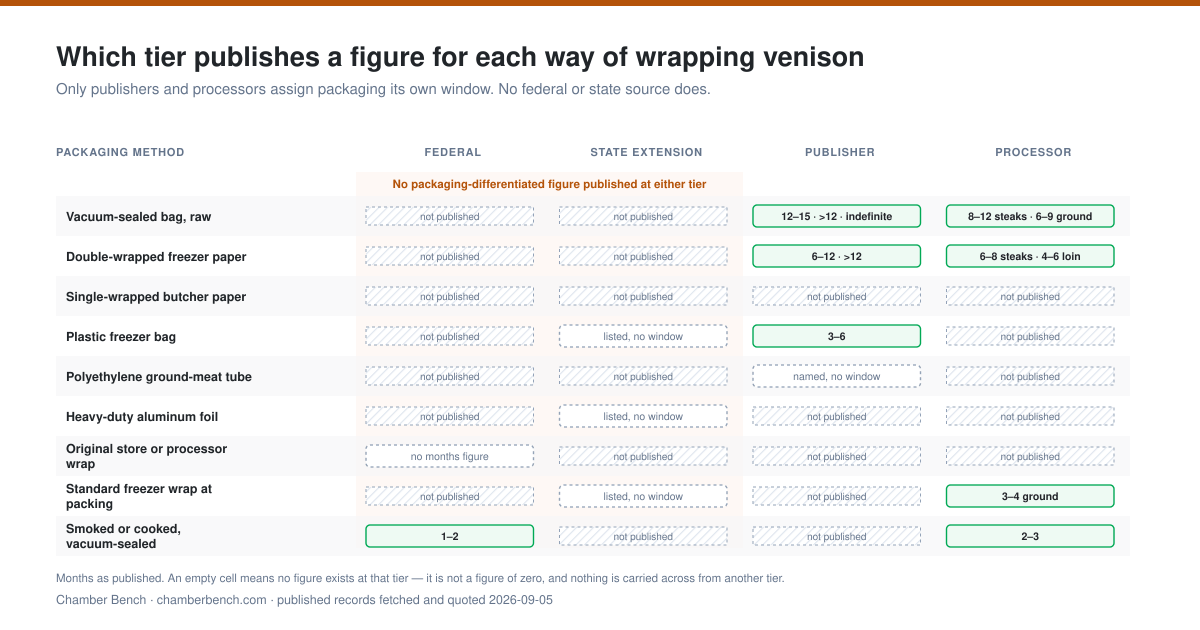
Packaging method changes the published answer only at publisher and processor tier. No federal source and no state extension source in this ledger assigns different months to different packaging methods for venison. Penn State Extension makes the point most directly by listing five materials in one sentence, "Use heavily waxed paper, freezer wrap, heavy-duty aluminum foil, vacuum bags, or plastic freezer storage bags for meat storage" [9], and then publishing one window covering all of them: "Properly wrapped game meat will store in the freezer for 9-12 months" [9]. Ohio State University Extension [5], Michigan State University Extension [6], NDSU Extension in both its documents [7][8] and the Minnesota Department of Agriculture [10] likewise publish figures that do not move with the wrap: Michigan State splits its figure by cut, three months ground against six to nine for roasts and steaks, and neither of those two numbers changes with the packaging method [6]. Vacuum here means the reduced-pressure condition inside the sealed bag, not the appliance that produces it.
Below the extension tier, four sources publish a position on what packaging does to the number, and they contradict each other about how large the effect is. Deer & Deer Hunting treats packaging as the dominant variable: "Plastic Bagged: 3 to 6 months. Double Wrapped Freezer Paper: 6 months to 1 year. Vacuum Sealed: 1 year to 15 months" [12]. MeatEater treats packaging as making no difference between its two accepted methods for whole-muscle red meat, stating that vacuum-sealed bags and double-wrapping with plastic wrap and waxed freezer paper "will keep meat for well over a year if you do it right" [13]. Wilson Farm Meats extends each window by roughly a third to double depending on the cut, publishing steaks and roasts at "8 to 12 months with vacuum sealing; 6 to 8 months with quality double wrapping" and ground venison at "3 to 4 months with standard freezer wrap; up to 6 to 9 months if vacuum sealed and kept very cold" [15]. Wide Open Spaces removes the limit altogether for one method, publishing that properly vacuum-sealed deer meat "can last indefinitely" while giving frozen venison 12 months generally, three months for ground and six to nine for roasts and steaks [14]. Four sources, four different magnitudes for one effect — a fixed extension, no difference at all, roughly a third to double depending on cut, and no limit — and not one of them names a measurement.
USDA does publish one row that names vacuum sealing, and it carries the shortest frozen window in the entire game table. Game from Farm to Table lists smoked game, vacuum-sealed, at 1 to 2 months frozen [2]. That row covers smoked product, not raw venison, and it is not a statement about vacuum-sealing raw game. Read as one, it produces the opposite of what publisher-tier sources claim. Wilson Farm Meats publishes a figure for the same class of product, "Smoked or fully cooked venison products: 2 to 3 months for peak quality", and repeats it in its cut-by-cut list as "Smoked sausage and cooked products: 2 to 3 months for peak taste" [15] — a processor figure one month longer than USDA's at both ends of the range, and one that is not split by packaging method the way Wilson's raw-cut figures are. The federal record contains no vacuum-sealed figure for raw venison at all: USDA's "Wild game, uncooked" row carries one window regardless of wrap [1], and so does its "Fresh game animal meat" row [2]. That is why the figure on this page draws the federal and state extension tiers as single undifferentiated bands rather than assigning a vacuum-sealed value by interpolation.
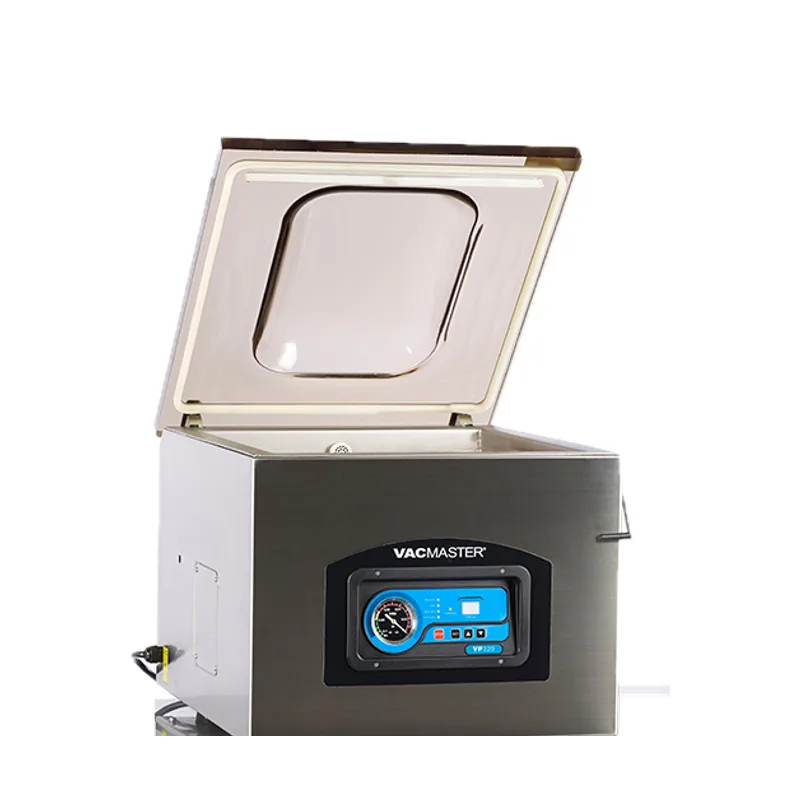
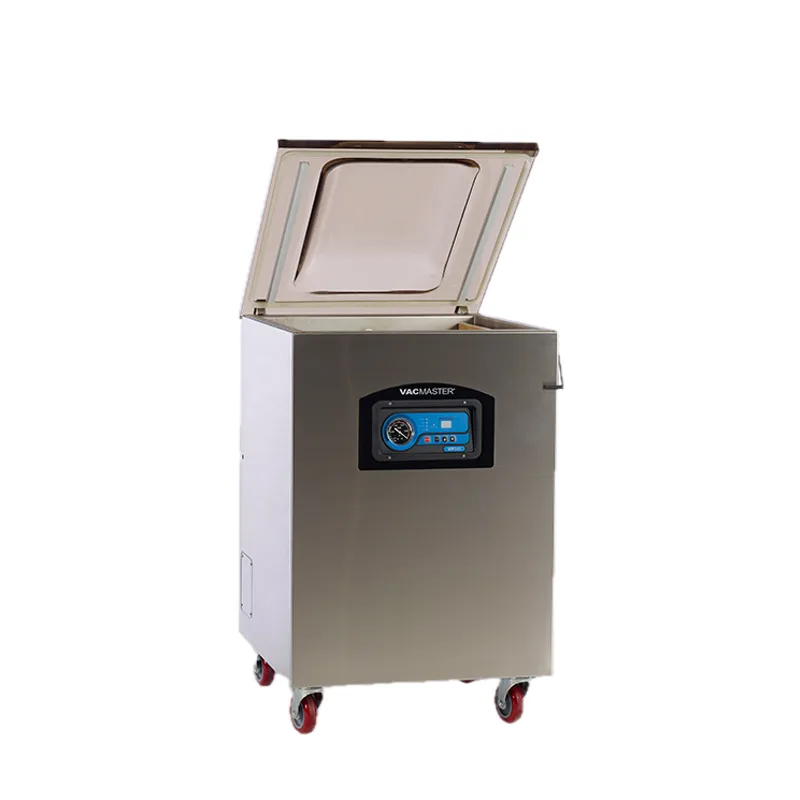
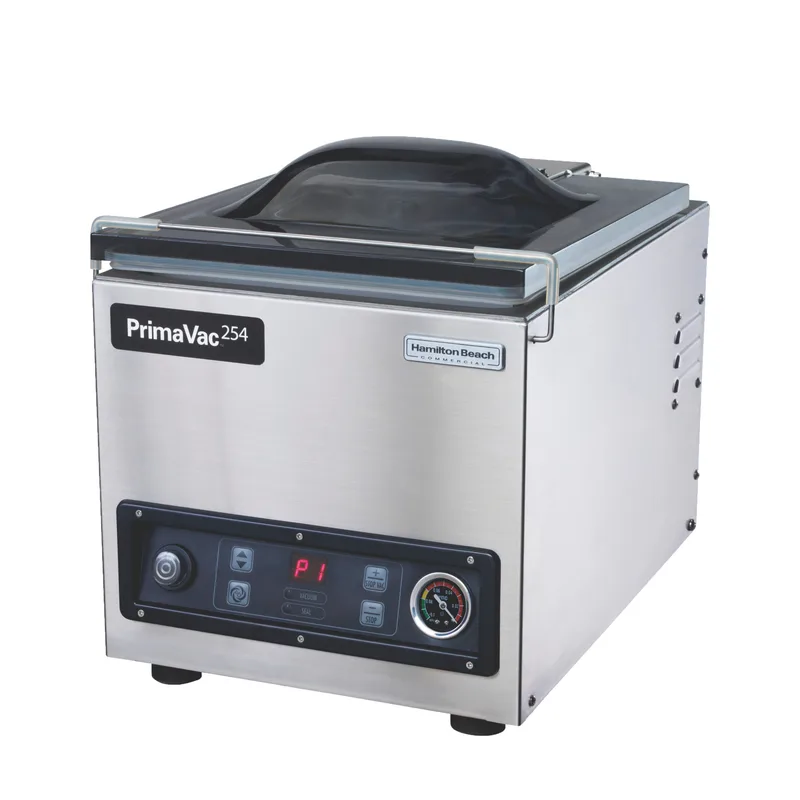
Hardware choice sits downstream of this record, and the record supports less than the marketing around it. No federal or state extension source in this ledger assigns a vacuum-sealed bag a different venison window from waxed paper [1][2][4][5][6][7][8][9][10][18]. The claim that packaging changes the number comes from publisher and processor tier [12][15], one publisher at that tier disputes it for whole-muscle cuts [13], and the peer-reviewed review concedes that vacuum packaging extends shelf life while still capping venison at one year [16]. Machine specifications, chamber dimensions, cycle controls and bag compatibility are compared on the deer and wild game machine analysis, linked below, and are not re-derived here.
Which packaging methods have a published window of their own?
No packaging method has a window of its own at federal or state extension tier. USDA's 8-to-12-month wild game row [1], its 6-to-9-month fresh game animal meat row [2], Penn State's 9 to 12 [9] and NDSU's three to four [7][8] each cover every material the source names: Penn State's shared window covers heavily waxed paper, freezer wrap, heavy-duty aluminum foil, vacuum bags and plastic freezer storage bags [9], and NDSU's covers foil, laminated and heavily waxed freezer wrap and freezer-weight polyethylene bags [7][8]. Below that tier the coverage is partial. Deer & Deer Hunting covers plastic bags, double-wrapped freezer paper and vacuum sealing only [12]. MeatEater recommends "tube-shaped polyethylene ground meat bags" for ground meat and attaches no months figure to them [13]. Single-wrapped butcher paper is named by no source located here, at any tier, and carries no window anywhere. Those slots are drawn as explicit gaps in the figure on this page rather than filled by interpolation between neighboring bars.
Does vacuum sealing make frozen venison last indefinitely?
Vacuum sealing does not give frozen venison indefinite quality, and the source claiming it does argues from the wrong mechanism. Wide Open Spaces publishes "If properly vacuum-sealed, frozen deer meat can last indefinitely! Vacuum-sealing removes most of the oxygen from the meat, slowing the growth of bacteria" [14], which is a safety mechanism used to support a quality claim — and the same article elsewhere publishes 12 months, three months for ground and six to nine for roasts and steaks [14]. The 2026 systematic review sets a one-year quality ceiling for vacuum-packaged venison [16]. Deer & Deer Hunting publishes 1 year to 15 months [12]. USDA's indefinite statement is about safety at 0 degrees Fahrenheit and applies to any packaging [1].
Scroll horizontally to see every column.
| Packaging method | Federal figure | State extension figure | Publisher or processor figure |
|---|---|---|---|
| Vacuum-sealed bag, raw venison | No packaging-specific figure; 8 to 12 months for uncooked wild game covers every wrap (USDA FSIS) [1], as does 6 to 9 months for fresh game animal meat (Game from Farm to Table) [2] | 9 to 12 months, shared with the four other materials Penn State lists and not differentiated by method [9] | 1 year to 15 months (Deer & Deer Hunting) [12]; well over a year (MeatEater) [13]; 8 to 12 months steaks and roasts, 6 to 10 tenderloin and backstrap, 6 to 9 ground (Wilson Farm Meats) [15]; indefinitely (Wide Open Spaces) [14] |
| Double-wrapped waxed freezer paper | No packaging-specific figure; the federal game rows carry one window regardless of wrap [1][2] | Waxed paper and freezer wrap sit inside Penn State's shared 9-to-12-month window [9] and inside NDSU's shared three-to-four-month window [7][8]; neither names double wrapping or gives it a figure of its own | 6 months to 1 year (Deer & Deer Hunting) [12]; well over a year (MeatEater) [13]; 6 to 8 months steaks and roasts, 4 to 6 tenderloin and backstrap (Wilson Farm Meats) [15] |
| Single-wrapped butcher paper | No packaging-specific figure; the federal game rows carry one window regardless of wrap [1][2] | Not named as a material by any state extension source in this ledger [5][6][7][8][9] | None published; no source located assigns butcher paper a window distinct from waxed freezer paper |
| Plastic freezer bag | No packaging-specific figure; the federal game rows carry one window regardless of wrap [1][2] | Inside Penn State's shared 9-to-12-month window as "plastic freezer storage bags" [9] and inside NDSU's shared three-to-four-month window as "freezer-weight polyethylene bags" [7][8]; neither gives the material a figure of its own | 3 to 6 months, with an instruction not to use plastic freezer bags for meat expected to keep more than six months (Deer & Deer Hunting) [12] |
| Tube-shaped polyethylene ground meat bag | No packaging-specific figure; the federal game rows carry one window regardless of wrap [1][2] | Not named in this format; NDSU's "freezer-weight polyethylene bags" carry its shared three-to-four-month window [7][8] | Recommended as the best method for ground meat, no window assigned (MeatEater) [13] |
| Heavy-duty aluminum foil | No packaging-specific figure; the federal game rows carry one window regardless of wrap [1][2] | Inside Penn State's shared 9-to-12-month window [9] and inside NDSU's shared three-to-four-month window [7][8]; listed as acceptable by both, given a figure of its own by neither | None published |
| Original store or processor packaging | No months figure; wrap described as "permeable to air" with quality that "may diminish over time" (USDA FSIS) [1] | None published; no state extension source in this ledger names original store packaging as a category | None published |
| Standard freezer wrap applied at packing | No packaging-specific figure; the federal game rows carry one window regardless of wrap [1][2] | Inside Penn State's material list at 9 to 12 months as "freezer wrap" [9] and inside NDSU's three-to-four-month window as laminated or heavily waxed freezer wrap [7][8] | 3 to 4 months for ground venison in standard freezer wrap (Wilson Farm Meats) [15]; this is wrap applied at packing, not the original store or processor packaging in the row above |
| Smoked or fully cooked game, vacuum-sealed | 1 to 2 months (USDA FSIS, revised May 2011) [2] | None published; no state extension source in this ledger publishes a smoked or cooked game figure [5][6][7][8][9] | 2 to 3 months, not split by packaging method (Wilson Farm Meats) [15] |
Source basis[1] USDA Food Safety and Inspection Service: Freezing and Food Safety · [2] USDA Food Safety and Inspection Service: Game from Farm to Table (revised May 2011), printed under the banner Food Safety of Farm-Raised Game, read via a Cornell Cooperative Extension PDF mirror · [4] FoodSafety.gov (US Department of Health and Human Services) · [5] Ohio State University Extension / Ohioline · [6] Michigan State University Extension · [7] North Dakota State University Extension · [8] North Dakota State University Extension (Extension and Ag Research News) · [9] Penn State Extension · [10] Minnesota Department of Agriculture: Proper Handling and Cooking of Venison · [12] Deer & Deer Hunting · [13] MeatEater · [14] Wide Open Spaces · [15] Wilson Farm Meats, Elkhorn, Wisconsin · [16] Comprehensive Reviews in Food Science and Food Safety, vol. 25 issue 2, e70420 (Ayaz, Aydin, Bilska-Zajac et al.), DOI 10.1111/1541-4337.70420 · [18] USDA Food Safety and Inspection Service: Mail Order Food Safety
Can you eat three-year-old frozen venison?
Three-year-old frozen venison sits on the safe side of every source in this ledger that addresses safety at all, and outside the published quality window of every source that publishes one. USDA FSIS states "Food stored constantly at 0 °F will always be safe" [1]. USDA's game document states "If kept frozen continuously, it will be safe indefinitely" [2]. Thirty-six months is between roughly two and a half and twelve times the published quality windows: 1 year to 15 months at the top from Deer & Deer Hunting [12], three to four months at the bottom from NDSU Extension [7] and three months for ground venison from Michigan State University Extension [6]. Not one source in this ledger publishes a quality window that extends to three years. The only published quality claim that would cover thirty-six months is Wide Open Spaces' "can last indefinitely" for properly vacuum-sealed deer meat [14], and the same article publishes 12 months for frozen venison generally [14]. MeatEater's "well over a year" names no upper limit but does not state that the window is unlimited either [13], and the 2026 systematic review caps venison at one year even vacuum packaged [16].
What three years costs is described mechanically rather than numerically. USDA attributes color change to "lack of oxygen, freezer burn or abnormally long storage" [1], attributes drip loss and lost juiciness to ice crystals damaging cells during thawing [1], and defines freezer burn as "grayish-brown leathery spots" caused by air contact [1]. None of those three descriptions carries a rate, so no source in this ledger supports a statement about how much quality thirty-six months costs compared with twelve. The published windows mark where organizations stopped recommending the meat, not where a measured quality attribute crossed a threshold.
Institutional positions on old frozen venison diverge sharply on the quality side while agreeing on the safety side. The Minnesota Department of Agriculture is the only source in this ledger that sets a time-based mandatory discard point rather than a recommendation, requiring distribution within six months and discard at nine for venison it channels through its own donation program [11], while telling consumers 9 to 12 months on its public page [10]. That discard rule is not the shortest window on the page: NDSU Extension's three to four months is shorter still, in both 2003 and 2022 [7][8], and Wilson Farm Meats publishes 3 to 4 months for organs and for ground venison in standard wrap [15]. Michigan State University Extension frames a planning horizon instead: "For best quality, preserve only the amount of venison that you and your family can consume in one year" [6], which sits above its own three-month figure for ground venison [6]. The 2026 systematic review sets one year as a ceiling even with vacuum packaging [16].
Does a date written on the package still mean anything after freezing?
Dates written on venison packaging stop functioning as safety dates once the meat is frozen. USDA's game document states "It's not important if a date expires after freezing game because all foods stay safe while properly frozen" [2]. A processing or pack date still functions as a quality clock, and that is what makes labeling load-bearing: the date is the only way to know which published window a given package has passed, whether that is three to four months [7], six to nine [5][6], nine to twelve [9][10], or 1 year to 15 months [12].
Source basis[1] USDA Food Safety and Inspection Service: Freezing and Food Safety · [2] USDA Food Safety and Inspection Service: Game from Farm to Table (revised May 2011), printed under the banner Food Safety of Farm-Raised Game, read via a Cornell Cooperative Extension PDF mirror · [5] Ohio State University Extension / Ohioline · [6] Michigan State University Extension · [7] North Dakota State University Extension · [8] North Dakota State University Extension (Extension and Ag Research News) · [9] Penn State Extension · [10] Minnesota Department of Agriculture: Proper Handling and Cooking of Venison · [11] Minnesota Department of Agriculture: Charitable Organizations Participating Requirements — Venison Donation Program · [12] Deer & Deer Hunting · [13] MeatEater · [14] Wide Open Spaces · [15] Wilson Farm Meats, Elkhorn, Wisconsin · [16] Comprehensive Reviews in Food Science and Food Safety, vol. 25 issue 2, e70420 (Ayaz, Aydin, Bilska-Zajac et al.), DOI 10.1111/1541-4337.70420
What does freezer burn actually do to venison?
Freezer burn is a moisture and appearance defect, and USDA FSIS defines it without reference to safety at all: "Freezer burn does not make food unsafe, merely dry in spots. It appears as grayish-brown leathery spots and is caused by air coming in contact with the surface of the food" [1]. Two things follow from that sentence. The defect is caused by air reaching the meat surface, which makes it a packaging-sensitive failure. And the defect is a quality failure, which places it on the same side of the ledger as the month figures rather than alongside anything about risk.
The remedy USDA publishes is partial removal rather than disposal: "Cut freezer-burned portions away either before or after cooking the food. Heavily freezer-burned foods may have to be discarded for quality reasons" [1]. The qualifier "for quality reasons" is doing real work in that sentence, because it names the only discard trigger USDA attaches to freezer burn anywhere in the document. Wilson Farm Meats, the only processor-tier source in this ledger, states the underlying split correctly too: "The short answer is that frozen venison stays safe indefinitely at 0 degrees Fahrenheit or colder, but quality has a shelf life" [15]. It also describes the defect in its own words — "It shows up as grayish or whitish dry spots, often with a rough texture" — and, like USDA, prescribes cutting the affected area away rather than discarding the package [15].
Color change and freezer burn are separate events that readers routinely merge. USDA attributes browning to three causes: "The bright red color of meat as purchased usually turns dark or pale brown depending on its variety. This may be due to lack of oxygen, freezer burn or abnormally long storage" [1]. Lack of oxygen is a condition a sealed bag at reduced pressure creates by design, so a dark or brown surface inside a vacuum-sealed bag is not by itself evidence that a quality window has been passed. Grayish-brown leathery patches with a dried surface match USDA's freezer-burn description [1]; uniform darkening does not.
Should freezer-burned venison be thrown away?
Freezer-burned venison does not have to be discarded on safety grounds. USDA FSIS instructs: "Cut freezer-burned portions away either before or after cooking the food. Heavily freezer-burned foods may have to be discarded for quality reasons" [1]. The phrase "for quality reasons" is the whole answer, because the discard trigger USDA names is palatability rather than risk, and the same document states that freezer burn "does not make food unsafe, merely dry in spots" [1]. No source in this ledger publishes a threshold for how much freezer burn counts as heavy.
Why does frozen venison turn brown or gray?
Browning in frozen venison has three causes in the USDA account, and only one of them involves long storage: "The bright red color of meat as purchased usually turns dark or pale brown depending on its variety. This may be due to lack of oxygen, freezer burn or abnormally long storage" [1]. Lack of oxygen is the condition inside a sealed bag at reduced pressure, so color change in vacuum-sealed venison is consistent with the packaging working as designed. USDA attaches no months figure to any of the three causes [1].
Source basis[1] USDA Food Safety and Inspection Service: Freezing and Food Safety · [15] Wilson Farm Meats, Elkhorn, Wisconsin
How should venison be packaged for the freezer?
Packaging materials that published sources accept for venison are named explicitly, and the list is broader than most buying advice implies. Penn State Extension: "Use heavily waxed paper, freezer wrap, heavy-duty aluminum foil, vacuum bags, or plastic freezer storage bags for meat storage" [9]. NDSU Extension names materials in both of its documents: FN125 gives "Heavy-duty aluminum foil, polyethylene bags or laminated freezer wrap" [7], and the 2022 Prairie Fare column gives "moisture/vapor-proof wrap such as heavily waxed freezer wrap, laminated freezer wrap, heavy duty aluminum foil or freezer-weight polyethylene bags" [8]. MeatEater names two methods for whole-muscle red meat, vacuum-sealed bags and double-wrapping with plastic wrap and waxed freezer paper [13], and a third for ground meat: "the best way bet is to use tube-shaped polyethylene ground meat bags" [13]. USDA states that freezing meat in its original store packaging is safe but flags the material: "It is safe to freeze meat or poultry directly in its original packaging, however this type of wrap is permeable to air and quality may diminish over time" [1]. That sentence is the closest a federal source comes to a packaging-method statement, and it still assigns no months figure.
Freezing speed is the second variable the sources name, and it is a handling variable rather than a packaging one. USDA FSIS: "Slow freezing creates large, disruptive ice crystals. During thawing, they damage the cells and dissolve emulsions. This causes meat to 'drip' and lose juiciness" [1]. NDSU Extension gives the same instruction operationally without a months adjustment: "Avoid overloading the freezer. Freeze only the amount that will become solidly frozen within 24 hours" [8]. Deer & Deer Hunting names the same class of variables without assigning any of them a number: "Many factors come into play — air access, temperature of freezer, wrapping material used — but in general one year is the target time frame for finishing off venison" [12]. Freezer temperature stability appears in all three accounts and carries no published months adjustment in any of them.
Labeling is the one packaging step whose value this ledger supports without qualification, because every published window is counted from a date the package must carry. USDA states that an expired date on frozen game does not matter for safety [2], which leaves the pack date doing quality work only. NDSU Extension conditions its three-to-four-month figure on venison being "properly wrapped" [7] and repeated the figure nineteen years later in a 2022 column, "For best quality, game will keep three to four months in the freezer if properly wrapped" [8]. Both documents name acceptable materials, and neither assigns any of the named materials a window different from any other.
Does freezing speed change how long venison keeps its quality?
Freezing speed is one of the two quality mechanisms USDA names, and it operates independently of packaging material. USDA FSIS states: "Slow freezing creates large, disruptive ice crystals. During thawing, they damage the cells and dissolve emulsions. This causes meat to 'drip' and lose juiciness" [1]. No source in this ledger publishes a months figure conditioned on freezing speed, so none of the published windows can be adjusted for it. NDSU Extension turns it into a loading instruction rather than a number, telling readers to freeze only what will freeze solid within 24 hours [8], and Deer & Deer Hunting names freezer temperature as one of three variables behind the spread and assigns it no number [12].
- Penn State Extension accepts five materials under one shared window of 9 to 12 months: heavily waxed paper, freezer wrap, heavy-duty aluminum foil, vacuum bags, and plastic freezer storage bags [9].
- USDA FSIS flags original store packaging as "permeable to air" with quality that "may diminish over time," and publishes no replacement months figure for repackaged meat [1].
- USDA FSIS attributes drip loss and lost juiciness to slow freezing and the large ice crystals it creates [1].
- MeatEater accepts two methods for whole-muscle red meat and assigns them the same window — vacuum-sealed bags and double-wrapping with plastic wrap and waxed freezer paper, both "well over a year" — and separately recommends tube-shaped polyethylene ground meat bags for ground meat with no window attached [13].
- Deer & Deer Hunting names three variables behind the spread, air access, freezer temperature and wrapping material, and assigns a number to none of them [12]. It does publish one negative instruction: do not use plastic freezer bags if the meat has to keep more than six months [12].
- Michigan State University Extension advises freezing one year's worth of venison at most, a horizon that sits above its own three-month figure for ground venison [6].
- NDSU Extension names acceptable materials in both 2003 and 2022 — foil, polyethylene bags, laminated freezer wrap, heavily waxed freezer wrap — and never assigns any of them a different window from the others [7][8].
Source basis[1] USDA Food Safety and Inspection Service: Freezing and Food Safety · [2] USDA Food Safety and Inspection Service: Game from Farm to Table (revised May 2011), printed under the banner Food Safety of Farm-Raised Game, read via a Cornell Cooperative Extension PDF mirror · [6] Michigan State University Extension · [7] North Dakota State University Extension · [8] North Dakota State University Extension (Extension and Ag Research News) · [9] Penn State Extension · [12] Deer & Deer Hunting · [13] MeatEater
Where the federal venison figures live now
The six-to-nine-month federal figure was not being served by USDA at its own address when this page was compiled. Fetching the canonical FSIS URL for Game from Farm to Table on 2026-09-05 returned HTTP 404 with a body reading "Page Not Found" [3], and a map of fsis.usda.gov for game and venison pages surfaced no Game from Farm to Table page in the live index [3]. The version quoted throughout this page is a Cornell Cooperative Extension PDF mirror whose footer reads "Revised May 2011" [2]. Ohio State University Extension cites the same mirror in its own source list rather than an FSIS address [5], which suggests the mirror has been the working copy for some time. That is an observation about document availability on one date. It is not a claim that USDA withdrew or reversed the guidance, and nothing in this ledger would support such a claim.
The gap in the live federal record is wider than one missing document, and it is not the same gap on every federal page. The FoodSafety.gov Cold Food Storage Chart contains no venison, deer or wild-game row anywhere in it; its rows include beef, veal, lamb, pork, poultry, ham, fin fish, shellfish, eggs, salad, hot dogs, luncheon meat, bacon and sausage, ground meats, casseroles, eggnog, pies, quiche, soups and stews, and leftovers [4]. The nearest analogue a reader lands on is "Fresh beef, veal, lamb, and pork | Steaks | 3 to 5 days | 4 to 12 months" [4], which is domestic meat. The third FSIS chart quoted here, the live Mail Order Food Safety page, carries a game row that covers birds only: "Game Birds | Frozen or refrigerator cold | N/A | 1-2 days | 1 year" [18]. That page was last updated March 30, 2015, and its one-year game-bird figure runs six months longer than the six months the mirrored 2011 document gives fresh game birds [2]. The live FSIS Freezing and Food Safety chart does carry a game animal row, "Wild game, uncooked | 8 to 12" months [1], and it disagrees with the mirrored 2011 document by two to three months at both ends.
Broken attribution is visible in the published record too. Wide Open Spaces states "According to the U.S. Department of Agriculture, uncooked, frozen venison can be eaten up to 12 months after it is frozen" [14] and links that sentence to a USDA article about beef, not venison [17]. That article is no longer reachable: the URL returns HTTP 503 with the message "The ask.usda.gov/s website is no longer available" [17]. A twelve-month venison figure attributed to USDA therefore traces to a retired page about a different animal, and no live FSIS question-and-answer figure for venison appears in this ledger. Neither the Freezing and Food Safety chart nor the Mail Order chart publishes twelve months for venison as a point value: the first publishes a range of 8 to 12 for uncooked wild game [1], and the second publishes one year for game birds only [18].
Where can the USDA six-to-nine-month game figure be read today?
The USDA six-to-nine-month game figure is readable in a Cornell Cooperative Extension PDF mirror of Game from Farm to Table, revised May 2011, which lists "Fresh game animal meat | 3 to 5 days | 6 to 9 months" [2]. The canonical FSIS address for that document returned HTTP 404 on 2026-09-05 [3]. Anyone citing the six-to-nine-month federal figure today is citing a mirror, or an extension document quoting it — Ohio State University Extension cites that same mirror URL in its source list [5] — rather than a live FSIS page. The live FSIS charts carry 8 to 12 months for uncooked wild game [1] and one year for game birds [18] instead.
Source basis[1] USDA Food Safety and Inspection Service: Freezing and Food Safety · [2] USDA Food Safety and Inspection Service: Game from Farm to Table (revised May 2011), printed under the banner Food Safety of Farm-Raised Game, read via a Cornell Cooperative Extension PDF mirror · [3] USDA Food Safety and Inspection Service: Game from Farm to Table, canonical FSIS address · [4] FoodSafety.gov (US Department of Health and Human Services) · [5] Ohio State University Extension / Ohioline · [14] Wide Open Spaces · [17] USDA (ask.usda.gov, retired service) · [18] USDA Food Safety and Inspection Service: Mail Order Food Safety
What this page cannot tell you
Records that would narrow this range exist and were not obtained, so this page names them rather than working around them. The most directly relevant one is a peer-reviewed measurement of frozen venison quality over time: Daszkiewicz, Kubiak and Panfil (2018), "The Effect of Long-Term Frozen Storage on the Quality of Meat (Longissimus thoracis et Lumborum) from Female Roe Deer," Journal of Food Quality 2018, article 4691542, DOI 10.1155/2018/4691542. The publisher returned HTTP 403 and the paper was not read. No duration, figure or finding from it appears anywhere on this page, and nothing here should be read as summarizing it.
The structural gap matters more than any single missing paper. Ten federal and state documents were checked for a packaging-differentiated venison figure and none publishes one: USDA FSIS Freezing and Food Safety [1], USDA Game from Farm to Table [2], FSIS Mail Order Food Safety [18], FoodSafety.gov [4], OSU Extension HYG-5367 [5], MSU Extension E3233 [6], NDSU Extension FN125 [7], the NDSU Prairie Fare column [8], Penn State Extension [9] and the Minnesota Department of Agriculture [10]. Every packaging-differentiated number in circulation comes from publisher or processor tier. A page that presents "vacuum sealed: 12 to 15 months" as an authoritative answer is presenting an uncited magazine figure as a federal one.
A second structural gap sits underneath the temperature question. Seven of the documents quoted here publish months with no storage temperature attached, and none of them publishes a corrected figure for a freezer that runs warmer than 0 degrees Fahrenheit. No source in this ledger publishes a months adjustment for any temperature at all — not for an upright freezer that cycles through an auto-defrost, not for a refrigerator freezer compartment, not for a chest freezer held colder than zero. Every temperature statement located here is a condition on the figure, never a variable the figure moves with.
What has this site not verified about venison freezer life?
Chamber Bench has not measured venison quality over frozen storage and holds no bench data of any kind. Every figure on this page is a published record attributed to the source named beside it. The most directly relevant peer-reviewed measurement located, Daszkiewicz, Kubiak and Panfil (2018) on long-term frozen storage of roe deer Longissimus in Journal of Food Quality, DOI 10.1155/2018/4691542, returned HTTP 403 and was not read, so no duration or finding from it appears here. The USDA FoodKeeper database was not queried for a venison record either, and FSIS storage tables beyond the three quoted here [1][2][18] were not enumerated.
- Daszkiewicz et al. (2018) on long-term frozen storage of roe deer meat: title, authors, journal and DOI known from another paper's reference list only. HTTP 403 from the publisher, not read, no figure from it used.
- No federal or state extension source assigns different months to different packaging methods for venison, across all ten documents checked [1][2][4][5][6][7][8][9][10][18].
- No published months figure was located for single-wrapped butcher paper as distinct from waxed freezer paper, at any tier.
- No source in this ledger publishes a months adjustment for a freezer running warmer or colder than 0 degrees Fahrenheit, and seven documents publish their months with no temperature stated at all [7][8][9][10][11][13][16].
- The USDA FoodKeeper database was not queried for a venison record, so this page cannot say whether one exists or what it says.
- FSIS storage tables beyond the three quoted here [1][2][18] were not enumerated; Mail Order Food Safety [18] was located only because its game-bird row conflicts with the mirrored 2011 document [2], and other FSIS pages may carry further game rows.
- No University of Wisconsin or Wisconsin Extension venison freezer figure was located, despite Wisconsin being a high-volume deer state.
- The successor service ask.fsis.usda.gov was not queried for a venison-specific answer, so no live federal question-and-answer figure appears in this ledger.
- Chamber Bench has run no freezer trial, holds no bench data, and publishes no figure of its own on this page.
Source basis[1] USDA Food Safety and Inspection Service: Freezing and Food Safety · [2] USDA Food Safety and Inspection Service: Game from Farm to Table (revised May 2011), printed under the banner Food Safety of Farm-Raised Game, read via a Cornell Cooperative Extension PDF mirror · [4] FoodSafety.gov (US Department of Health and Human Services) · [5] Ohio State University Extension / Ohioline · [6] Michigan State University Extension · [7] North Dakota State University Extension · [8] North Dakota State University Extension (Extension and Ag Research News) · [9] Penn State Extension · [10] Minnesota Department of Agriculture: Proper Handling and Cooking of Venison · [11] Minnesota Department of Agriculture: Charitable Organizations Participating Requirements — Venison Donation Program · [13] MeatEater · [16] Comprehensive Reviews in Food Science and Food Safety, vol. 25 issue 2, e70420 (Ayaz, Aydin, Bilska-Zajac et al.), DOI 10.1111/1541-4337.70420 · [18] USDA Food Safety and Inspection Service: Mail Order Food Safety
Questions readers still ask
Does ground venison get a shorter published window than steaks and roasts?
Ground venison gets a shorter window from every source that publishes a separate ground figure. Michigan State University Extension publishes no longer than three months for ground venison against six to nine months for roasts and steaks [6]. Wilson Farm Meats publishes 3 to 4 months for ground in standard freezer wrap against 8 to 12 months for vacuum-sealed steaks and roasts [15]. Wide Open Spaces publishes ground venison "at its best quality if eaten before three months" against six to nine months for roasts and steaks [14]. USDA's general chart makes the same split for domestic meat, listing uncooked ground at 3 to 4 months and uncooked roasts, steaks or chops at 4 to 12 [1]. Ohio State Extension splits whole cuts from organ meat but publishes no ground figure [5], and NDSU Extension in both its documents, Penn State Extension and the Minnesota Department of Agriculture publish one figure covering all cuts [7][8][9][10].
How long does smoked, vacuum-sealed game keep in the freezer?
Two sources publish a figure and they do not match. USDA's Game from Farm to Table gives smoked, vacuum-sealed game 1 to 2 months frozen, alongside 2 weeks refrigerated unopened and 7 days after opening [2]. Wilson Farm Meats gives "Smoked or fully cooked venison products: 2 to 3 months for peak quality" and repeats it as "Smoked sausage and cooked products: 2 to 3 months for peak taste", without splitting that figure by packaging method the way it splits its raw cuts [15]. USDA's row is the shortest frozen figure in its game table and the only row in the four federal storage charts quoted on this page that names vacuum sealing; it covers smoked product, and it is regularly misread as a statement about vacuum-sealing raw venison. No federal chart quoted here makes that statement: none of the four assigns raw venison a window that depends on the packaging method [1][2][4][18].
Do the federal cold-storage charts contain a venison row?
Four federal storage charts are quoted on this page and two of them carry a game animal row. The FSIS Freezing and Food Safety chart contains "Wild game, uncooked | 8 to 12" months [1], and the FSIS Game from Farm to Table table, read in a Cornell Cooperative Extension mirror, contains "Fresh game animal meat | 3 to 5 days | 6 to 9 months" [2]. The other two carry no game animal row at all. FSIS Mail Order Food Safety carries a game row for birds only, "Game Birds ... 1 year" in its 0 °F freezer column, and no game animal meat row at all [18]. The FoodSafety.gov Cold Food Storage Chart contains no venison, deer or wild-game row anywhere in it; its rows include beef, veal, lamb, pork, poultry, ham, fin fish, shellfish, eggs, hot dogs, luncheon meat, bacon and sausage, ground meats, casseroles, eggnog, pies, quiche, soups and stews, and leftovers, and the nearest analogue readers are pushed onto is "Fresh beef, veal, lamb, and pork | Steaks | 3 to 5 days | 4 to 12 months" [4]. That absence is a documented gap in the federal consumer record.
Does the Minnesota Department of Agriculture follow its own consumer guidance?
The Minnesota Department of Agriculture applies a stricter rule to venison it handles than the one it publishes for consumers. Its consumer page states "Properly wrapped or packaged venison can be stored in a freezer for 9-12 months" [10]. The requirements for its Venison Donation Program state "Donated venison should be distributed within six months of the processing date. Any product not distributed at the end of nine months must be discarded" [11]. The operational target is six months and the operational limit is nine, which is where the consumer range starts. Neither document attaches a storage temperature to its figure.
How long do venison organ meats keep in the freezer?
Three sources publish an organ-meat figure and they split two to one. Ohio State University Extension publishes "Liver, heart, kidney, or tongue may be frozen for six months for best quality" [5]. USDA's Game from Farm to Table lists fresh organ meat, liver, heart, kidney or tongue, at 6 months frozen and 1 to 2 days refrigerated [2]. Wilson Farm Meats publishes a shorter figure, 3 to 4 months — 50 to 67 percent of a six-month window rather than half of it: "Liver, heart, and other organs: 3 to 4 months. Use sooner for best flavor" [15]. Nothing in this ledger reconciles the processor figure with the two six-month figures, and none of the three cites a measurement. The same USDA table gives fresh game birds 6 months and cooked game, soups, stews or casseroles containing game 2 to 3 months [2].
Is one year a defensible planning horizon for a freezer of venison?
One year appears as a planning horizon in three sources at three different tiers. Michigan State University Extension: "For best quality, preserve only the amount of venison that you and your family can consume in one year" [6]. Deer & Deer Hunting: "in general one year is the target time frame for finishing off venison" [12]. The 2026 systematic review sets one year as a ceiling even with vacuum packaging [16]. One year also sits above MSU Extension's own three-month figure for ground venison [6] and above NDSU Extension's three-to-four-month figure for all venison [7], so it is a planning horizon rather than a window every source endorses.
Sources
Each record carries its own access date. Manufacturer statements are attributed; they are not treated as Chamber Bench test results.
- Freezing and Food SafetyUSDA Food Safety and Inspection Service — Page last updated August 09, 2024. Source of the 0 degF indefinite-safety rule, the "freezer storage is for quality only" chart note, the "Wild game, uncooked | 8 to 12" months row, the domestic meat rows (uncooked roasts and steaks 4 to 12, uncooked ground 3 to 4), the freezer-burn definition and remedy, the air-permeable original-packaging statement, the color-change causes and the ice-crystal mechanism. The chart is headed 0 °F. · Accessed
- Game from Farm to Table (revised May 2011), printed under the banner Food Safety of Farm-Raised Game, read via a Cornell Cooperative Extension PDF mirrorUSDA Food Safety and Inspection Service — Nine-page PDF, footer reads "Revised May 2011". The document title is "Game from Farm to Table"; the banner line "Food Safety of Farm-Raised Game" is printed above that title, and the document defines farm-raised game as "originally wild species of animals and birds that are now being raised domestically for sale under voluntary USDA inspection." Both strings appear in the PDF and this page uses the first as the title and the second as the banner. Its HOME STORAGE OF GAME table carries columns headed REFRIGERATOR 40 °F and FREEZER 0 °F and is the source of "Fresh game animal meat | 3 to 5 days | 6 to 9 months", the 6-month game bird and organ meat rows, the 2-to-3-month cooked game row, the 1-to-2-month smoked vacuum-sealed row, the indefinite-safety statement for frozen game and the statement that dates lose meaning after freezing. Cited as USDA FSIS 2011 accessed via the Cornell mirror; the mirror is not an FSIS-hosted document. Note the category label is "Fresh game animal meat", not "wild game". · Accessed
- Game from Farm to Table, canonical FSIS addressUSDA Food Safety and Inspection Service — Fetched 2026-09-05: HTTP 404, page body reads "Page Not Found". A map of fsis.usda.gov for game and venison pages returned no Game from Farm to Table page in the live index. Recorded as an observation about document availability on one date, not as evidence that USDA withdrew or reversed the guidance. · Accessed
- Cold Food Storage ChartFoodSafety.gov (US Department of Health and Human Services) — Date last reviewed September 19, 2023. Freezer column headed 0°F (-18°C) or below. Source of "The guidelines for freezer storage are for quality only—frozen foods stored continuously at 0°F (-18°C) or below can be kept indefinitely" and of the documented absence: the complete chart contains no venison, deer or wild-game row. Its rows include beef/veal/lamb/pork, poultry, ham, fin fish, shellfish, eggs, salad, hot dogs, luncheon meat, bacon and sausage, ground meats, casseroles with eggs, eggnog, pies, quiche, soups and stews, and leftovers. Nearest analogue row quoted is "Fresh beef, veal, lamb, and pork | Steaks | 3 to 5 days | 4 to 12 months". · Accessed
- Food Preservation: Freezing and Canning Venison (HYG-5367)Ohio State University Extension / Ohioline — Authors Melinda Hill and Treva Williams, fact sheet dated 09/19/2019. Source of "Most cuts of venison may be stored for six to nine months in a freezer with the temperature at 0 F or below" and the six-month organ meat figure; publishes no ground-venison window. Also the source of "Wrap meat tightly, pushing out as much air as possible" and of the C. botulinum warning about vacuum-sealed venison during thawing, which this page links out rather than expands. Its own source list cites Game from Farm to Table at the Cornell mirror URL, not at an FSIS address. · Accessed
- Michigan Fresh: Handling, Using and Storing Venison (Bulletin E3233)Michigan State University Extension — Author Laurie Messing, dated October 21, 2015. Source of the three-month ground venison figure and the six-to-nine-month roast and steak figure, both stated at 0 degrees F or colder, plus the safety-versus-quality restatement and the one-year household planning horizon. · Accessed
- Wild Side of the Menu No. 2: Field to Freezer (FN125)North Dakota State University Extension — Lead author Julie Garden-Robinson, co-author Martin Marchello. Published September 2003, reviewed November 2017, page marked "Reviewed August 2022". Source of "Properly wrapped venison, like meat of other ruminants, will keep three to four months in your freezer" — the shortest single figure in this ledger covering venison as one category, though Michigan State University Extension's three-month ground venison figure is shorter for that cut — and of the material list "Heavy-duty aluminum foil, polyethylene bags or laminated freezer wrap are good materials to use for freezing." No storage temperature is published with the months figure. · Accessed
- Prairie Fare: Prepare and store wild game safelyNorth Dakota State University Extension (Extension and Ag Research News) — By Julie Garden-Robinson, dated November 3, 2022. Repeats the three-to-four-month figure nineteen years after FN125, which is why this page treats the low anchor as current guidance rather than a stale 2003 artifact. Also the source of "Prevent 'freezer burn' by using the right packaging materials", the material list "heavily waxed freezer wrap, laminated freezer wrap, heavy duty aluminum foil or freezer-weight polyethylene bags", and the 24-hour freeze-solid loading instruction. No storage temperature is published with the months figure. · Accessed
- Proper Care and Handling of Venison from Field to TablePenn State Extension — Document byline reads "Prepared by Catherine N. Cutter, associate professor and food safety specialist"; the site's separate author card gives her title as Professor of Food Science. Page updated November 18, 2020. Source of "Properly wrapped game meat will store in the freezer for 9-12 months" and of the five-material list that assigns waxed paper, freezer wrap, foil, vacuum bags and plastic freezer bags one shared window. No storage temperature is published with the months figure. · Accessed
- Proper Handling and Cooking of VenisonMinnesota Department of Agriculture — Page last modified 05/22/2025. Source of "Properly wrapped or packaged venison can be stored in a freezer for 9-12 months". No storage temperature is published with the freezer figure; the 40 degF figure on the page applies to refrigeration and marinating. The agency cites Penn State (Cutter 2000), University of Illinois Extension 2006, University of Minnesota Extension 2003 and Clemson 2007, all retrieved 2007. · Accessed
- Charitable Organizations Participating Requirements — Venison Donation ProgramMinnesota Department of Agriculture — Page last modified 06/04/2026. Source of "Donated venison should be distributed within six months of the processing date. Any product not distributed at the end of nine months must be discarded" — the same agency's operational rule, and the only mandatory discard point in this ledger, though not the shortest window in it. No storage temperature is published with the rule. · Accessed
- The Best Tips for Wrapping and Freezing VenisonDeer & Deer Hunting — By Tom Carpenter. Published 2017-10-09, modified 2025-08-04. Source of the three packaging-specific windows (bagged 3 to 6 months, double-wrapped freezer paper 6 months to 1 year, vacuum sealed 1 year to 15 months), prefaced in the article by "Given a 0 degree F freezer", and of the one-year target framing. Also the source of the instruction not to use plastic freezer bags for meat expected to keep more than six months. The article cites no source for any of the three figures; treated here as publisher tier. · Accessed
- Tips for Freezing Game MeatMeatEater — By Steven Rinella, January 7, 2018. Source of the statement that, for whole-muscle red meat, vacuum-sealed bags and plastic-plus-waxed-paper double wrapping both keep meat "well over a year", which contradicts Deer & Deer Hunting on whether packaging changes the window and contradicts NDSU Extension on the window itself. Also names a third method for ground meat — "tube-shaped polyethylene ground meat bags" — with no months figure attached. No storage temperature is published anywhere in the article. · Accessed
- How Long Is Deer Meat Good in the Freezer?Wide Open Spaces — By Chelsey Cook. Published 2023-09-15, modified 2024-01-12. Publishes four separate positions: 12 months attributed to USDA through a link pointing to a USDA article about beef on a service that has since been retired; ground venison "at its best quality if eaten before three months"; roasts and steaks "tastiest before they reach the six-to-nine-month mark"; and, for vacuum-sealed meat, "can last indefinitely", justified by a bacterial-growth mechanism. States zero degrees Fahrenheit or colder as the storage condition. · Accessed
- How Long Can Deer Meat Stay Frozen? Safe Storage Timelines & Labeling TipsWilson Farm Meats, Elkhorn, Wisconsin — Published 2025-09-04, modified 2025-10-07. Processor tier. Publishes more than a dozen windows across two lists: steaks and roasts, tenderloin and backstrap, ground venison, fresh sausage with pork fat, smoked or fully cooked products at 2 to 3 months, jerky at 1 to 2 months pantry and up to 6 months frozen, bones for broth at 6 to 12 months, and "Liver, heart, and other organs: 3 to 4 months." All stated at a constant 0 degrees Fahrenheit or lower. Also the source of a correct statement of the safety-versus-quality split. No sources cited for any figure. · Accessed
- The Effectiveness of Postharvest Processing on Microbiological Safety of Game Meat — A Systematic ReviewComprehensive Reviews in Food Science and Food Safety, vol. 25 issue 2, e70420 (Ayaz, Aydin, Bilska-Zajac et al.), DOI 10.1111/1541-4337.70420 — Published 2026-02-28, read via PMC full text. Source of the six-to-nine-month recommendation attributed to "Anonymous 2010" and of the one-year quality ceiling for vacuum-packaged venison citing Sauvala et al. 2023. Neither figure carries a storage temperature in the review. Used here as evidence about provenance, not as a criticism of the review. · Accessed
- How long can you freeze beef? (retired ask.usda.gov article)USDA (ask.usda.gov, retired service) — Fetched 2026-09-05: HTTP 503 with the message "The ask.usda.gov/s website is no longer available. For all Food Safety and Inspection Service (FSIS) questions, please use the FSIS website at ask.fsis.usda.gov." This is the destination of the Wide Open Spaces link that attributes a 12-month venison figure to USDA. The successor service was not queried for a venison answer. · Accessed
- Mail Order Food SafetyUSDA Food Safety and Inspection Service — Page last updated March 30, 2015; live at fsis.usda.gov on 2026-09-05. A third federal storage chart, compiled by the USDA Meat and Poultry Hotline and the FDA Outreach and Information Center, with a freezer column headed 0 °F. Source of "Game Birds | Frozen or refrigerator cold | N/A | 1-2 days | 1 year" — six months longer than the six-month game bird figure in Game from Farm to Table — and of "Because freezing keeps food safe indefinitely, recommended storage times are for quality only." The chart carries no game animal meat row. · Accessed