When a chamber machine earns the bench space
A chamber vacuum sealer earns bench space for sous vide on two patterns and very few others: liquid that goes into the pouch as a matter of routine, and portion counts high enough that closing bags by hand becomes the slow step in the session. Anova states the packaging case on its chamber sealer page, writing that 'achieving a mess-free, airtight seal is key to sous vide success, ensuring the pouch stays safely sealed and doesn't float while cooking.' That claim sits entirely on the packaging side. It says nothing about doneness, nothing about pasteurization, and nothing about how a pouch behaves at a given bath temperature, which are the three questions most sous-vide buyers are actually asking when they shop for a sealer.
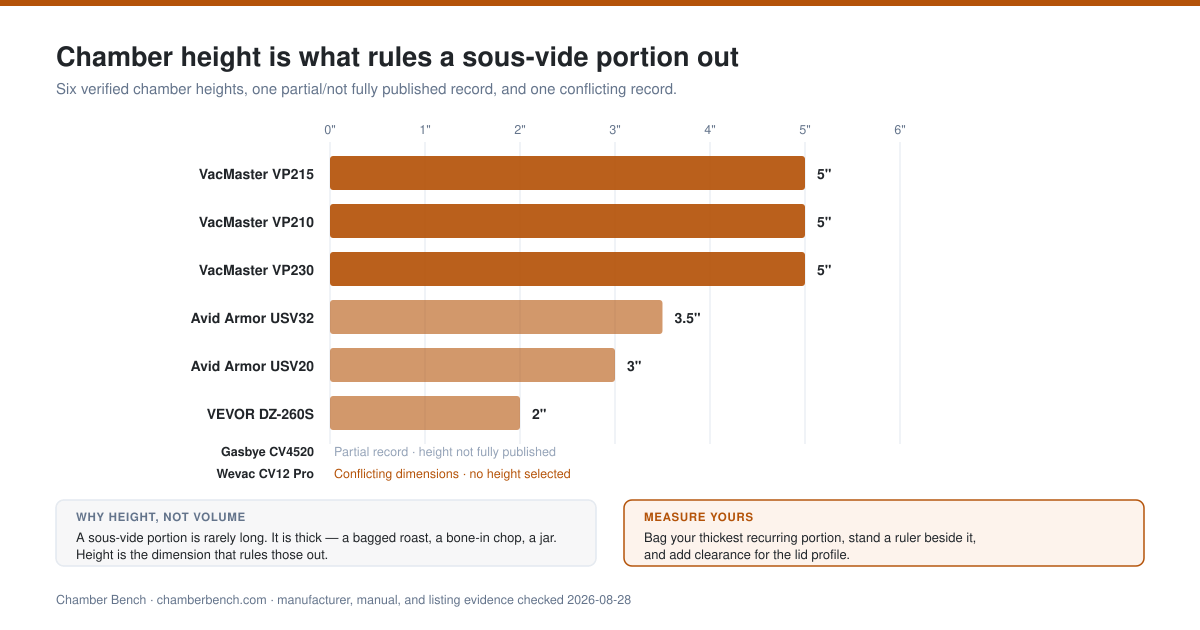
Portion geometry settles most of the remaining argument, and one published number does the work. Anova publishes the interior of the Precision Chamber Vacuum Sealer as '305W x 220D x 75H mm | 12 x 8.6 x 3 in.' Lid clearance, not floor area, is the dimension that removes a portion from contention, because the lid has to close on the filled pouch before any other specification matters. The arithmetic belongs to the reader rather than to this site: measure the largest recurring sous-vide portion inside its filled pouch, at its thickest point, and compare that single measurement against the 3 in Anova publishes. Chamber Bench has loaded no chamber and measured no portion, so the comparison on offer here is between a manufacturer's published figure and a measurement the reader takes.
Water displacement is the baseline this comparison runs against, and it uses a bag already in the drawer and no appliance at all. Lowering an open zip-top bag into water until pressure pushes the air out, then closing the seal above the waterline, requires nothing that is not already in the kitchen. A chamber machine changes that arithmetic in exactly two places: it seals under vacuum, meaning the reduced-pressure condition inside the chamber rather than the appliance itself, so a liquid fill does not fight the technique; and it seals a chamber-load on one cycle rather than one bag at a time. Anova describes the first of those two in its own words: 'Equalized pressure within the chamber ensures that the food or liquid being sealed stays wherever you have placed it within the sealer pouch. This is especially useful when sealing fish, soups, foods in marinades, and more.' Both are throughput and liquid-handling arguments. Neither is a cooking argument. The bag itself is a separate question again, because SC Johnson states that its polyethylene Ziploc bags 'should not be used for sous vide cooking,' so the displacement route inherits a pouch-selection problem that the chamber route does not escape either.
Do I need a chamber vacuum sealer for sous vide?
Sous vide does not require a chamber vacuum sealer. Water displacement uses a bag already in the drawer and no appliance, and it closes one bag at a time. A chamber machine earns the counter space when marinades and sauces go into the bag as a matter of routine, or when one session produces many portions; both are packaging problems, not cooking ones. Chamber Bench has run no comparison between the two routes and publishes no outcome for either one. The harder question for either route is the pouch, because pouch makers publish temperature ceilings that do not agree with each other and, in one case, do not agree with themselves.
Scroll horizontally to see every column.
| Your pattern | What the chamber mechanism changes, per the published description | Alternative to consider |
|---|---|---|
| Frequent wet marinades or sauces | Equalized chamber pressure, which Anova describes as keeping the food or liquid 'wherever you have placed it within the sealer pouch' | Displacement with a pouch whose maker publishes a ceiling above the bath temperature in use |
| Many repeated portions | Seals a chamber-load on one cycle rather than one bag at a time; the load is bounded by the published interior, 12 x 8.6 x 3 in on the Anova machine | External sealer, if textured-bag economics and liquid control are acceptable |
| Occasional dry portions | Nothing that a hand-closed or externally sealed bag does not already do for a dry portion | External sealer, or a zipper and displacement workflow with a pouch carrying a published ceiling above the bath in use |
| Large roasts or long cuts | Nothing, once the filled pouch exceeds the published interior; Anova publishes 3 in of lid clearance | External bags, which are not constrained by a chamber envelope |
Source basis[1] Anova Culinary: Anova Precision Chamber Vacuum Sealer · [8] SC Johnson (Ziploc)
Vacuum level is not doneness, and not a safety control
The sealer packages the food; the cooking process controls time and temperature. A stronger-looking vacuum does not establish pasteurization, safe cooling, or safe storage. Perishable sealed food still needs disciplined refrigeration or freezing before and after cooking, following current food-safety guidance and the recipe or process you trust.
USDA FSIS publishes safe minimum internal temperatures that no sealer touches: 145 degrees F for beef, pork, veal and lamb steaks, chops and roasts with at least a three-minute rest; 160 degrees F for ground meats; 165 degrees F for all poultry; and 145 degrees F for fish and shellfish. FSIS publishes those as instantaneous minimums rather than as sous-vide time-temperature guidance, and several of them sit above bath settings that sous-vide cooks commonly use. That mismatch is exactly why the cooking method belongs to a validated time-temperature process and not to the packaging step, and why the sealer cannot be measured against any of those four numbers.
Low-oxygen packaging changes storage microbiology, not the cook. USDA FSIS states that 'some pathogenic bacteria, such as Clostridium botulinum which causes the deadly botulism poisoning, prefer low-oxygen environments and reproduce well in vacuum-packaged foods,' and sets the cold chain accordingly: 'perishable foods must be kept either in the refrigerator at or below 40 °F, or in the freezer at 0 °F.' The same FSIS page states that vacuum packaging 'is not a substitute for safely processing perishable foods to be stored at room temperature, such as canning or dehydrating.' A chamber machine makes the low-oxygen condition more complete, which argues for more refrigeration discipline rather than less.
One storage figure is routinely misapplied here, and it belongs to a different product. FSIS writes that 'Sous Vide products must be kept refrigerated but can be stored for 3 to 4 weeks. To serve, you simply heat the bag in boiling water.' The surrounding text applies that window to commercially processed sous-vide products, not to a pouch sealed on a home counter. Chamber Bench does not transfer the three-to-four-week figure to home packaging, because the source it comes from does not.
One published vacuum figure sits in this page's ledger, and its publisher attaches it to no cooking outcome. Anova's specifications block for the Precision Chamber Vacuum Sealer prints a row labeled 'Pressure' whose value reads "'-0.95bar" — quoted exactly, including the stray leading apostrophe the page carries — alongside 'Pump 70L/min 12VDC No maintenance dry pump.' Neither figure is tied, on that page or on any other page surveyed here, to a doneness result, a pasteurization outcome, or a pouch temperature. A pressure specification describes what a pump reaches inside a chamber. It does not describe what happens to the food, and no manufacturer surveyed publishes a claim that it does.
Does a stronger vacuum cook food better?
Vacuum level has no bearing on doneness or pasteurization. The bath's time and temperature control the cook; the sealer's only job is a package that stays closed and holds the food against the water. Anova publishes a chamber pressure specification for its Precision Chamber Vacuum Sealer, printed as "'-0.95bar", and attaches it to no cooking outcome anywhere on that page. Chamber Bench has measured no vacuum on any machine, so every vacuum figure on this site is one a manufacturer published, and none of them is connected by its publisher to how the food turns out.
Source basis[1] Anova Culinary: Anova Precision Chamber Vacuum Sealer · [3] USDA Food Safety and Inspection Service (askFSIS) · [4] USDA Food Safety and Inspection Service: Shelf-Stable Food Safety · [24] USDA Food Safety and Inspection Service: Safe Minimum Internal Temperature Chart
Published pouch temperature ceilings, laid side by side
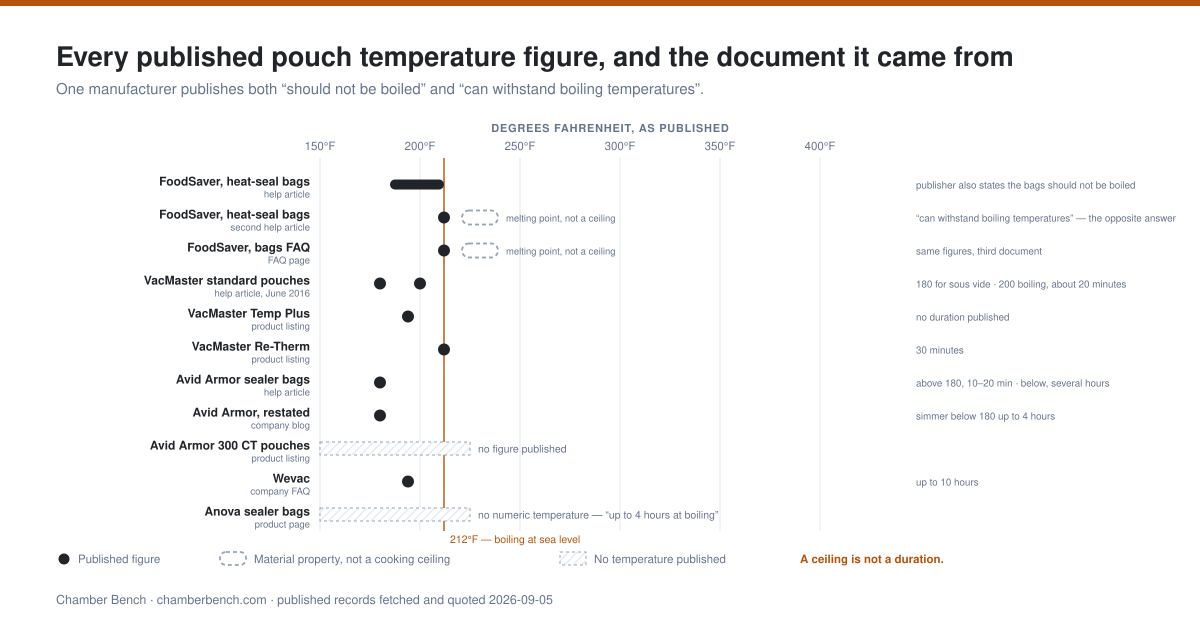
Pouch temperature figures published by the makers below do not agree, and the disagreement is the finding. VacMaster publishes four different numbers across three of its own pouch lines. VacMaster and Wevac publish the identical 194 degrees F ceiling with entirely different companion language. FoodSaver publishes two opposite answers to a single question, across three documents. Two chamber-pouch listings publish no temperature figure at all. Chamber Bench reports each figure as the ceiling or restriction its publisher states, names the document it appears in, and converts no ceiling into a duration promise of its own.
Read the table by publisher and by document, not by number alone. A figure printed in a help-center article, a figure printed on a company blog, and a figure printed on the product listing a buyer adds to cart are three different disclosures with three different lifespans. Several of the records below carry no date whatsoever, one is dated 2016, and one editorial figure is dated 2018 and has not been revised since.
What temperature can chamber vacuum pouches handle?
Chamber vacuum pouch temperatures are published by their makers and do not agree. VacMaster publishes 'Safe for cooking up to 194° F / 90° C' for Temp Plus pouches, '212° F for 30 minutes' for Re-Therm pouches, and for standard chamber pouches describes boiling at '200°F or higher' as survivable 'on average 20 minutes' while calling those pouches sufficient below 180°F for sous vide. Wevac publishes 194 degrees F. Avid Armor publishes a 180 degrees F threshold in its help center but no figure on its chamber pouch listing, and Anova publishes no temperature figure at all for its chamber pouches. Each figure above is the publisher's own stated ceiling or restriction.
Why do two pouches with the same 194 degrees F ceiling carry different time language?
VacMaster Temp Plus and Wevac pouches both publish a 194 degrees F (90 degrees C) ceiling, and the agreement ends there. Wevac's FAQ attaches 'for up to 10 hours' to that ceiling; VacMaster's Temp Plus listing attaches no duration at all. Neither publisher publishes a test method, a burst pressure, or a delamination temperature behind its figure. The gap between a ten-hour claim and no stated duration cannot be resolved from the published record, and Chamber Bench does not resolve it by inference.
Scroll horizontally to see every column.
| Publisher and pouch line | Published figure, as worded | Document it appears in |
|---|---|---|
| FoodSaver, regular heat-seal bags | "should not be boiled as this may jeopardize the seal"; "safe to use in simmering temperatures, with a range around 185°F to 212°F" | Help-center article, 'Can FoodSaver bags be boiled? What is the temperature limit?', undated |
| FoodSaver, regular heat-seal bags | "can withstand boiling temperatures"; "we do not recommend exceeding 212°F (100°C)"; melting point "roughly between 221°F (105°C) and 239°F (115°C)" | Help-center article, 'Can FoodSaver® Bags be boiled?', undated |
| FoodSaver, regular heat-seal bags, the same answer restated | "we do not recommend exceeding 212°F. The melting point is roughly between 221 and 239°F." The Celsius conversions carried by the previous row are absent from this document. | Bags FAQ, undated, printed under the first article's exact question heading |
| VacMaster standard chamber pouches, 3-, 4- and 5-mil | "Boiling (200°F or higher) - typically the pouch will survive the rigors of the higher temps for (on average) 20 minutes"; for sous vide, standard pouches described as sufficient "below 180°F" | Help-center article dated June 20, 2016 |
| VacMaster Temp Plus chamber pouches | "Safe for cooking up to 194° F / 90° C"; no duration published | Product listing |
| VacMaster Re-Therm chamber pouches | "(100° C) 212° F for 30 minutes" | Product listing |
| Avid Armor vacuum sealer bags | "For temperatures above 180 degrees F, we suggest only 10-20 minutes. For temperatures below, you can cook in them for several hours" | Help-center article, marked updated seven months ago |
| Avid Armor, same threshold restated by method | "Simmer: Safe to cook at low temperatures (below 180 degrees F) for up to 4 hours"; "Boil: Safe to cook at high temperatures (above 180 degrees F) for up to 20 minutes"; "Microwave: Safe to cook when bag is punctured up to 10 minutes" | Company blog post |
| Avid Armor 300 CT chamber pouches for USV32 | No temperature figure published; the listing states only that the pouches are "safe to microwave, boil, simmer, or use for sous vide recipes" | Product listing |
| Wevac | "Safe for sous vide cooking at temperatures up to 194°F (90°C) for up to 10 hours" | Company FAQ page |
| Anova Precision vacuum sealer bags, edge sealer | "safe cooking up to 4 hours at boiling temperatures" | Product page |
| Anova Precision chamber vacuum sealer pouches | No temperature figure published on the listing or in its specifications block | Product page |
| SC Johnson, polyethylene Ziploc bags | "should not be used for sous vide cooking (boiling in water) as the softening point is 230°F and boiling point for water is 212°F" | Ziploc FAQ |
| SC Johnson, Ziploc Endurables silicone | "can withstand extreme temperatures, up to 425°F" | Ziploc FAQ |
| Bon Appetit, editorial | "you shouldn't use a single Ziploc bag when cooking in water temperatures above 158°F" | Feature article published 2018-02-14 |
Source basis[5] FoodSaver (help.foodsaver.com): Can FoodSaver bags be boiled? What is the temperature limit? · [6] FoodSaver (help.foodsaver.com): Can FoodSaver® Bags be boiled? · [7] FoodSaver (help.foodsaver.com): FoodSaver® Bags FAQ · [8] SC Johnson (Ziploc) · [10] Bon Appetit (Conde Nast) · [15] VacMaster Help Center · [16] VacMaster (vacmasterfresh.com): 12" x 15" Temp Plus Vacuum Chamber Pouches 3-Mil 100/Pack · [17] VacMaster (vacmasterfresh.com): 12" X 16" Re-Therm Vacuum Chamber Pouches 4-Mil 500/Box · [18] Avid Armor (avid-armor.gorgias.help) · [19] Avid Armor (avidarmor.com): Cooking in Vacuum Sealed Plastic Bags · [20] Avid Armor (avidarmor.com): 300 CT Assorted Pack Chamber Vacuum Pouches for USV32 · [21] Wevac (wevactech.com) · [22] Anova Culinary: Anova Precision™ Vacuum Sealer Bags · [23] Anova Culinary: Anova Precision™ Chamber Vacuum Sealer Pouches
FoodSaver's help center answers the boiling question both ways
FoodSaver publishes two opposite answers to the boiling question, and both were live on 2026-09-05. One help-center article, titled 'Can FoodSaver bags be boiled? What is the temperature limit?', states: 'FoodSaver® Bags should not be boiled as this may jeopardize the seal. However, they are safe to use in simmering temperatures, with a range around 185°F to 212°F. Do not use zipper bags which are not marked as Reusable for cooking.' The same article routes buyers to a different product for boiling: 'We recommend using our specialty Sous Vide Vacuum Sealing Bags for cooking in boiling temperatures, as they are specifically designed to withstand the heat.'
A second FoodSaver article, 'Can FoodSaver® Bags be boiled?', states the reverse: 'Regular FoodSaver® Bags can withstand boiling temperatures, which makes them perfect for Sous Vide cooking. However, we do not recommend exceeding 212°F (100°C). The melting point is roughly between 221°F (105°C) and 239°F (115°C).' FoodSaver's consolidated Bags FAQ repeats that second answer in substance and prints it under the first article's exact question heading, but not in identical words: the FAQ's version reads 'we do not recommend exceeding 212°F. The melting point is roughly between 221 and 239°F.', dropping the Celsius conversions the article carries. The Fahrenheit figures match across the two documents; the metric ones exist in one and not the other. The tally inside one help center is therefore two live pages saying the bags can be boiled and one saying they should not be.
Neither article carries a publication date or a revision date. No published basis exists for deciding which answer is current or which supersedes the other, so Chamber Bench names both and picks neither. The 221 to 239 degrees F range in the second article also deserves precise reading: FoodSaver publishes it as a melting point, which is a material property of the film, not a cooking ceiling and not a duration. A reader who treats a melting point as a cooking allowance has changed what the record says.
USDA FSIS describes the opposite practice for a different product, and that difference is the answer rather than a further conflict. Writing about commercially processed sous-vide products, FSIS states: 'Sous Vide products must be kept refrigerated but can be stored for 3 to 4 weeks. To serve, you simply heat the bag in boiling water.' A commercially processed sous-vide pouch and a consumer heat-seal bag are not the same package. A reader who takes the FSIS sentence as permission for a FoodSaver bag has crossed between two records that were never describing the same thing, and the pouch maker's own document is the one that governs the pouch in hand.
SC Johnson adds a third position for the zip-top route, and publishes its reasoning as a margin. The Ziploc FAQ states that polyethylene Ziploc bags 'should not be used for sous vide cooking (boiling in water) as the softening point is 230°F and boiling point for water is 212°F.' Stated as arithmetic on the maker's own two numbers, that is 18 degrees F between the film's softening point and a rolling boil, and the conclusion SC Johnson publishes on that margin is a prohibition. The same FAQ names the one line it does endorse: 'The only Ziploc® brand bags that should be used for sous vide cooking are Ziploc Endurables®. These bags are made with durable and reusable platinum silicone which can withstand extreme temperatures, up to 425°F.' Chamber Bench reports both figures and the conclusion as published, and does not substitute a judgment of its own about whether 18 degrees F is adequate headroom.
The zip-top record disagrees across publishers as sharply as the pouch record does. America's Test Kitchen, in a 2018 piece last modified 2018-06-25, concluded that 'after reviewing the considerable amount of research that's been done, we believe the answer is: It's safe,' and named 'Ziploc Brand Freezer Bag with Easy Open Tabs' as its top pick for sous vide. That is the exact product family SC Johnson now says not to use for sous vide. Bon Appetit publishes a third figure again, writing that 'you shouldn't use a single Ziploc bag when cooking in water temperatures above 158°F because the heat can cause the bag to open at the seams.' A blanket prohibition from the manufacturer, a top pick from a test kitchen, and a 158 degrees F editorial limit are three live positions about one bag, and no published test method sits behind any of them.
Can you boil vacuum sealer bags?
Vacuum sealer bag makers do not agree on boiling. FoodSaver's help center publishes both 'FoodSaver® Bags should not be boiled as this may jeopardize the seal' and 'Regular FoodSaver® Bags can withstand boiling temperatures' on separate live pages, neither dated. VacMaster describes boiling at 200 degrees F or higher as survivable 'on average 20 minutes' for standard chamber pouches and directs longer boils to its Re-Therm line. SC Johnson states its polyethylene Ziploc bags 'should not be used for sous vide cooking.' The governing record is the specific pouch's own published document, not a general rule about plastic.
Does a published ceiling mean the pouch was tested at that temperature?
Manufacturer pouch ceilings are published without test methods. No maker surveyed on this page publishes a burst pressure, a seal-integrity figure, a delamination temperature, or a procedure behind its stated ceiling. VacMaster declines to stand behind its own guideline in writing: 'we strongly suggest that users "test" the pouch(es) first before entering production. With many variables of heat, time, weight, contents, etc… it is always best to test / develop recipe before finalizing production.' The published ceilings are manufacturer assertions, and Chamber Bench treats them as assertions rather than as measurements.
Source basis[4] USDA Food Safety and Inspection Service: Shelf-Stable Food Safety · [5] FoodSaver (help.foodsaver.com): Can FoodSaver bags be boiled? What is the temperature limit? · [6] FoodSaver (help.foodsaver.com): Can FoodSaver® Bags be boiled? · [7] FoodSaver (help.foodsaver.com): FoodSaver® Bags FAQ · [8] SC Johnson (Ziploc) · [9] America's Test Kitchen / Cook's Illustrated · [10] Bon Appetit (Conde Nast) · [15] VacMaster Help Center
What food safe and FDA-approved state about a pouch
Two federal regulations cover the resins in a sous-vide pouch, and both resolve live on eCFR. 21 CFR 177.1500 covers nylon resins and states that 'the nylon resins listed in paragraph (a) of this section may be safely used to produce articles intended for use in processing, handling, and packaging food, subject to the provisions of this section.' 21 CFR 177.1520 covers olefin polymers, including polyethylene and polypropylene, stating that they 'may be safely used as articles or components of articles intended for use in contact with food, subject to the provisions of this section.' FoodSaver publishes its own bags as 'made of polyethylene and nylon for added strength and rigidity,' which is precisely the two-resin pairing those two sections govern. America's Test Kitchen described the same construction in 2018: 'The bags made by the manufacturer FoodSaver for use with its vacuum sealers use plasticizer-free polyethylene with a layer of nylon on the outside.'
The clearances inside those sections are condition-bound rather than blanket, and the conditions are temperatures. 21 CFR 177.1500 clears one grade 'for use only in articles intended for repeated use in contact with food at temperatures not to exceed 212 °F' — that entry is for nylon 612 resins, and 212 °F there is a ceiling written into the regulation, not a performance promise made about any finished pouch. A second entry, impact modified Nylon MXD-6 used as a modifier in nylon 6 film, clears the finished film only 'at temperatures not to exceed 49 °C (120 °F).' A third, nylon resins PA 6-3-T, carries 'a hot-fill temperature limitation of 40 °C.' The nylon 12 entry is the one most often quoted out of context, and it has to be read to its end: it clears the resin 'In food-contact films having an average thickness not to exceed 0.0016 inch intended for use in contact with nonalcoholic food under the conditions of use A (sterilization not to exceed 30 minutes at a temperature not to exceed 250 °F), and B through H of table 2 of § 176.170(c) of this chapter, except as provided in § 177.1390(d).' The clearance runs across conditions A through H; the parenthetical only defines what condition A is. Cutting the sentence at the parenthesis turns an A-through-H clearance into an A-only restriction, and reading the parenthetical forwards — as though it promised that a pouch is good for thirty minutes at 250 degrees F — inverts a regulatory maximum into a performance claim. 21 CFR 177.1520 works on the same pattern, limiting one listed grade to 'flexible packaging, in contact with food at temperatures not exceeding 49 °C (120 °F).'
The lettered conditions of use that both sections point to are published in table 2 of 21 CFR 176.170, and sous vide is not named among them. The table runs 'A. High temperature heat-sterilized (e.g., over 212 °F)', 'B. Boiling water sterilized', 'C. Hot filled or pasteurized above 150 °F', 'D. Hot filled or pasteurized below 150 °F', 'E. Room temperature filled and stored (no thermal treatment in the container)', 'F. Refrigerated storage (no thermal treatment in the container)', 'G. Frozen storage (no thermal treatment in the container)', and 'H. Frozen or refrigerated storage: Ready-prepared foods intended to be reheated in container at time of use'. Condition H deserves naming rather than being folded into a summary of the back half of the table, because it is the single entry describing food heated inside its own package, and the regulation's test condition for its aqueous case is '212 °F, 30 min'. That is the closest regulatory analogue to a sous-vide pouch anywhere in the framework. It still does not say sous vide, and what it does describe — a ready-prepared food reheated in its container out of frozen or refrigerated storage — is not a raw portion held for hours in a bath. PPRC, reviewing this framework for sous vide specifically, could say only that Use D 'may be most applicable ... although Use C could also be applicable when SV bath temperatures are above 150 dF,' and noted that the FDA's migration-testing guidance 'refers to "boil-in bags" but does not specifically refer to materials used in SV cooking.' No regulator has assigned sous vide a condition letter of its own. That is why a bare compliance badge carries no temperature information: a reader cannot tell from it which lettered condition, if any, the pouch in hand was cleared against.
'FDA-approved' is a phrase the record does not support when applied to a finished pouch, and three publishers in this page's ledger print it anyway. PPRC states plainly: 'The FDA does not "approve products" containing any of the regulated polymers; it only regulates use of individual polymers and additives in food contact materials per the Inventory (above) and/or appropriate CFRs.' PPRC calls the phrase 'a misnomer.' The FDA uses the language of authorization instead: food contact substances 'must be authorized through either a food contact notification or a food additive regulation, or be the subject of a Threshold of Regulation exemption,' and that review 'includes analyzing testing data that demonstrates the amount of migration of a food contact substance to food because of its intended use, and toxicological data to ensure that the consumer exposure resulting from this migration is safe.' Anova prints 'FDA-approved and BPA-free' on its edge-sealer bag page. VacMaster prints 'BPA-free and FDA approved, they are transparent' in the description on its Re-Therm chamber pouch listing. Avid Armor prints 'Made with BPA-free, FDA-approved food-grade materials' on its 300 CT chamber pouch listing for the USV32. PPRC recorded a supplier using the identical construction more than a decade ago: 'Our material is FDA-approved, BPA and phthalate free.' Naming one of the three would understate a pattern this page's own ledger documents three times over.
One of those three listings disagrees with itself on a single screen. The VacMaster Re-Therm page's description text reads 'BPA-free and FDA approved, they are transparent, allowing for easy identification of the product.' The structured attribute table further down the same page publishes a row reading 'FDA Approved | No'. Both were live on 2026-09-05, and Chamber Bench does not decide which half of that page is correct. Neither half is a temperature figure in any case: whichever way the row is read, it says nothing about what the pouch does at a bath temperature, which is the specification a sous-vide cook actually needs and the one the badge is routinely mistaken for.
'BPA-free' on a pouch answers a question the pouch never posed. The FDA states that BPA 'is a structural component in polycarbonate beverage bottles' and 'a component in metal can coatings, which protect the food from directly contacting metal surfaces,' both rigid materials rather than the film a pouch is made from. PPRC states it directly: 'BPA should not be found in film products, as the compound is used in rigid (#7) plastics.' The FDA's published position for the applications where BPA is actually used is that 'BPA is safe at the current levels occurring in foods' and that 'the available information continues to support the safety of BPA for the currently approved uses in food containers and packaging.' That second clause is the agency itself using the word approved about a use, in the same document this section leans on to separate authorization from approval, and it is quoted here rather than left out. The page carries its own dateline as a series — January 2010; March 30, 2012; Updated March 2013; July 2014; November 2014 — so it is a position last substantively updated in November 2014 and still live, and this page attaches that date to it exactly as it does for every other undated source. The same page records that removing BPA from baby bottles, sippy cups, and infant-formula packaging was an abandonment action: 'an amendment of the food additive regulations based on abandonment is not based on safety.' A regulatory change frequently cited as proof that BPA was found unsafe was, per the agency itself, nothing of the kind.
Are vacuum sealer bags safe?
Vacuum sealer bags in the sous-vide category are typically polyethylene and nylon, and both resins are cleared for food contact under 21 CFR 177.1520 and 21 CFR 177.1500 respectively. Those clearances are condition-bound: nylon 612 is cleared only 'at temperatures not to exceed 212 °F,' one modifier grade only at 49 °C (120 °F), and nylon 12 film only under 'conditions of use A ... and B through H of table 2 of § 176.170(c).' That lettered table names no condition for sous vide; its closest analogue, condition H, covers ready-prepared foods reheated in the container and is tested at 212 °F for 30 minutes. The regulations establish that the resins are authorized for food contact under stated conditions. They do not establish that any particular finished pouch was evaluated at a sous-vide bath temperature.
Does FDA-approved on a pouch package mean anything?
'FDA-approved' applied to a finished pouch is not an FDA category. PPRC states plainly: 'The FDA does not "approve products" containing any of the regulated polymers; it only regulates use of individual polymers and additives in food contact materials per the Inventory (above) and/or appropriate CFRs.' The same report calls the phrase a misnomer. The FDA describes food contact substances as authorized through a food contact notification, a food additive regulation, or a Threshold of Regulation exemption. Three listings in this page's ledger print the construction regardless: Anova's 'FDA-approved and BPA-free', VacMaster Re-Therm's 'BPA-free and FDA approved', and Avid Armor's 'Made with BPA-free, FDA-approved food-grade materials'. The VacMaster page's own attribute table separately publishes 'FDA Approved | No'. None of that wording carries a temperature or a duration.
Source basis[7] FoodSaver (help.foodsaver.com): FoodSaver® Bags FAQ · [9] America's Test Kitchen / Cook's Illustrated · [11] Pacific Northwest Pollution Prevention Resource Center (PPRC) · [12] U.S. Food and Drug Administration, via eCFR (Office of the Federal Register): 21 CFR 177.1500 -- Nylon resins. · [13] U.S. Food and Drug Administration, via eCFR (Office of the Federal Register): 21 CFR 177.1520 -- Olefin polymers. · [14] U.S. Food and Drug Administration, via eCFR (Office of the Federal Register): 21 CFR 176.170 -- Components of paper and paperboard in contact with aqueous and fatty foods. · [17] VacMaster (vacmasterfresh.com): 12" X 16" Re-Therm Vacuum Chamber Pouches 4-Mil 500/Box · [20] Avid Armor (avidarmor.com): 300 CT Assorted Pack Chamber Vacuum Pouches for USV32 · [22] Anova Culinary: Anova Precision™ Vacuum Sealer Bags · [27] U.S. Food and Drug Administration: Understanding How the FDA Regulates Substances that Come into Contact with Food · [28] U.S. Food and Drug Administration: Bisphenol A (BPA): Use in Food Contact Application
Chemical migration under sous-vide conditions is not a closed record
The 'no studies exist' line that dominates the search results for this question traces to two documents, both old, and both of them say more than the line quotes. A 2013 Pacific Northwest Pollution Prevention Resource Center rapid-response report states in its conclusions that 'no studies were found in the literature evaluating migration of chemical additives from plastics in simulated SV conditions,' and states elsewhere that the question 'is unable to be confirmed due to lack of data and studies on migration of chemicals from plastics in simulated SV cooking conditions (e.g., 120 to 180 dF for an hour or more).' The same conclusions list carries two bullets that are almost never quoted alongside it. One reads: 'For heated plastics in contact with food, several studies have shown migrated contaminants or additives that would be present in or on the contacted food. The amount or potency is unknown and dependent on many variables.' The other reads: 'Testing (Yang et al, Barkby et al, Soto-Valdez et al) has shown migration of plastic additives from various "food wrap" plastics, including additives that have estrogenic or hormonal affects.' PPRC's actual finding is therefore narrower and sharper than the summary it gets reduced to: no sous-vide-specific migration study existed in 2013, while adjacent evidence of additive migration from heated food-contact film did. A fourth bullet bounds both halves: 'Available study results provide information on the chemicals that migrate from the plastic, but have not provided any toxicity or health impacts.' Bon Appetit repeated only the narrow half in 2018: 'There currently aren't any published studies specifically focused on the migration of chemicals in sous vide conditions, so you should sous vide only if you're comfortable with the gray area surrounding the effect of chemicals in non-BPA plastics.' That piece carries a modified date of 2018-02-14 and has not been revised since. America's Test Kitchen, working the same period, reached the opposite posture: 'After reviewing the considerable amount of research that's been done, we believe the answer is: It's safe.'
At least one directly relevant study has been published since, and it has to be reported with the parts that cut in both directions. LWT volume 250, article 119455, published online 2026-05-05 with an issue date of 2026-06-15 and DOI 10.1016/j.lwt.2026.119455, measured microplastic content and phthalate profile in packaged salmon cooked sous vide at 45, 65, 72 and 80 degrees C 'for an equal duration (30 min).' The reported peak sat in the hottest oiled group: 'The highest MP content was detected in the group marinated with olive oil (OO) and subjected to high heat-treatment (80+OO) at 0.50 ± 0.17 MP/g.' The same abstract ranks the phthalates it found: 'In the So-Vd application groups, the top three phthalate esters at the highest level are DBP, DEHP, and BBP, respectively, while the lowest are DPENP < DNCH < DHEXP = DINP.' It also states that 'the levels of 10 ester derivatives, determined in varying amounts, were below the individual LOQ.' Those two sentences sit next to each other in one abstract; the abstract does not reconcile them, and Chamber Bench read the abstract and the highlights rather than the full text, so it does not reconcile them either. The paper's published highlights state the authors' own framing without ambiguity: 'Sous-vide cooking can promote microplastic release from vacuum packaging'; 'Higher temperatures increased microplastic abundance in packaged salmon'; 'Oil-based marinades enhanced the migration potential of plastic additives'; 'DBP and DEHP were the most dominant phthalates detected in the samples'; and 'Findings highlight potential food safety risks of plastic–food interactions.' That last line is the authors' conclusion, and this page reports it as theirs rather than replacing it with a milder one of its own.
That study also cannot be attached to any pouch this site covers. The publisher's abstract and highlights name no pouch brand and do not state whether a chamber sealer or an edge sealer produced the packages. No study located here isolates migration from a chamber-sealed pouch specifically, and none of the four temperatures in the study design is presented by its authors as a limit for any commercial pouch line. Reporting the study accurately means reporting three things together: its measured figure, its authors' stated conclusion, and the boundary of what it can be applied to.
The FDA's published position is a statement about the state of evidence rather than a verdict on the underlying science. The agency states that 'current scientific evidence does not demonstrate that levels of microplastics or nanoplastics detected in foods pose a risk to human health' and that 'there is not sufficient scientific evidence to show that microplastics and nanoplastics from plastic food packaging migrate into foods and beverages.' It explains the constraint in the same document: 'Because there are no standardized methods for how to detect, quantify, or characterize microplastics and nanoplastics, many of the scientific studies have used methods of variable, questionable, and/or limited accuracy and specificity,' and it concludes that 'more research is needed before the agency can assess potential effects of microplastics and nanoplastics on human health.'
Chamber Bench does not resolve this question, because the published records do not resolve it, and they now point in more than one direction at once. The 2013 report the popular summary rests on found no sous-vide-specific study while separately reporting adjacent migration evidence from heated food wrap. A 2026 peer-reviewed paper reports measured microplastic content rising with temperature and publishes 'potential food safety risks' as its own conclusion. The regulator states that the evidence does not demonstrate a risk and that the measurement methods are not standardized. Those three positions are not one position, and none of them is a health verdict about a pouch a reader owns. A buyer who wants the plastic question closed before cooking will not get closure from the published record. The honest sequence is to read what each publisher actually wrote, note that a 2013 finding of no studies is no longer literally current, and decide with the uncertainty visible rather than hidden behind a compliance badge.
Is sous vide plastic safe?
Sous-vide plastic safety is not settled in the published record. Five records hold four distinct positions. PPRC in 2013 found no studies of chemical migration under simulated sous-vide conditions while separately reporting adjacent evidence of additive migration from heated food wrap. Bon Appetit repeated the narrow half of that in 2018 and has not revised the piece. America's Test Kitchen concluded in 2018 that 'It's safe.' A 2026 study in LWT measured microplastics in sous-vide salmon, ranked DBP, DEHP and BBP as the phthalates it found at the highest levels, and published the conclusion that its findings 'highlight potential food safety risks of plastic–food interactions.' The FDA's published position is that current evidence does not demonstrate a risk and that more research is needed. None of those five records closes the question.
Do sous vide bags put microplastics in my food?
Microplastic migration from sous-vide packaging has no settled published answer. The FDA states that 'there is not sufficient scientific evidence to show that microplastics and nanoplastics from plastic food packaging migrate into foods and beverages,' which is a statement about the evidence rather than a finding that migration does not occur. A 2026 study in LWT reported 0.50 ± 0.17 microplastic particles per gram in salmon cooked sous vide at 80 degrees C in olive oil, and published as a highlight that 'sous-vide cooking can promote microplastic release from vacuum packaging,' without naming a pouch brand or a sealer type. The FDA also states that no standardized detection methods exist, which is the stated reason it declines to assess health effects.
Source basis[9] America's Test Kitchen / Cook's Illustrated · [10] Bon Appetit (Conde Nast) · [11] Pacific Northwest Pollution Prevention Resource Center (PPRC) · [25] U.S. Food and Drug Administration: Microplastics and Nanoplastics in Foods · [26] LWT (Elsevier / Academic Press), volume 250, article 119455
Where the pouch figure is published, and where a buyer will not find it
The temperature ceiling tends not to live where the purchase happens. Avid Armor publishes a 180 degrees F threshold in its help center and restates it on its blog, but its 300 CT assorted chamber pouch listing for the USV32 publishes no numeric temperature, stating only that the pouches are 'safe to microwave, boil, simmer, or use for sous vide recipes, giving you flexible options for preparing and storing food.' A scan of that fetched listing returned no Fahrenheit or Celsius figure anywhere on the page; what it does publish in that slot is a compliance sentence, 'Made with BPA-free, FDA-approved food-grade materials.' Avid Armor therefore has a published rating; a buyer reading only the product listing does not see it, and sees a badge in its place.
Anova draws the same line between two of its own products, and draws it harder. Its edge-sealer bag page publishes 'safe cooking up to 4 hours at boiling temperatures,' together with a construction disclosure most makers omit: '2 layers LDPE plastics with 1% prodegradant additive & 1 layer PA/Nylon BPA free.' Its chamber pouch page publishes 'Food-safe and free from harmful BPA plastics' plus a single dimension line, 'Product Dimensions 280mm x 250mm | 11.0 x 9.8 in,' and no temperature figure appears on the listing or in its specifications block. The edge bags carry a boiling-temperature claim; the chamber pouches carry none. Chamber Bench does not transfer the edge-bag figure to the chamber pouch, and neither does Anova.
Machine specifications carry the same disclosure problem inside one brand, and the shape of the gap is not what a reader would guess. Anova's product page for the Precision Chamber Vacuum Sealer publishes a specifications row labeled 'Volume' whose value is not a volume: it reads 'Chamber Dimensions 305W x 220D x 75H mm | 12 x 8.6 x 3 in.' No chamber volume in liters appears anywhere on that page; the only liter figure the page carries is the pump flow rate, 'Pump 70L/min'. Anova's own support FAQ does publish one for the same machine, 'Vacuum chamber volume (in liters): 4 liters,' and both documents were live on 2026-09-05. Multiplying the product page's own three chamber dimensions as a rectangular solid — 305 × 220 × 75 mm — gives 5.03 liters, above the 4 liters the support FAQ publishes; a real chamber is not a perfect box, and neither Anova document explains the difference or acknowledges that the other figure exists. Chamber Bench names the published liter figure, names the arithmetic that follows from Anova's own published dimensions, and resolves the two into no single number. The same support FAQ publishes 'Max. sealable width mm: 30mm (11.8in' — quoted exactly, including the unclosed parenthesis — while the product page publishes 'Seal Bar 300mm | 11.8 in.' 30 mm is not 11.8 in; 300 mm is. The product page's pressure row is printed as "'-0.95bar", carrying a stray leading apostrophe. These are published-record errors rather than machine faults, and together they are the reason this page runs its capacity arithmetic on the interior linear dimensions the product page publishes, rather than on a volume figure, which appears in the support FAQ and nowhere on the page a buyer reads before adding the machine to cart.
Supplier disclosure was already documented as thin more than a decade ago. PPRC recorded that 'SV packaging suppliers have not been transparent about the additives found in their products. Also, no specifications or MSDS' have been provided by manufacturers, or found online. Two manufacturers did disclose that their base resin materials are LDPE or LDPE/nylon layers.' PPRC also noted in the same 2013 report that the FDA inventory 'currently lists 963 different chemicals that can be used in food contact packaging.' That count is dated to 2013 by PPRC's own word 'currently,' and Chamber Bench has not re-counted the live inventory, so the figure is attributed to that report and to that year rather than presented as a present-day total.
One published figure on this page cannot be reconciled at all. FoodSaver publishes its heat-seal bag thickness as 'FoodSaver Bags – Heat-Seal Smooth side: 3 mil thick Textured side: 11.5 mil thick.' That ratio is implausible on its face and reads like a typographical error in the published record, but no corrected figure appears anywhere Chamber Bench could locate. The figure is reported as published, with the site stating that it cannot reconcile it rather than quietly rewriting it into something more plausible.
Where do manufacturers publish pouch temperature ratings?
Pouch temperature ratings usually appear in a help center or a blog post rather than on the product listing. Avid Armor's 180 degrees F threshold appears in its help article and on its blog, while its USV32 chamber pouch listing carries no temperature figure and prints a compliance sentence in its place. VacMaster publishes ceilings on its Temp Plus and Re-Therm listings but routes standard chamber pouch guidance to a help-center article dated June 20, 2016. Anova publishes a boiling-temperature claim on its edge-sealer bag page and none on its chamber pouch page. Check the maker's help center before treating the product listing as the whole record.
- Record which document each figure comes from: product listing, help-center article, company blog, or FAQ.
- Treat an undated help-center page as undated. Both FoodSaver articles on boiling carry no publication and no revision date.
- Check whether a specification row's label matches its value. Anova's product page labels a row 'Volume' and fills it with chamber dimensions.
- FoodSaver classifies its bags as 'number 7: Other plastics' and states 'Unfortunately, they are not recyclable,' which is the catch-all code a multi-layer laminate lands in.
- Anova publishes no chamber-pouch temperature figure at all. Treat that as an unpublished record rather than assuming the edge-bag figure applies.
- No maker surveyed here publishes a test method, a burst pressure, or a delamination temperature behind its stated ceiling.
Source basis[1] Anova Culinary: Anova Precision Chamber Vacuum Sealer · [2] Anova Culinary Support · [7] FoodSaver (help.foodsaver.com): FoodSaver® Bags FAQ · [11] Pacific Northwest Pollution Prevention Resource Center (PPRC) · [15] VacMaster Help Center · [16] VacMaster (vacmasterfresh.com): 12" x 15" Temp Plus Vacuum Chamber Pouches 3-Mil 100/Pack · [17] VacMaster (vacmasterfresh.com): 12" X 16" Re-Therm Vacuum Chamber Pouches 4-Mil 500/Box · [18] Avid Armor (avid-armor.gorgias.help) · [19] Avid Armor (avidarmor.com): Cooking in Vacuum Sealed Plastic Bags · [20] Avid Armor (avidarmor.com): 300 CT Assorted Pack Chamber Vacuum Pouches for USV32 · [22] Anova Culinary: Anova Precision™ Vacuum Sealer Bags · [23] Anova Culinary: Anova Precision™ Chamber Vacuum Sealer Pouches
Build a sous-vide-specific shortlist
Build the shortlist around the filled pouch rather than the machine's headline specification. Lid clearance is the dimension that removes machines from contention. Anova publishes the interior of its Precision Chamber Vacuum Sealer as '305W x 220D x 75H mm | 12 x 8.6 x 3 in,' and 3 in is the number a measured portion gets checked against. Floor area determines how many portions lie side by side on one cycle; height determines whether the thickest recurring portion goes in at all, and no amount of floor area compensates for a lid that will not close on the food. Chamber Bench has loaded no chamber and measured no portion, so both of those checks are arithmetic a reader performs against a published figure, not a fit result reported here.
Batch capacity is portions per cycle, and that arithmetic needs a figure a buyer can trust. Anova publishes chamber dimensions on the product page and a 4-liter chamber volume in its support FAQ, and publishes no volume at all on the page a buyer reads before adding the machine to cart. The linear dimensions are what a bagged portion physically has to fit inside, and a volume figure supplies neither of the two numbers that check needs. Anova publishes its own chamber pouches at '280mm x 250mm | 11.0 x 9.8 in' and the chamber interior at '12 x 8.6 x 3 in', so the comparison a reader runs is between two published dimension sets and the filled pouch on the counter. Four liters describes neither of them, and Chamber Bench has laid no pouch in any chamber to settle it by observation. Run portions-per-cycle on the published width and depth, check the thickest portion against the published height, and treat the liter figure as a specification that exists in the support FAQ and nowhere on the product page.
Settle the pouch before settling the machine. The pouch supplier, not the machine maker, publishes whatever temperature ceiling exists. Across the chamber-pouch and heat-seal records assembled above, the published figures run 180, 185, 194, 200 and 212 degrees F depending on publisher and product line, and two chamber-pouch listings publish no figure whatsoever. The zip-top records widen that spread further, and they are not all the same kind of number: SC Johnson publishes 230 degrees F as the softening point of polyethylene Ziploc bags and draws a prohibition from it rather than a ceiling, publishes 425 degrees F as the ceiling for the silicone Ziploc Endurables line, and Bon Appetit publishes 158 degrees F as an editorial limit for a single zip-top bag. A softening point, a maker's ceiling and an editorial limit are three different kinds of statement, and no publisher named here supplies a test method behind its figure. A shortlist that fixes on a machine before the pouch is decided has answered the easier question first and left the one that actually governs the cook unanswered.
What chamber height do I need for sous-vide portions?
Chamber height, not floor area, is what rules a thick sous-vide portion out. Anova publishes 3 in of interior height for its Precision Chamber Vacuum Sealer, listed as '305W x 220D x 75H mm | 12 x 8.6 x 3 in.' That is the only published interior height among this page's sources, and it is the number a reader checks a measurement against: measure the largest recurring portion inside its filled pouch, at its thickest point, and compare that single figure to 3 in before comparing any other specification. Chamber Bench has measured no portion and publishes no fit result, so the comparison is between the manufacturer's published dimension and the reader's own measurement.
- Measure the largest recurring sous-vide portion inside its filled pouch, then compare that measurement against each machine's published interior height.
- Weigh clean seal control and liquid headroom above novelty presets.
- Compare portions per session against how many filled pouches lie flat on the published chamber floor, using linear dimensions rather than a volume figure.
- Confirm the pouch supplier's published temperature ceiling, note which document it appears in, and check it against the bath temperature actually in use.
- Where a pouch maker publishes no temperature figure, record the absence and the page checked rather than assuming a sibling product's figure carries over.
- Keep a separate cold-storage labeling system for prepared packages, since USDA FSIS treats sous-vide products as refrigerated rather than shelf stable.
Source basis[1] Anova Culinary: Anova Precision Chamber Vacuum Sealer · [2] Anova Culinary Support · [4] USDA Food Safety and Inspection Service: Shelf-Stable Food Safety · [5] FoodSaver (help.foodsaver.com): Can FoodSaver bags be boiled? What is the temperature limit? · [6] FoodSaver (help.foodsaver.com): Can FoodSaver® Bags be boiled? · [8] SC Johnson (Ziploc) · [10] Bon Appetit (Conde Nast) · [15] VacMaster Help Center · [16] VacMaster (vacmasterfresh.com): 12" x 15" Temp Plus Vacuum Chamber Pouches 3-Mil 100/Pack · [17] VacMaster (vacmasterfresh.com): 12" X 16" Re-Therm Vacuum Chamber Pouches 4-Mil 500/Box · [18] Avid Armor (avid-armor.gorgias.help) · [20] Avid Armor (avidarmor.com): 300 CT Assorted Pack Chamber Vacuum Pouches for USV32 · [21] Wevac (wevactech.com) · [23] Anova Culinary: Anova Precision™ Chamber Vacuum Sealer Pouches
Audit the sous-vide workflow before buying another appliance
Track actual prep sessions before assigning value to a chamber machine. For each package, record whether the food is wet or dry, the filled pouch dimensions, the current packaging method, the problem that occurred, the number of portions, and the refrigeration or freezing handoff. The audit should distinguish a recurring chamber-shaped problem from a technique or fit problem that another machine will not solve.
Classify each problem before committing to a purchase. Liquid climbing toward the seal, repeated smooth-pouch batches, or operator-heavy wet packaging may support a chamber use case when the portions fit. An oversized roast, insufficient counter clearance, an unsuitable cooking pouch, or an uncertain cooling process is not solved by a stronger vacuum. Preserve those as fit, materials, space, or food-safety constraints instead of crediting the appliance for them.
Log only the packaging step: preparation time, loading, intervention, clean-seal outcome, pouch use, and cold-storage handoff. Do not attribute cooking doneness, pasteurization, chilling, or storage duration to the sealer. Confirm the pouch supplier permits the intended cooking temperature and process, then use a current, trusted time-temperature method independently of the packaging decision.
Log the pouch alongside the machine. For each recorded session, note which pouch line was used and which published document its temperature ceiling came from, because the same audit that shows whether a chamber machine is warranted also shows whether the pouch already in the drawer carries a published ceiling above the bath temperature in use. Where no ceiling is published — Anova's chamber pouch listing and Avid Armor's USV32 chamber pouch listing both publish none — record that as an unpublished record rather than as a pass. An absent figure is information, and it is information the product page will not label as absent.
Record the document, not just the figure. An audit line reading '194 degrees F' is not the same record as one reading 'VacMaster Temp Plus product listing, 194 degrees F, no duration published,' or 'Wevac FAQ, 194 degrees F, up to 10 hours.' Those two ceilings agree while their companion language does not, and only the longer form of the note survives a later question about what the pouch in the drawer was actually rated for. Where the maker publishes no figure, write down that the figure is unpublished and name the page checked, so the gap is preserved as a gap rather than mistaken later for an oversight in the audit.
- Count liquid-control problems separately from pouch-size failures.
- Mark packages that would not fit the chamber envelope under consideration.
- Record whether smooth-pouch economics matter at the batch size you actually prepare.
- Keep cooking time-temperature and cooling decisions outside the packaging log; they remain separate safety controls.
- Count how often the current packaging method actually causes rework; an occasional inconvenience is not the same record as a recurring failed package.
- Note the document each pouch figure came from, and flag any pouch whose maker publishes no temperature figure at all.
Source basis[1] Anova Culinary: Anova Precision Chamber Vacuum Sealer · [3] USDA Food Safety and Inspection Service (askFSIS) · [4] USDA Food Safety and Inspection Service: Shelf-Stable Food Safety · [20] Avid Armor (avidarmor.com): 300 CT Assorted Pack Chamber Vacuum Pouches for USV32 · [23] Anova Culinary: Anova Precision™ Chamber Vacuum Sealer Pouches
Questions readers still ask
Is a chamber sealer better than water displacement?
Water displacement uses a bag already in the drawer and no appliance, and it closes one bag at a time by hand. A chamber machine changes the arithmetic when a session produces many portions, or when liquid goes in the bag: displacement needs the bag mouth held above the waterline, and a liquid fill works against exactly that. Chamber Bench has sealed nothing on either route and publishes no result for either. The bag itself is a separate question. SC Johnson states its polyethylene Ziploc bags 'should not be used for sous vide cooking,' so the displacement route inherits a pouch-selection problem that the chamber route does not escape either.
Why does my sous-vide bag float?
A floating pouch is the failure Anova names on its chamber sealer page, where it states that a mess-free airtight seal ensures 'the pouch stays safely sealed and doesn't float while cooking.' That is a manufacturer claim about what its machine addresses, and it is quoted here as one. Whether a given pouch holds air is a packaging outcome that can be inspected before the pouch ever reaches the water. Chamber Bench has run no comparison between a chamber cycle and a hand-closed bag, and publishes no reliability figure for either.
Can I seal a marinade in the bag with the meat?
Sealing marinade in with the protein is the case chamber sealer makers themselves advertise. Anova describes the mechanism this way: 'Equalized pressure within the chamber ensures that the food or liquid being sealed stays wherever you have placed it within the sealer pouch. This is especially useful when sealing fish, soups, foods in marinades, and more.' Chamber Bench publishes no operating technique of its own, because it has run no cycles. The pouch supplier rather than the machine maker publishes whatever cooking limit exists, and it may not be on the listing: Avid Armor publishes 'For temperatures above 180 degrees F, we suggest only 10-20 minutes' in a help article, while its USV32 chamber pouch listing carries no temperature figure.
Do I need a bigger machine for batch cooking?
Batch capacity for sous vide is portions per cycle, and the check is arithmetic on the published interior. Anova publishes '305W x 220D x 75H mm | 12 x 8.6 x 3 in' for the Precision Chamber Vacuum Sealer, so the question is how many filled pouches lie flat within 12 by 8.6 in with the lid closing over 3 in. Run that on linear dimensions rather than chamber volume: Anova's product page publishes no volume in liters at all, and only its support FAQ publishes one, 'Vacuum chamber volume (in liters): 4 liters.' The interior dimensions are published on the product page; the liter figure is published only in the support FAQ, and neither document acknowledges the other.
Does a chamber machine make sous vide safer?
Package integrity, the bath's time and temperature, chilling after the cook, and cold storage are four separate controls, and a sealer touches only the first. USDA FSIS states that perishable foods 'must be kept either in the refrigerator at or below 40 °F, or in the freezer at 0 °F,' and that vacuum packaging 'is not a substitute for safely processing perishable foods to be stored at room temperature, such as canning or dehydrating.' A more complete vacuum makes the low-oxygen condition more complete, and that is the environment Clostridium botulinum prefers, so a better package raises the importance of the cold chain rather than lowering it.
Is a Ziploc bag suitable for sous vide?
SC Johnson and America's Test Kitchen publish opposite answers about the same bag. SC Johnson's Ziploc FAQ states that polyethylene Ziploc bags 'should not be used for sous vide cooking (boiling in water) as the softening point is 230°F and boiling point for water is 212°F,' and names only the silicone Ziploc Endurables line, 'up to 425°F,' as suitable. America's Test Kitchen's 2018 piece names 'Ziploc Brand Freezer Bag with Easy Open Tabs' as its top pick for sous vide. Bon Appetit publishes a third figure again, 158°F, above which it says a single zip-top bag should not be used. Three publishers, three positions, and no published test method behind any of them.
Sources
Each record carries its own access date. Manufacturer statements are attributed; they are not treated as Chamber Bench test results.
- Anova Precision Chamber Vacuum SealerAnova Culinary — Publishes chamber interior dimensions '305W x 220D x 75H mm | 12 x 8.6 x 3 in' inside a specifications row labeled 'Volume', plus 'Seal Bar 300mm | 11.8 in', a pressure row printed as "'-0.95bar", 'Pump 70L/min 12VDC No maintenance dry pump', the equalized-pressure description of liquid sealing, and the manufacturer's sous-vide sealing claim. Re-fetched 2026-09-05: the page publishes no chamber volume in liters; its only liter figure is the pump flow rate, 70L/min. · Accessed
- Chamber Vacuum Sealer frequently asked questionsAnova Culinary Support — Publishes 'Vacuum chamber volume (in liters): 4 liters' and 'Max. sealable width mm: 30mm (11.8in' for the same machine as source 1. It is the only Anova document located here that publishes a chamber volume at all. · Accessed
- Can Clostridium botulinum be in vacuum- packaged foods?USDA Food Safety and Inspection Service (askFSIS) — Low-oxygen safety limits, 40 degrees F refrigeration and 0 degrees F freezing requirements, and the statement that vacuum packaging is not a substitute for safe processing. Last updated Jul 3, 2024. · Accessed
- Shelf-Stable Food SafetyUSDA Food Safety and Inspection Service — States sous-vide products require refrigeration, gives a 3-to-4-week window for commercially processed products, and describes heating the bag in boiling water. · Accessed
- Can FoodSaver bags be boiled? What is the temperature limit?FoodSaver (help.foodsaver.com) — States bags 'should not be boiled', gives a 185 to 212 degrees F simmering range, and refers buyers to a specialty sous-vide bag. Carries no publication or revision date. · Accessed
- Can FoodSaver® Bags be boiled?FoodSaver (help.foodsaver.com) — States regular bags 'can withstand boiling temperatures', advises against exceeding 212°F (100°C), and gives a melting point of 221°F (105°C) to 239°F (115°C), with Celsius conversions. Directly contradicts source 5. Undated. · Accessed
- FoodSaver® Bags FAQFoodSaver (help.foodsaver.com) — Repeats source 6's boiling-is-fine answer under source 5's exact question heading, in substance but not in identical words: this document reads 'we do not recommend exceeding 212°F. The melting point is roughly between 221 and 239°F.', with the Celsius conversions absent. Also publishes polyethylene and nylon construction, BPA-free status, plastic code number 7, non-recyclability, and heat-seal bag thicknesses. · Accessed
- Frequently Asked Questions: Storage Bags & More | Ziploc FAQsSC Johnson (Ziploc) — States polyethylene Ziploc bags should not be used for sous vide, cites a 230 degrees F softening point against water's 212 degrees F boiling point, and names Ziploc Endurables silicone at up to 425 degrees F as the only suitable line. · Accessed
- Is Sous Vide Safe?America's Test Kitchen / Cook's Illustrated — Concludes sous vide in plastic is safe, names a Ziploc freezer bag as top pick, and describes FoodSaver bag construction. Published and last modified 2018-06-25. · Accessed
- Is It Safe to Cook With Plastic Bags? And Other Sous Vide Questions, ExplainedBon Appetit (Conde Nast) — Repeats the narrow half of the PPRC finding, conceding no published studies focus on sous-vide migration, and publishes a 158 degrees F limit for a single zip-top bag. Published and modified 2018-02-14. · Accessed
- Do Plastic Chemicals Leach into Food From Sous Vide (SV) Cooking?Pacific Northwest Pollution Prevention Resource Center (PPRC) — The primary source behind the 'no studies' claim. Its conclusions also state that 'for heated plastics in contact with food, several studies have shown migrated contaminants or additives that would be present in or on the contacted food' and that testing 'has shown migration of plastic additives from various "food wrap" plastics, including additives that have estrogenic or hormonal affects', while noting that available results 'have not provided any toxicity or health impacts'. Also identifies 21 CFR 177.1500 and 177.1520, calls 'FDA-approved' a misnomer in a sentence that runs to '... per the Inventory (above) and/or appropriate CFRs.', records supplier non-disclosure, and cites 963 food-contact chemicals as of 2013. Published 2013-08-27, modified 2022-08-28. · Accessed
- 21 CFR 177.1500 -- Nylon resins.U.S. Food and Drug Administration, via eCFR (Office of the Federal Register) — Authorizes named nylon resins for food contact and attaches explicit temperature limits: nylon 612 'at temperatures not to exceed 212 °F'; a modifier grade at 'not to exceed 49 °C (120 °F)'; PA 6-3-T with 'a hot-fill temperature limitation of 40 °C'. The nylon 12 film entry clears the resin 'under the conditions of use A (sterilization not to exceed 30 minutes at a temperature not to exceed 250 °F), and B through H of table 2 of § 176.170(c)' — an A-through-H clearance, verified verbatim on 2026-09-05. Title 21 current as of 9/03/2026. · Accessed
- 21 CFR 177.1520 -- Olefin polymers.U.S. Food and Drug Administration, via eCFR (Office of the Federal Register) — Authorizes named olefin polymers including polyethylene and polypropylene for food contact, with grade-specific limits such as flexible packaging at temperatures not exceeding 49 degrees C. · Accessed
- 21 CFR 176.170 -- Components of paper and paperboard in contact with aqueous and fatty foods.U.S. Food and Drug Administration, via eCFR (Office of the Federal Register) — Table 2 conditions of use A through H, the lettered temperature framework the resin regulations bind clearances to. Condition H reads 'Frozen or refrigerated storage: Ready-prepared foods intended to be reheated in container at time of use', tested at '212 °F, 30 min' for its aqueous case — the closest analogue to in-package heating in the table. No condition names sous vide. · Accessed
- Guidlines for cooking in Standard Chamber Pouches (3-mil, 4-mil, 5-mil)VacMaster Help Center — Publishes a 200 degrees F boiling guideline with a 20-minute average, describes standard pouches as sufficient below 180 degrees F for sous vide, and tells users to test pouches themselves. Two of VacMaster's four published figures live here. Dated June 20, 2016. · Accessed
- 12" x 15" Temp Plus Vacuum Chamber Pouches 3-Mil 100/PackVacMaster (vacmasterfresh.com) — Publishes 'Safe for cooking up to 194° F / 90° C' with no duration attached. · Accessed
- 12" X 16" Re-Therm Vacuum Chamber Pouches 4-Mil 500/BoxVacMaster (vacmasterfresh.com) — Publishes a 212 degrees F / 30 minute figure and nylon-polyethylene construction for the Re-Therm line. Its description text also reads 'BPA-free and FDA approved, they are transparent', while the structured attribute table on the same page publishes a row reading 'FDA Approved | No'. Both were live on 2026-09-05. · Accessed
- Can I cook in the vacuum sealer bags?Avid Armor (avid-armor.gorgias.help) — Publishes the 180 degrees F threshold with a 10-20 minute limit above it and 'several hours' below. Page marked updated seven months ago. · Accessed
- Cooking in Vacuum Sealed Plastic BagsAvid Armor (avidarmor.com) — Restates the same 180 degrees F threshold as a three-way split by method: simmer, boil, and microwave. · Accessed
- 300 CT Assorted Pack Chamber Vacuum Pouches for USV32Avid Armor (avidarmor.com) — Chamber pouch listing that publishes permitted methods and the compliance sentence 'Made with BPA-free, FDA-approved food-grade materials', but no Fahrenheit or Celsius figure anywhere on the page. Re-scanned 2026-09-05 for any degrees pattern: none present. · Accessed
- FAQS-How to use Wevac vacuum sealers and other productsWevac (wevactech.com) — Publishes a 194 degrees F (90 degrees C) sous-vide ceiling with a ten-hour window, and a ten-minute microwave limit with a vented corner. · Accessed
- Anova Precision™ Vacuum Sealer BagsAnova Culinary — Edge-sealer bag page publishing 'FDA-approved and BPA-free', a four-hour claim at boiling temperatures, and a construction disclosure naming a 1% prodegradant additive. · Accessed
- Anova Precision™ Chamber Vacuum Sealer PouchesAnova Culinary — Chamber pouch page whose only published specifications are the product dimensions 'Product Dimensions 280mm x 250mm | 11.0 x 9.8 in' and a food-safe, BPA-free statement. No temperature figure appears on the listing or in its specifications block. · Accessed
- Safe Minimum Internal Temperature ChartUSDA Food Safety and Inspection Service — Published instantaneous minimum internal temperatures for meat, poultry, and seafood, used here only to keep the cooking control separate from the packaging control. · Accessed
- Microplastics and Nanoplastics in FoodsU.S. Food and Drug Administration — The regulator's published position that current evidence does not demonstrate risk, that evidence of migration from packaging is insufficient, and that no standardized measurement methods exist. Modified 2024-07-24. · Accessed
- Microplastic content and phthalate profile in packaged salmon marinated with or without oil using the sous vide methodLWT (Elsevier / Academic Press), volume 250, article 119455 — Measured microplastic content and phthalate profile in salmon cooked sous vide at 45, 65, 72 and 80 degrees C for 30 minutes, reporting 0.50 ± 0.17 MP/g in the hottest oiled group, ranking DBP, DEHP and BBP highest, and stating that 10 ester derivatives fell below the individual LOQ. Its published highlights state that 'sous-vide cooking can promote microplastic release from vacuum packaging' and that the findings 'highlight potential food safety risks of plastic–food interactions'. DOI 10.1016/j.lwt.2026.119455; online 2026-05-05, issue 2026-06-15. Abstract and highlights read; the paper names no pouch brand or sealer type. · Accessed
- Understanding How the FDA Regulates Substances that Come into Contact with FoodU.S. Food and Drug Administration — Describes food contact substances as authorized rather than approved, via a food contact notification, a food additive regulation, or a Threshold of Regulation exemption. Modified 2025-05-08. · Accessed
- Bisphenol A (BPA): Use in Food Contact ApplicationU.S. Food and Drug Administration — States BPA is safe at current levels in foods and that available information 'continues to support the safety of BPA for the currently approved uses in food containers and packaging' — the agency using 'approved' about a use. Identifies BPA as a component of polycarbonate and can coatings, and explains that the baby-bottle and infant-formula amendments were abandonment actions rather than safety findings. The page's own dateline is a series: January 2010; March 30, 2012; Updated March 2013; July 2014; November 2014. · Accessed