Estimate cost per successful seal
Planning estimate only. Electricity is calculated from cycle wattage × cycle time × annual attempts; idle power is excluded. Use your own measured inputs.
Are chamber vacuum sealers worth it?
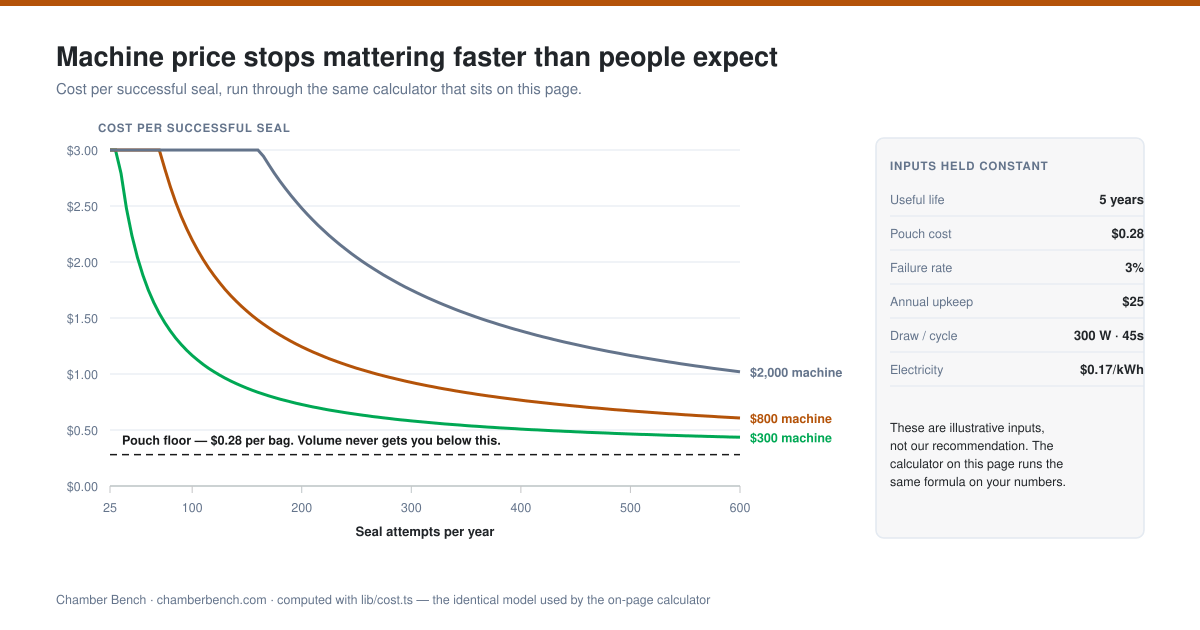
A chamber vacuum sealer is worth it once your recurring seal volume is high enough to spread the machine across enough successful packages to stop noticing it, and where that happens is arithmetic rather than opinion. The calculator above divides annualized machine cost, pouches, maintenance and electricity by successful seals rather than attempted ones, so the machine's share of each package halves every time annual volume doubles, while the pouch's share does not move at all.
That is why the answer splits by household and not by product. At low volume the annualized machine cost dominates every other input and the result barely responds to pouch cost; at high volume the machine's share shrinks toward nothing and cost per seal settles on a floor set by the pouch and the failure rate. The calculator opens on placeholder figures in eight of its nine fields, and not one of those eight is a number Chamber Bench stands behind. The machine-cost field opens on an illustrative dollar amount that is not a quote, is not drawn from any seller, and is attributed to no machine cataloged here. The useful-life field opens on a round number of years no manufacturer publishes. The pouch field carries a unit cost that came from no seller and no manufacturer. The annual-maintenance field opens on a dollar amount no manufacturer publishes for any part, oil change or service call. The failure rate is a round number that no manufacturer this guide covers publishes in any form, and the attempts, watts and seconds fields are starting values chosen to make the arithmetic legible rather than figures read off a specification. The ninth field, the electricity rate, is the single opening value taken from a publication, and the next section names the table it comes from. Every placeholder is there to be overwritten with your own quote, your own landed pouch cost and your own measured rate, and the floor that the pouch cost and the failure rate imply together is the number no amount of extra use can beat.
Nothing in that calculation prices the reasons people actually buy one. Sealing a marinade without freezing it first, filling a pouch to a depth the chamber allows, and using smooth pouches instead of embossed ones are capability differences, not savings, and the tool does not attempt to value them. What the chamber allows is at least published: VacMaster gives a chamber size of 11.25 by 15.25 by 5 inches for both the VP215 and the VP210, and Avid Armor gives 11.5 by 12 by 3.5 inches for the USV32, so the depth available to a filled pouch differs by an inch and a half between two machines whose stated maximum pouch sizes are 10 by 13 inches and 11 by 13 inches. Run the low-volume case and the high-volume case, then decide whether the capability is worth the gap between the two numbers.
The published duty cycle caps how fast any household can reach a given annual attempt count, so the attempts input is not a free variable. VacMaster's VP215 user guide of June 2024 states a maximum vacuum on time of 70 seconds, a minimum off time of 10 seconds between cycles, and a stop-and-cool instruction once the appliance has run for 45 minutes. The identical sentence appears in the VP210 guide of the same date. Vacuum in that sentence is the pressure condition inside the chamber, not the appliance. A household entering 600 attempts a year sits far below the ceiling; a household entering several thousand is planning around it.
The seconds-per-cycle input has manufacturer documents behind it, and they disagree with each other inside a single PDF. The specs table of VacMaster's VP215 user guide of June 2024 publishes a cycle time of 20 to 40 seconds. Elsewhere in that same guide, VacMaster gives initial timing settings of 40 seconds vacuum, 1.2 seconds sealing and 2.2 seconds cooling, which totals 43.4 seconds, longer than the maximum the specs table publishes for the same machine. The VP210 guide of the same month repeats both halves of the pattern: the identical three initial settings, against a published cycle time of 20 to 60 seconds. The calculator's 45-second placeholder therefore sits above the VP215's published cycle-time ceiling and above the guide's own initial-settings total, and this page will not call it manufacturer-adjacent. It is a round number that lands near one of two published figures VacMaster gives for one machine, and it should be replaced with the setting you actually run.
How many seals a year does it take for a chamber machine to make sense?
No universal number exists, because the crossing point moves with the machine quote you enter, the service life you assume, and what you are comparing against. The shape is fixed even though the number is not: the machine's contribution to each package is annualized cost divided by successful seals, so it halves each time your annual volume doubles, while the pouch contribution stays flat forever.
Is a chamber vacuum sealer cheaper to run than an external sealer?
Chamber pouch cost against external-sealer bag cost decides whether a chamber vacuum sealer is cheaper to run than an external one, and only the buyer holds both quotes, which is why the calculator asks you to enter a pouch cost rather than shipping a market figure. The structural difference is that chamber pouches are smooth and bought pre-cut in fixed case counts, VacMaster publishing 250, 500, 1,000 and 2,000 per box, while external-sealer bags are embossed and usually cut from a roll, so the two consumables are priced on different bases and only compare honestly per successful seal.
How many cycles fit inside the published 45-minute duty window?
VacMaster's VP215 and VP210 user guides of June 2024 publish the only ceiling available: a maximum vacuum on time of 70 seconds, a minimum off time of 10 seconds, and a stop-and-cool instruction after 45 minutes of use. At the guides' own initial settings of 43.4 seconds a cycle plus the 10-second minimum off time, 50 whole cycles fit inside that 45-minute window; at the maximum 70 seconds plus 10 seconds off, 33. No manufacturer this guide covers publishes a cycles-per-hour rating, and neither guide states how long the cooldown lasts, so the 45-minute window cannot be converted into an hourly figure from published records.
Source basis[6] VacMaster (ARY, Inc.): VP215 Chamber Vacuum Sealer User Guide (June 2024) · [8] VacMaster (ARY, Inc.): VP210 Chamber Vacuum Sealer User Guide (June 2024) · [10] VacMaster (ARY, Inc.): MACHINE SPECS VP230 Chamber Vacuum Sealer · [11] Avid Armor: Ultra Series USV32 chamber vacuum sealer product page
Use one formula for every shortlist
Annualized equipment cost equals purchase cost divided by expected years of useful service. Keep maintenance as its own annual input. Estimate annual electricity in kilowatthours as watts times seconds per cycle times annual attempts divided by 3,600,000, then multiply by your local dollars per kilowatthour. Add equipment, pouches, maintenance, electricity, and wasted consumables, then divide by successful seals, not attempted seals.
The U.S. Energy Information Administration is the authority for that conversion and states it in plain terms: one kilowatthour is one kilowatt generated for one hour, and a 40-watt bulb burning for five hours has used 200 watthours, or 0.2 kilowatthours. The calculator's watts times seconds times attempts divided by 3,600,000 is that same statement rearranged for a machine that runs in seconds rather than hours. The 3,600,000 is 1,000 watts per kilowatt multiplied by 3,600 seconds per hour. The conversion is EIA's, and so is the electricity rate the calculator's own field opens on; the machine wattage, the cycle length and the attempt count that feed them are yours.
Eight of the calculator's nine opening values are illustrative placeholders Chamber Bench supplied so the arithmetic has something to run on, and this page names them as placeholders rather than letting them read as findings. Three of those eight have no published record standing behind them at all. The machine cost is the first: Chamber Bench attributes no price to any machine it catalogs, in this guide or anywhere else on the site, and the dollar amount that field opens on came from no seller and no manufacturer, so it is entirely the reader's to replace with a quote verified at the moment of comparison. The service life is the second: no manufacturer among the six cited here publishes an expected working life for a chamber machine, so the years field opens on a horizon the reader picks. The failure rate is the third: no manufacturer among those same six publishes a failed-seal or defect rate of any kind, so the 3 percent placeholder rests on nothing and exists only to be replaced by an observed rate. The other five placeholders sit beside published material without being drawn from it. The attempts field has the duty cycle as a ceiling but no published count. The pouch field has published case counts and no published price. The maintenance field has two published schedules and no published dollar figure. The watts and seconds fields have the contested published specifications that the next two sections work through, and neither placeholder is one of the figures those documents print.
The electricity rate is the exception, which is why the table below marks that one value as anchored. It opens on 18.34 cents per kilowatthour, the U.S. residential average for June 2026 published in table 5.3 of EIA's Electric Power Monthly, and the kilowatthour conversion that rate feeds is EIA's as well, so both halves of the energy arithmetic trace to a federal publication instead of to a round number. What no manufacturer publishes is the machine half. Not one of the nine machines cited here has an energy figure published for it per cycle or per year, not kilowatthours, not energy per cycle, not a standby draw. That is why the energy term has to be assembled from a rated wattage and a cycle time rather than read off a label, and why the wattages disagreeing with each other matters more than it first appears.
Scroll horizontally to see every column.
| Input | Use your own value | Why it belongs | Published anchor for the placeholder |
|---|---|---|---|
| Machine cost and years | Current verified quote; conservative life | Spreads capital cost across use | None. Chamber Bench attributes no price to any machine it catalogs, and no manufacturer publishes a service life. Both opening figures are illustrative placeholders that came from no seller |
| Seals per year | Actual recurring workflow | Prevents high-volume assumptions | The opening attempt count is Chamber Bench's own. Only the ceiling is published: the VP215 and VP210 duty cycle of 70 seconds on, 10 seconds off, cool down after 45 minutes |
| Pouch cost | Landed cost for the right size and mil | Captures the main consumable | VacMaster publishes case counts of 250, 500, 1,000 and 2,000 with no price attached. The field's opening value is a placeholder unit cost, not a seller's quote |
| Failure rate | Observed or cautious estimate | Prices wasted pouches and rework | None published by any of the six manufacturers cited here; 3 percent is a placeholder |
| Annual maintenance | Manual-backed parts, oil, and service | Keeps scheduled upkeep visible | Two published schedules for the VP215 and no published dollar figure. VP215 guide: every 3 months or 250 cycles. VacMaster Help Center: approximately 2 times a year. The opening dollar amount is Chamber Bench's own placeholder |
| Electricity | Watts, cycle seconds, annual attempts, and local dollars per kilowatthour | Calculates energy separately from service | EIA's conversion method, and the rate field opens on the U.S. residential average for June 2026 in table 5.3 of EIA's Electric Power Monthly, 18.34 cents per kilowatthour. The watts and seconds placeholders beside it are Chamber Bench's own, because no manufacturer publishes the machine half |
Source basis[1] U.S. Energy Information Administration: Electric Power Monthly, Table 5.3. Average Price of Electricity to Ultimate Customers: Total by End-Use Sector · [3] U.S. Energy Information Administration: Electricity explained: Measuring electricity · [6] VacMaster (ARY, Inc.): VP215 Chamber Vacuum Sealer User Guide (June 2024) · [7] VacMaster Help Center · [8] VacMaster (ARY, Inc.): VP210 Chamber Vacuum Sealer User Guide (June 2024) · [10] VacMaster (ARY, Inc.): MACHINE SPECS VP230 Chamber Vacuum Sealer
The watts field, and the published figures that fight over it
Wattage is the input where the published record is at its most contradictory, because the manufacturers either publish nothing or do not agree with themselves about what they are publishing. VacMaster's VP215 and VP210 user guides of June 2024 both give the electrical spec as single phase 110 V, 20 Amp. Twenty amps at 110 volts is 2,200 volt-amperes, which is the branch circuit the machine wants, not the power the pump pulls. Neither guide publishes a wattage anywhere in its 22 or 24 pages, so a reader who types 2,200 into a watts field is entering a circuit rating, and a reader who wants an actual draw for either machine has nothing published to enter at all. Separating a circuit rating from a draw is the single most useful thing a spec sheet can be made to do here, and on these two machines the spec sheet only does half of it.
VacMaster's VP230 machine spec sheet publishes amperage instead of wattage as well: 110V, 60Hz, 4 Amps, alongside a half-horsepower rotary oil pump and an 89-pound machine weight. No watt figure appears anywhere on that sheet either. Four amps at 110 volts is 440 volt-amperes, one fifth of the 2,200 volt-amperes the VP215 and VP210 guides imply, for machines sold on the same brand's chamber line. Nothing VacMaster publishes reconciles a 20-amp line on one document with a 4-amp line on another, and neither document says which of the two is a circuit requirement and which is closer to a rating. Chamber Bench holds no manufacturer-published wattage for any VacMaster chamber machine and therefore prints none, in the body, in the table below, or in the calculator.
VEVOR's DZ-260S-V1 page carries four different watt figures for one machine, and publishes the lowest of them twice. A feature bullet says a 120W vacuum pump works with a stainless steel chamber to handle heavy use. The page's own option selector publishes that same figure as a structured attribute, rendering Power: 120 W for this SKU, with a sibling 380W option that links to a different model at a different URL with an 11.5-inch sealing length, so the 380W value belongs to another machine and not to this one. The description further down the same page then says the machine is crafted with a 180W vacuum pump. The specification table lists Maximum Power 950W with a plus five, minus ten percent tolerance, and separately Seal Power 260W, while a heading on the page calls the 950W figure a motor rating. All of it was live on 5 September 2026, none of it is retracted and none of it is footnoted. VEVOR therefore publishes 120 W in two places, one of them a spec field rather than a marketing sentence, and 180 W in a third, and reconciles none of them, so a reader after the draw of the component that runs for the whole cycle has a structured attribute pointing one way and a description sentence pointing another.
Two of the six manufacturers this guide covers publish a plain wattage, three publish no watt figure at all, those three being VacMaster, Avid Armor and Anova, and the sixth is VEVOR, which publishes four. Gasbye states 300 W at 115 V for its chamber sealer on the product page, next to a 5.28 quart chamber, an 11.5-inch seal bar and a 9.7-inch interior width. Wevac's CV12 Pro user manual states 360W at 120V, 60Hz with a pump flow rate of 85 liters a minute, although that PDF's own document title reads Model V513-V553 while the spec table names the CV12 Pro. Avid Armor's USV32 product page publishes seal bar, controls, chamber size, maximum pouch size, chamber material, lid, accessory port, machine dimensions and weight, and no wattage, voltage or amperage at all; the USV20 page, fetched separately on 5 September 2026 at its own URL, is equally silent on power while publishing a time-adjustable vacuum of 15 to 60 seconds and a seal setting of 3 to 9. Anova's support page publishes a pump rated in flow, 4.32 cubic meters an hour, rather than in power.
The horsepower rating a reader might use to sanity-check a wattage is itself contested inside one brand. VacMaster's VP215 user guide spec table says .2 HP Rotary Oil Pump. The VP215 product page says heavy-duty 1/5 hp oil pump. VacMaster's Help Center says the VP215 uses a powerful 1/4 HP rotary oil pump. Point two horsepower and one fifth horsepower are the same value; one quarter horsepower is 25 percent larger. All three were re-fetched on 5 September 2026 and all three are VacMaster's own. This page does not convert any of them into watts, because a horsepower rating describes mechanical output rather than the draw a meter would see, and no source here publishes the conversion for these machines.
None of that is a reason to leave the watts field blank, because the field barely moves the result. It is a reason to record which figure you entered and what its publisher said the figure rates, so a later reader of your own log knows whether the number came from a wattage, a circuit rating, a maximum, a seal bar or a marketing sentence. The next section prices the whole span, from the lowest published watt figure among the machines this guide covers to the highest, and shows the answer changes by less than a quarter of a cent per finished package across all of it.
What wattage should I enter for a chamber vacuum sealer?
Enter the rated wattage the manufacturer publishes for that machine, and record which figure you used. Gasbye publishes 300 W and Wevac publishes 360W, so those two enter directly. VEVOR publishes 120 W for its pump in a feature bullet and again as this SKU's own Power attribute, 180W for the same pump in the page description, 260W for the seal bar and 950W as a maximum, so a VEVOR owner is choosing among four published figures, with the only structured pump field on the page reading 120 W while the description still reads 180W and VEVOR reconciles neither. VacMaster publishes amperage instead, and its 20 Amp figure is a circuit requirement rather than a draw, so it must not be typed into a watts field. Avid Armor publishes no power figure for the USV20 or USV32 at all. Where the manufacturer publishes nothing, run the calculator across the published span and see whether the answer moves, which at these magnitudes it will not.
Scroll horizontally to see every column.
| Machine | Published figure | Document | What the figure actually rates |
|---|---|---|---|
| VacMaster VP215 | Single Phase 110 V 20 Amp | VP215 user guide, June 2024, specs table | A branch-circuit requirement, 2,200 volt-amperes if read as a draw |
| VacMaster VP210 | Single phase 110 V 20 AMP | VP210 user guide, June 2024, specs table | The same circuit rating, in the same wording |
| VacMaster VP230 | 110V, 60Hz, 4 Amps | VP230 machine spec sheet | 440 volt-amperes, one fifth of the VP215 and VP210 figure; the sheet carries no watt figure anywhere |
| Gasbye chamber sealer | 300 W at 115 V | Gasbye product page | A rated wattage, published as a wattage |
| Wevac CV12 Pro | 360W at 120V, 60Hz | CV12 Pro user manual, spec table | A rated wattage, in a PDF titled for models V513-V553 |
| VEVOR DZ-260S-V1 | 120W vacuum pump | Product page feature bullet, and the page's Power variant attribute for this SKU | The pump, according to one marketing sentence and one structured spec field; the lowest watt figure published for any machine this guide covers |
| VEVOR DZ-260S-V1 | 180W vacuum pump | Product page description | The same pump, according to another sentence |
| VEVOR DZ-260S-V1 | Maximum Power 950W (+5%/-10%) | Product page specification table | A maximum, also described as a motor rating in the page copy |
| VEVOR DZ-260S-V1 | Seal Power 260W | Product page specification table | The seal bar, which draws for seconds rather than for the cycle |
| Avid Armor USV32 | No figure published | USV32 product page, full specification table | No wattage, voltage or amperage appears in the table |
| Avid Armor USV20 | No figure published | USV20 product page, fetched 5 September 2026 | No wattage, voltage or amperage appears anywhere on the page |
| Anova Precision chamber sealer | 4.32 cubic meters an hour | Anova support FAQ | Pump flow, which the formula cannot convert to power |
Source basis[6] VacMaster (ARY, Inc.): VP215 Chamber Vacuum Sealer User Guide (June 2024) · [7] VacMaster Help Center · [8] VacMaster (ARY, Inc.): VP210 Chamber Vacuum Sealer User Guide (June 2024) · [9] VacMaster (ARY, Inc.): VacMaster VP215 chamber vacuum sealer product page · [10] VacMaster (ARY, Inc.): MACHINE SPECS VP230 Chamber Vacuum Sealer · [11] Avid Armor: Ultra Series USV32 chamber vacuum sealer product page · [12] Gasbye · [13] Wevac Technology Co., Limited · [14] VEVOR · [15] Anova Culinary Support · [22] Avid Armor: Ultra Series USV20 chamber vacuum sealer product page
Sizing the electricity term against EIA's own figures
Active cycling at the calculator's starting inputs consumes 4.5 kilowatthours a year. Six hundred watts times 45 seconds times 600 attempts, divided by 3,600,000, is 4.5, using the conversion EIA publishes. Set against the 10,791 kilowatthours EIA reports the average U.S. residential electric-utility customer purchased in 2022, about 899 kilowatthours a month, that is 0.04 percent of a household's annual electricity. EIA's figure is a 2022 figure and its page was last updated on 8 January 2024, so the comparison is against a four-year-old baseline and is stated here as one.
Pricing those 4.5 kilowatthours at the U.S. residential average for June 2026 in table 5.3 of EIA's Electric Power Monthly, 18.34 cents per kilowatthour, which is also the figure the calculator's rate field opens on, gives about 83 cents for the year. Spread across 582 finished packages, which is what 600 attempts yield at the placeholder 3 percent failure rate, the electricity term is about 0.14 cents per successful seal. That is the whole electricity contribution, and it is the reason this guide treats energy as a term to be quantified and then set aside rather than as a lever.
Machine wattage moves that term without rescuing it. Across every watt figure published for a chamber machine this guide covers, the same 45 seconds and 600 attempts give 0.9 kilowatthours at VEVOR's 120W pump bullet, 1.35 at its 180W description, 1.95 at its 260W seal power, 2.25 at Gasbye's 300 W, 2.7 at Wevac's 360W, 4.5 at the calculator's 600-watt placeholder and 7.125 at VEVOR's 950W maximum power. The published span is therefore 120 W to 950 W, not 300 W to 950 W: three of VEVOR's four figures sit below Gasbye's, and this page does not drop them to make the band tidier. The bottom of that band is 0.008 percent of EIA's 2022 average household consumption and the top is 0.066 percent. Cycle time moves the term on the same scale: published cycle times run from 20 to 40 seconds for the VP215 and VP230, 20 to 60 seconds for the VP210, an adjustable 15 to 60 seconds on the USV20 and 20 to 99 seconds on the USV32, a 6.6-fold published span across one catalog that the energy term follows linearly.
Location moves the electricity term on the same order as wattage does, which is why the calculator asks for a local rate instead of assuming a national one. EIA's Table 5.6.A for June 2026 puts residential electricity at 52.72 cents per kilowatthour in Hawaii and 13.37 cents in Utah among the ten states checked here, with California at 34.74, Massachusetts at 29.61, New York at 29.49, Texas at 15.94, Washington at 14.91, Idaho at 14.37, North Dakota at 14.12 and Louisiana at 13.49. Chamber Bench read ten rows of that table and not all 51, so no state is described here as the highest or the lowest. Applying only the two ends to the same 4.5 kilowatthours moves the annual energy line from about 60 cents to about $2.37, a 3.9-fold swing that never touches the pouch term. Which of the two levers moves the line further depends on how the question is put, and this page will not settle it with a preference: the published wattage span is the wider multiple, 7.9-fold from VEVOR's 120 W to its 950W, while the ten state rates open the wider dollar range, about $1.77 against about $1.14, because the wattage band starts from a smaller number. Both stay under $2.40 a year at the calculator's starting attempt count.
Which EIA residential price is the current one is itself unsettled, and a calculator has to name the period it used. The Electric Power Monthly gives 18.34 cents for June 2026, 18.16 cents year to date and 17.90 cents for the rolling twelve months ending June 2026. The annual column on the same table gives 17.30 cents for 2025 and 16.48 cents for 2024. EIA's Energy Explained pages quote the 17.30 cents 2025 figure as the residential average, citing February 2026 preliminary data. EIA also notes that values for 2024 and prior years are final while values for 2025 and 2026 are preliminary estimates based on a cutoff model sample. Five defensible figures from one agency, a spread of 1.86 cents between the highest and the lowest, and the most current one is also the least settled.
How much electricity does a chamber vacuum sealer use in a year?
A chamber vacuum sealer's annual energy use is the product of its rated wattage, its cycle length and the number of cycles run, and no manufacturer this guide covers publishes it directly. At 600 watts, 45 seconds a cycle and 600 attempts a year, EIA's conversion method gives 4.5 kilowatthours. Across every wattage manufacturers do publish, 120 W to 950 W, the same cycle count spans 0.9 to 7.125 kilowatthours, which is about 17 cents to about $1.31 for the year at EIA's June 2026 U.S. residential average of 18.34 cents per kilowatthour. The upper end is 0.066 percent of the 10,791 kilowatthours EIA reports for the average U.S. residential customer in 2022.
Does the state I live in change the cost per seal?
State electricity rates change the smallest term in the chamber vacuum sealer calculation and leave the largest ones untouched. EIA's Table 5.6.A for June 2026 gives 52.72 cents per kilowatthour in Hawaii and 13.37 cents in Utah among the ten states Chamber Bench checked. Applied to 4.5 kilowatthours of annual cycling, that is roughly $2.37 against roughly 60 cents for the year, a 3.9-fold difference on a line that was already under a dollar. Pouch cost and failure rate carry the result; the state rate adjusts a rounding term.
Source basis[1] U.S. Energy Information Administration: Electric Power Monthly, Table 5.3. Average Price of Electricity to Ultimate Customers: Total by End-Use Sector · [2] U.S. Energy Information Administration: Electricity explained: Electricity prices and factors affecting prices · [3] U.S. Energy Information Administration: Electricity explained: Measuring electricity · [4] U.S. Energy Information Administration: Electric Power Monthly, Table 5.6.A. Average Price of Electricity to Ultimate Customers by End-Use Sector, by State · [5] U.S. Energy Information Administration: Frequently Asked Questions: How much electricity does an American home use? · [6] VacMaster (ARY, Inc.): VP215 Chamber Vacuum Sealer User Guide (June 2024) · [8] VacMaster (ARY, Inc.): VP210 Chamber Vacuum Sealer User Guide (June 2024) · [10] VacMaster (ARY, Inc.): MACHINE SPECS VP230 Chamber Vacuum Sealer · [11] Avid Armor: Ultra Series USV32 chamber vacuum sealer product page · [12] Gasbye · [13] Wevac Technology Co., Limited · [14] VEVOR · [22] Avid Armor: Ultra Series USV20 chamber vacuum sealer product page
Pouch cost per seal moves with case count, size and mil at once
The pouch is the term volume can never dilute, so how it is quoted decides the floor. VacMaster publishes chamber pouches in cases of 250, 500 and 1,000 on the VP230 spec sheet and adds a 2,000-per-box line in the VP215 and VP210 packaging tables. A case figure therefore divides by four different counts before it becomes a cost per seal, and comparing two boxes without dividing by their contents compares nothing. Chamber Bench found this case structure published by VacMaster alone; no other manufacturer cited here publishes a chamber-pouch case count, so no second publisher corroborates it.
The clearest demonstration sits inside one VacMaster manual. Item 40725 is a 10 by 13 inch, 3-mil chamber pouch sold 250 to a box. Item 30725 is a 10 by 13 inch, 3-mil chamber pouch sold 1,000 to a box. Same nominal pouch, same thickness, two item numbers, a fourfold difference in what a box contains. The identical pair appears in the VP210 guide of June 2024. Any pouch figure a reader enters has to be a per-pouch figure derived from the case count printed on that item, not a box figure carried across from a different item number.
Size and thickness move the same input again, and the seal bar those sizes are measured against is itself published twice. VacMaster's VP215 user guide specs table gives a seal bar length of 10.25 inches; the VP215 product page describes a 10 inch removable seal bar with double seal wire. The VP210 guide publishes 10.25 inches as well, so the quarter inch is a document disagreement rather than a model difference. VacMaster's published pouch range runs from 2.5 by 10 inches up to 10 by 13 inches, with a stated maximum pouch size of 10 by 13 inches. Even the mil count is published two ways in one document: the packaging page states that bag thickness is available in standard 3mil or heavy duty 4mil, while the item table on that same page lists 10 by 13 inch chamber pouches in 5-Mil at 1,000 per box. A 5-mil 10 by 13 pouch and a 3-mil 6 by 7 pouch are both single seals in the calculator's denominator and are not the same consumable in its numerator.
The machine's own inclusions make the first pouch entry a blend rather than a single value, and VacMaster publishes two versions of that blend. The VP215 user guide of June 2024 lists the 60 assorted 3-mil pouches as 20 at 6 by 10 inches, 20 at 8 by 12 and 20 at 10 by 13. The VP215 product page lists the same 60 as 20 at 6 by 8 inches, 20 at 8 by 12 and 20 at 10 by 13. Same machine, same count, same manufacturer, two different smallest pouches, and neither document acknowledges the other. The VP210 guide lists 60 assorted vacuum chamber pouches with no sizes attached at all. A reader deriving a first pouch cost from what shipped in the box is averaging over a blend VacMaster itself describes two ways, which is a reason to price the size you actually reorder rather than the assortment.
The pouch input is not locked to the machine brand, which matters because it is the input with the most leverage on the long-run result. Anova states plainly that its own chamber pouches work best with its chamber sealer, however other chamber-style pouches can be used. A reader is therefore quoting a category, not a captive part, and the cost-per-seal floor moves with sourcing rather than with the machine decision that the rest of the calculator is about.
How much do chamber vacuum sealer pouches cost per seal?
Chamber pouch cost per seal is the landed case cost divided by the case count printed on that item number, then divided again by one minus your failure rate, and Chamber Bench publishes no figure for either half. The published structure is what makes the division necessary: VacMaster sells chamber pouches in cases of 250, 500, 1,000 and 2,000, and lists the same 10 by 13 inch 3-mil pouch under one item number at 250 per box and another at 1,000 per box. Enter the per-pouch figure from your own quote for the size and mil you actually reorder.
Does pouch thickness change the cost per seal?
Pouch thickness changes the numerator of the cost-per-seal calculation without changing the denominator, because a 5-mil pouch and a 3-mil pouch each count as one seal. VacMaster's published record is not settled on how many thicknesses exist: the VP215 and VP210 packaging pages state that bag thickness is available in standard 3mil or heavy duty 4mil, while the item tables on those same pages list 10 by 13 inch chamber pouches in 5-Mil at 1,000 per box. No manufacturer this guide covers publishes a failure rate by thickness, so the trade between a thicker pouch and a lower rework rate cannot be quantified from any published record and remains a judgment the reader makes.
Scroll horizontally to see every column.
| Published record | Value | Effect on cost per seal |
|---|---|---|
| Case counts (VacMaster) | 250, 500, 1,000 and 2,000 per case or box | One case figure divides by four possible counts before it is a per-seal number |
| Same pouch, two item numbers (VacMaster) | 40725 at 250 per box; 30725 at 1,000 per box, both 10 by 13 inch 3-mil | A fourfold difference in box contents for an identical pouch |
| Seal bar length (VacMaster VP215) | 10.25 inches in the June 2024 guide; 10 inch removable seal bar on the product page | The dimension every pouch width is measured against is published twice |
| Size range (VacMaster) | 2.5 by 10 inches up to a stated maximum pouch size of 10 by 13 inches | Width and length change the consumable while the seal count stays one |
| Thickness options (VacMaster) | Packaging page says standard 3mil or heavy duty 4mil; the item table on the same page lists 10 by 13 inch pouches in 5-Mil at 1,000 per box | Thickness is a separate axis from size, and how many axes there are is itself disputed inside one guide |
| In-box pouch assortment (VacMaster VP215) | Guide: 20 at 6 by 10, 20 at 8 by 12, 20 at 10 by 13. Product page: 20 at 6 by 8, 20 at 8 by 12, 20 at 10 by 13 | The first pouch cost a reader observes is a three-size blend that VacMaster publishes two ways |
| Cross-brand pouch use (Anova) | Other chamber-style pouches can be used | The pouch input is sourced from a category, not from the machine brand |
Source basis[6] VacMaster (ARY, Inc.): VP215 Chamber Vacuum Sealer User Guide (June 2024) · [8] VacMaster (ARY, Inc.): VP210 Chamber Vacuum Sealer User Guide (June 2024) · [9] VacMaster (ARY, Inc.): VacMaster VP215 chamber vacuum sealer product page · [10] VacMaster (ARY, Inc.): MACHINE SPECS VP230 Chamber Vacuum Sealer · [15] Anova Culinary Support
Maintenance is a published schedule that contradicts itself
The maintenance input is the only term with a real manufacturer schedule behind it, and VacMaster publishes two different schedules for the same machine. The VP215 user guide of June 2024 sets a required oil change schedule of a first change one week after use, then every 3 months or 250 cycles, whichever comes first. VacMaster's own Help Center article on the VP210 and VP215 difference says the VP215 requires oil changes approximately 2 times a year depending on use. Both documents were live on 5 September 2026, both are VacMaster's, and neither references the other. An owner budgeting from the manual plans twice the changes an owner budgeting from the support site plans.
Which of the manual's two rules binds depends on volume, and the crossover is calculable. At 600 cycles a year the calendar rule gives four changes and the cycle rule gives 2.4, so the calendar rule governs. The cycle rule only takes over above 1,000 cycles a year, which is 250 cycles multiplied by the four quarters in the calendar rule. A household running the calculator's default attempt count is on the calendar, not on the cycle counter, and a small commercial kitchen running several thousand attempts is on the counter.
How much oil each change consumes is also unsettled, inside a single PDF. The VP215 guide's pre-use warning page instructs the owner to fill the pump until the oil level is at one half to three quarters in the sight glass, approximately 9 to 9 1/2 ounces of oil. The How To Use section of the same guide gives the same instruction and calls it approximately 10 to 12 ounces. That is a 33 percent spread on the consumed quantity, in one document, for one procedure. The guide also states that the machine ships with half a quart of oil in its maintenance kit. Half a quart is 16 ounces, which is 1.3 fills at the guide's higher figure of 12 ounces and 1.8 fills at its lower figure of 9 ounces, so even how far the shipped bottle goes depends on which sentence of the same guide the owner follows.
Three machines this guide covers remove the oil line entirely, and two manufacturers publish the reason. VacMaster's VP210 user guide specifies an oil-free piston vacuum pump and a quarter-horsepower maintenance-free pump, and the two guides' inclusion lists differ accordingly: the VP215 guide lists 60 assorted 3-mil pouches, 2 filler plates, a maintenance kit and a user's guide, with oil inside that kit, while the VP210 guide lists 60 assorted vacuum chamber pouches, 2 filler plates, a maintenance kit and a user's guide with no oil anywhere in it. The VP215 product page states the difference in its own packing list, which includes filler plates, oil, maintenance kit and manual. Avid Armor states that its dry piston vacuum pump has no oil to change and no service schedule on the USV32 page, and the USV20 page says the same machine family has no oil to change, no reservoir to check and no service schedule to forget. For those machines the oil line of the ownership calculation is zero and the rest of the maintenance input is not.
What the rest of the maintenance input is made of is published; how often to buy it is not, and the kit is not the same kit on both VacMaster machines. The VP215 guide's maintenance kit lists seven items: double-sided tape, two 15-amp fuses, seal wire, seal tape, an oil fill bottle with oil, a hex or Allen wrench and a reversible screwdriver. The VP210 guide's maintenance kit lists six, the same list minus the oil fill bottle, which is a second published difference between two guides issued in the same month for machines on one chassis. Both guides specify replacement on condition rather than on an interval: seal wire should be replaced if the wire shows heavy discoloration, seal tape if the tape shows heavy discoloration, is torn, or is starting to lose the adhesive. VacMaster's one-year limited warranty is void as to components including, without limitation, Teflon tape, lid gaskets and seal wire, so those parts sit outside the warranty by name in both documents. Avid Armor names the chamber gasket and the seal bar as the two parts that wear on any chamber sealer and ships a replacement gasket and a spare seal bar with the USV32. Two manufacturers identify the same consumable set independently, and neither publishes a cycle count for any of it. That is a declarable evidence gap, and the maintenance input has to be entered as a household estimate rather than read off a schedule.
How often does a chamber vacuum sealer need an oil change?
VacMaster publishes two answers for the VP215 and does not reconcile them. The June 2024 user guide requires a first change one week after use, then every 3 months or 250 cycles, whichever comes first, which is four changes a year at 600 cycles. VacMaster's Help Center says the same machine requires oil changes approximately 2 times a year depending on use. The 250-cycle rule only becomes the binding one above 1,000 cycles a year. Enter whichever schedule you intend to follow and label which document it came from.
Does a dry-pump chamber sealer remove the maintenance input?
A dry-pump chamber sealer removes the oil line and not the rest of it. VacMaster's VP210 publishes an oil-free piston vacuum pump and a six-item maintenance kit with no oil bottle in it, while the VP215 on the same chassis ships with oil, a seven-item kit and a change schedule. Avid Armor states its dry piston pump has no oil to change and no service schedule on both the USV32 and the USV20 pages. Avid Armor also names the chamber gasket and the seal bar as the two parts that wear on any chamber sealer, and VacMaster's warranty excludes Teflon tape, lid gaskets and seal wire by name, so a non-zero parts estimate still belongs in the maintenance field.
Scroll horizontally to see every column.
| Document | Published schedule | Oil changes a year at 600 cycles |
|---|---|---|
| VP215 user guide, June 2024 | First change one week after use, then every 3 months or 250 cycles, whichever comes first | 4 on the calendar rule; 2.4 on the cycle rule, so the calendar governs |
| VacMaster Help Center, article 221196367 | Oil changes approximately 2 times a year depending on use | 2 |
| VP210 user guide, June 2024 | Oil-free piston vacuum pump, maintenance-free, no oil schedule and no oil bottle in the kit | 0 |
Source basis[6] VacMaster (ARY, Inc.): VP215 Chamber Vacuum Sealer User Guide (June 2024) · [7] VacMaster Help Center · [8] VacMaster (ARY, Inc.): VP210 Chamber Vacuum Sealer User Guide (June 2024) · [9] VacMaster (ARY, Inc.): VacMaster VP215 chamber vacuum sealer product page · [11] Avid Armor: Ultra Series USV32 chamber vacuum sealer product page · [22] Avid Armor: Ultra Series USV20 chamber vacuum sealer product page
Break-even against food waste cannot be computed from federal data
Food waste avoided is the argument most often used to justify the purchase, and it is the one the federal record cannot support with a number. USDA's Economic Research Service estimates that 31 percent, or 133 billion pounds, of the 430 billion pounds of food available at the retail and consumer levels in 2010 went uneaten, split into 10 percent at retail, 43 billion pounds, and 21 percent at the consumer level, 90 billion pounds. ERS values that loss at $161.6 billion at 2010 retail prices and at 1,249 of the 3,796 calories available per American per day. Those are 2010 figures and remain the agency's headline estimate, which the page states rather than implying currency.
The definition disqualifies the arithmetic before it starts. ERS defines food loss as the edible amount of food, postharvest, that is available for human consumption but is not consumed for any reason, and states that it includes cooking loss and natural shrinkage such as moisture loss, loss from mold, pests, or inadequate climate control, and food waste. Most of that denominator is not spoilage a sealed pouch addresses. Nothing in a cooking-loss figure or a moisture-shrinkage figure describes a package that failed, so the national total cannot be apportioned to packaging by any published method.
ERS publishes its own caveat alongside the number. The agency states that limitations on accurately measuring food loss suggest actual loss rates may differ from the assumptions used in the data series, that food loss is difficult to measure accurately at the consumer level, and that participants in household surveys on food waste tend to be highly reactive, changing their behavior during the survey period instead of acknowledging how much food they typically discard or misstating their true levels of discarded food products. Quoting the caveat is the only honest way to quote the figure.
The commodity detail is the part a chamber sealer buyer would actually reach for, and it is worth reading as a rate rather than as a saving. ERS's 2010 table gives consumer-level loss rates of 23 percent for meat, 22 percent for vegetables, 20 percent for dairy products and 31 percent for fish and seafood, against a 21 percent consumer-level rate across all food. Those are the categories a chamber machine is bought for. They describe how much of the category went uneaten in 2010 for every reason ERS counts, and they do not describe how much of it a vacuum-sealed pouch would have kept.
The second federal source disagrees with the first, publicly and without reconciliation. EPA estimates that in 2019, 66.2 million tons of wasted food was generated in the food retail, food service and residential sectors, of which the residential sector generated 26,502,346 tons, 40.0 percent of the total, with food service at 26,741,937 tons and food retail at 12,971,959 tons. EPA's web page rounds the same total to 66 million tons and states about 60 percent was sent to landfills. Elsewhere EPA states that 40 percent of food in the United States is lost or wasted, annually costing an estimated $218 billion or 1.3 percent of GDP, with no year and no citation attached to that figure, although the same page does cite sources for other statistics on it. Elsewhere again EPA states that over one-third of the food produced in the United States is never eaten. Two agencies, three shares, two dollar values, and no published reconciliation between them.
The direction of travel is the one thing both agencies let a reader carry away without arithmetic. EPA reports a 6 percent increase in per capita food leaving the human food supply chain from the food retail, food service and residential sectors between its 2016 baseline and its 2019 estimates, and 2019 remains its most recent sector estimate. Neither USDA nor EPA publishes a per-household dollar figure, and dividing a national total by a household count would be Chamber Bench's invention rather than a citation. The break-even against food waste can be framed on this page and cannot be computed on it.
Does a chamber vacuum sealer pay for itself in food savings?
No published federal figure supports a payback calculation for a chamber vacuum sealer. USDA's Economic Research Service estimates 31 percent of the U.S. food supply went uneaten in 2010, valued at $161.6 billion, but defines food loss to include cooking loss and moisture shrinkage as well as discarded food, so most of that total describes losses a pouch does not address. EPA separately states 40 percent and $218 billion with no year and no citation attached to that figure. Neither agency publishes a household figure or a spoilage share attributable to packaging, so the payback question can be framed with published rates and cannot be answered with them.
Source basis[16] USDA Economic Research Service: The Estimated Amount, Value, and Calories of Postharvest Food Losses at the Retail and Consumer Levels in the United States (EIB-121), summary · [17] USDA Economic Research Service: Food Availability (Per Capita) Data System - Loss-Adjusted Food Availability Documentation · [18] U.S. Environmental Protection Agency: 2019 Wasted Food Report · [19] U.S. Environmental Protection Agency: Food: Material-Specific Data · [20] U.S. Environmental Protection Agency: International Efforts on Wasted Food Recovery · [21] U.S. Environmental Protection Agency: From Farm to Kitchen: The Environmental Impacts of U.S. Food Waste
Read the result as a comparison, not a promise
The output is a planning estimate. It does not price food saved, labor, convenience, resale, financing, tax, downtime, or a failure outside the assumed rate. Run a low-volume and a high-volume case instead of treating one forecast as certain.
Use the same time horizon and successful-seal definition for a chamber machine and an external alternative. Replace assumptions with your own measured failure rate after purchase.
The terms sort by how much they can move the answer, which is the practical reading of the chart. Electricity contributes about 0.14 cents per successful seal at the starting inputs and at the 18.34-cent June 2026 residential average the rate field opens on, and across the full published wattage span of 120 W to 950 W it moves only between about 0.03 and about 0.22 cents per package. Swapping the state rate between the two ends of the ten rows checked moves the annual line from about 60 cents to about $2.37. Maintenance carries a published schedule that VacMaster's own two documents disagree about by a factor of two. The pouch carries no published price at all and sets the floor. Sorted that way, the inputs worth sourcing carefully are the machine quote you enter, pouch cost, failure rate and the maintenance schedule you intend to follow.
Three numbers in the calculation are assumptions wearing the clothes of data, and the chart cannot show that. The 3 percent failure rate matches no published manufacturer record. The machine's service life is a horizon the reader picks, and the machine's cost is a quote only the reader holds. All three sit in the numerator, all three scale everything above the pouch floor, and none improves by being carried forward from a previous session unchanged.
Why does the cost per seal stop falling?
Cost per successful seal falls toward the pouch cost and then stops there. Machine cost, maintenance and electricity are all divided by a rising number of packages, but every package still consumes exactly one pouch, so the pouch is a floor rather than a slope. That is why the pouch line, not the machine, decides the long-run number on the chart, and why the electricity band, at roughly 0.14 cents per successful seal at the starting inputs and no more than about 0.22 cents anywhere in the published wattage span, never becomes the reason to choose one machine over another.
Source basis[1] U.S. Energy Information Administration: Electric Power Monthly, Table 5.3. Average Price of Electricity to Ultimate Customers: Total by End-Use Sector · [3] U.S. Energy Information Administration: Electricity explained: Measuring electricity · [4] U.S. Energy Information Administration: Electric Power Monthly, Table 5.6.A. Average Price of Electricity to Ultimate Customers by End-Use Sector, by State · [5] U.S. Energy Information Administration: Frequently Asked Questions: How much electricity does an American home use? · [6] VacMaster (ARY, Inc.): VP215 Chamber Vacuum Sealer User Guide (June 2024) · [7] VacMaster Help Center · [12] Gasbye · [14] VEVOR
Run a scenario set instead of trusting one forecast
A single cost-per-seal result hides which assumption controls the decision. Keep the machine quote and comparison horizon consistent, then run separate cases for low use, expected use, and a cautious operating case. Change only the inputs named in the scenario so the movement in cost per successful seal remains explainable.
Document the source and date for every input. For electricity, use rated or measured watts, seconds per attempt, annual attempts, and the local energy rate, and name the EIA period you priced it at, because table 5.3 of the Electric Power Monthly reports 18.34 cents for June 2026, which is where the calculator's rate field starts, alongside 18.16 cents year to date and 17.90 cents for the trailing twelve months, while EIA's Energy Explained pages quote 17.30 cents for 2025. The formula estimates active-cycle energy only unless standby use is added separately, and no manufacturer here publishes a standby draw. Keep maintenance as a distinct annual amount based on the model manual and current parts information, and record which manual, because VacMaster's guide and its Help Center publish schedules that differ by a factor of two.
Use the same successful-seal definition in every scenario and calculate attempts consistently from that definition. Do not quietly add food savings, labor, financing, tax, resale, downtime, or an assumed service life to only one alternative. Those may matter to the household, but they need separate, labeled inputs or a written qualitative note rather than an invisible adjustment to the calculator result. The federal food-waste figures in particular are national rates for all causes and are not a savings input for any household.
Turn the estimate into an ownership log once the machine is in the kitchen, because every input except the machine quote and the service life you assign it can be replaced by observation within a season.
- Record every successful and failed seal during an initial observation period, then replace the 3 percent placeholder, which no manufacturer record supports.
- Track pouch size, mil and landed cost by batch, and divide by the case count printed on the item number rather than by the box.
- Record maintenance parts, oil quantity, shipping and service time, and note which VacMaster document set your interval, the June 2024 guide or the Help Center article.
- Log seconds per cycle from the settings you actually run, against the manufacturer-published range of 15 to 99 seconds across the machines this guide covers, and note that the VP215 guide's own two figures for that machine are 20 to 40 seconds and a 43.4-second initial-settings total.
- Price electricity at your own utility rate rather than at a national average, and record the EIA period you compared it to.
- Recalculate when actual use can replace a meaningful share of the assumptions, and keep the machine quote and horizon fixed while you do it.
Scroll horizontally to see every column.
| Scenario | Inputs to vary | Question answered |
|---|---|---|
| Low use | Annual attempts | Does capital cost dominate if use stays light? |
| Expected use | Your best-supported values | What does the current plan imply? |
| Cautious operation | Failure rate, maintenance schedule, energy rate, and pouch cost | How sensitive is the result to ownership friction? |
| Alternative machine | Same horizon and success definition | Is the comparison like for like? |
Source basis[1] U.S. Energy Information Administration: Electric Power Monthly, Table 5.3. Average Price of Electricity to Ultimate Customers: Total by End-Use Sector · [2] U.S. Energy Information Administration: Electricity explained: Electricity prices and factors affecting prices · [3] U.S. Energy Information Administration: Electricity explained: Measuring electricity · [6] VacMaster (ARY, Inc.): VP215 Chamber Vacuum Sealer User Guide (June 2024) · [7] VacMaster Help Center · [11] Avid Armor: Ultra Series USV32 chamber vacuum sealer product page · [16] USDA Economic Research Service: The Estimated Amount, Value, and Calories of Postharvest Food Losses at the Retail and Consumer Levels in the United States (EIB-121), summary · [22] Avid Armor: Ultra Series USV20 chamber vacuum sealer product page
Questions readers still ask
Should failed seals be counted in the cost?
Chamber vacuum sealer cost per seal counts successful seals, never attempts. A failed seal consumes a pouch plus the handling time to repack it, and at the calculator's starting 3 percent failure rate, 600 attempts a year yield 582 finished packages. That placeholder rate matches no manufacturer record this guide covers, so measure your own over the first few weeks and replace it.
Do pouches or the machine dominate the cost?
Whether pouches or the machine dominate chamber vacuum sealer cost per seal flips with volume, and that flip is the entire decision. Below the crossing point the annualized machine cost is the largest term and more volume is what changes the answer; above it, pouches and failures are the largest terms and pouch sourcing is what changes the answer. Electricity is never the largest term at any volume.
Which EIA electricity price should the calculator use?
Use your own utility rate, and record which EIA figure you compared it against. The calculator's rate field opens on 18.34 cents per kilowatthour, the U.S. residential average for June 2026 in table 5.3 of EIA's Electric Power Monthly, which on the same table gives 18.16 cents year to date and 17.90 cents for the twelve months ending June 2026, and 17.30 cents for 2025 and 16.48 cents for 2024 in its annual column. EIA notes that 2024 and earlier are final while 2025 and 2026 are preliminary estimates based on a cutoff model sample.
Why does Chamber Bench publish no machine wattage of its own?
Chamber Bench publishes no wattage of its own because for several machines this guide covers no manufacturer-published wattage exists to publish. Avid Armor's USV20 and USV32 pages carry no wattage, voltage or amperage; VacMaster publishes circuit ratings and amperage instead of watts on the VP215, VP210 and VP230; Anova rates its pump in flow at 4.32 cubic meters an hour. Gasbye publishes 300 W, Wevac publishes 360W, and VEVOR publishes four different watt figures on one product page. Where a manufacturer publishes nothing, this page records the gap rather than substituting a number from a retailer listing.
Does the calculator send my numbers anywhere?
The calculation runs entirely in your browser and nothing is submitted, stored or transmitted. The tool attributes no price to any machine or pouch Chamber Bench catalogs: the dollar amounts its machine-cost, pouch and annual-maintenance fields open on are illustrative placeholders drawn from no seller and no manufacturer, which is why it asks you for a verified quote instead of supplying one.
Why doesn't Chamber Bench publish machine prices?
Amazon's operating terms do not permit hardcoded price data, and a price typed into a page is wrong the week after it is written. That is why no dollar figure on this page is attached to a named product: the calculator's machine-cost, pouch and annual-maintenance fields open on illustrative placeholders that belong to no machine this guide covers and to no seller's listing. Entering the quote you verified at the moment you are comparing is also the only figure that reflects what you would actually pay.
Sources
Each record carries its own access date. Manufacturer statements are attributed; they are not treated as Chamber Bench test results.
- Electric Power Monthly, Table 5.3. Average Price of Electricity to Ultimate Customers: Total by End-Use SectorU.S. Energy Information Administration — Residential 18.34 cents per kilowatthour for June 2026, 18.16 year to date, 17.90 rolling twelve months, 17.30 for 2025 and 16.48 for 2024 - five figures on one table, a 1.86-cent spread. The 18.34-cent June 2026 figure is the value the calculator's electricity-rate field opens on. Page header reads data for June 2026, released 26 August 2026. Table notes state 2024 and prior are final while 2025 and 2026 are preliminary estimates based on a cutoff model sample. · Accessed
- Electricity explained: Electricity prices and factors affecting pricesU.S. Energy Information Administration — Quotes 17.30 cents per kilowatthour as the 2025 residential annual average, footnoted to February 2026 preliminary data. A different current-sounding figure from the same agency's Electric Power Monthly. · Accessed
- Electricity explained: Measuring electricityU.S. Energy Information Administration — Federal authority for the calculator's conversion: one kilowatthour is one kilowatt generated for one hour, and a 40-watt bulb for five hours uses 0.2 kilowatthours. · Accessed
- Electric Power Monthly, Table 5.6.A. Average Price of Electricity to Ultimate Customers by End-Use Sector, by StateU.S. Energy Information Administration — June 2026 residential rates for the ten states Chamber Bench read: Hawaii 52.72, California 34.74, Massachusetts 29.61, New York 29.49, Texas 15.94, Washington 14.91, Idaho 14.37, North Dakota 14.12, Louisiana 13.49, Utah 13.37. The full 51-row column was not read, so no state is called highest or lowest here. · Accessed
- Frequently Asked Questions: How much electricity does an American home use?U.S. Energy Information Administration — 10,791 kilowatthours purchased by the average U.S. residential electric-utility customer in 2022, about 899 a month. Page last updated 8 January 2024; the figure remains a 2022 figure, four years before this page's review date. · Accessed
- VP215 Chamber Vacuum Sealer User Guide (June 2024)VacMaster (ARY, Inc.) — Re-read in full 5 September 2026. Specs table: chamber 11.25 by 15.25 by 5 inches, seal bar 10.25 inches, .2 HP rotary oil pump, cycle time 20-40 seconds, single phase 110 V 20 Amp, 84 lbs, maximum pouch 10 by 13 inches. Also the oil change schedule, the two conflicting oil fill quantities in one document, the 70-second on and 10-second off duty cycle, initial timing settings of 40 / 1.2 / 2.2 seconds totalling 43.4, the seven-item maintenance kit including the oil fill bottle, the pouch item-number tables and case counts, the 3mil-or-4mil sentence against a 5-Mil item line, the in-box assortment of 20 at 6 by 10, 20 at 8 by 12 and 20 at 10 by 13, and the limited warranty exclusions. No wattage appears anywhere in the document, and no expected service life is published. · Accessed
- What is the difference between the VP210 and the VP215?VacMaster Help Center — States the VP215 requires oil changes approximately 2 times a year depending on use, and calls its pump 1/4 HP. Both conflict with VacMaster's own June 2024 user guide. · Accessed
- VP210 Chamber Vacuum Sealer User Guide (June 2024)VacMaster (ARY, Inc.) — Re-read in full 5 September 2026. Oil-free piston vacuum pump and 1/4 HP maintenance-free pump, the identical duty-cycle and initial-timing sentences, the same single phase 110 V 20 AMP spec line, seal bar 10.25 inches, chamber 11.25 by 15.25 by 5 inches, cycle time 20-60 seconds, 72 lbs, the same pouch item-number pairs, a six-item maintenance kit with no oil fill bottle, and an inclusion list of 60 assorted vacuum chamber pouches with no sizes given. No wattage appears anywhere in the document. · Accessed
- VacMaster VP215 chamber vacuum sealer product pageVacMaster (ARY, Inc.) — Re-fetched 5 September 2026. Describes a heavy-duty 1/5 hp rotary oil pump, a third horsepower figure alongside the guide and the Help Center; a 10 Inch removable seal bar with double seal wire against the guide's 10.25 inches; an in-box assortment of 20 at 6 by 8, 20 at 8 by 12 and 20 at 10 by 13 against the guide's 6 by 10 for the smallest; and a packing list that includes oil where the VP210 list does not. Any price in the page metadata was deliberately not recorded. · Accessed
- MACHINE SPECS VP230 Chamber Vacuum SealerVacMaster (ARY, Inc.) — Publishes 110V, 60Hz, 4 Amps with no wattage anywhere on the sheet, a 1/2 HP rotary oil pump, an 89-pound weight, a 20 to 40 second cycle time, and chamber pouches available in 250, 500 and 1,000 per case. · Accessed
- Ultra Series USV32 chamber vacuum sealer product pageAvid Armor — Full specification table with no wattage, voltage or amperage: seal bar 11.5 in, controls time-adjustable vacuum 20-99 s and seal 3-9, chamber size 11.5 by 12 by 3.5 in, max pouch size 11 by 13 in, stainless steel chamber, arched tempered glass lid, accessory port, machine dimensions and 26.40 lb weight. Also the dry piston pump statement of no oil to change and no service schedule, and the chamber gasket and seal bar named as the two parts that wear, shipped as spares with this model. · Accessed
- Gasbye chamber vacuum sealer product pageGasbye — Publishes wattage where the American brands publish none: 300 W at 115 V, alongside a 5.28 quart chamber, an 11.5-inch seal bar, a 9.7-inch interior width, and dual heating wires described as individually replaceable. · Accessed
- Model V513-V553 Chamber Vacuum Sealer User Manual (CV12 Pro)Wevac Technology Co., Limited — Spec table gives 360W at 120V, 60Hz with an 85 liter per minute pump flow rate. The document title names models V513-V553 while the table names the CV12 Pro, a mismatch inside the only document carrying this machine's wattage. · Accessed
- VEVOR Chamber Vacuum Sealer, 260W Sealing Power, 10.2 in Sealing Length (DZ-260S-V1)VEVOR — One page carrying four different watt figures: a 120W vacuum pump in a feature bullet, the same 120 W again as this SKU's structured Power attribute in the option selector, a 180W vacuum pump in the description, and Maximum Power 950W (+5%/-10%) with a separate Seal Power 260W in the specification table, with 950W also called a motor rating in a page heading. The Power selector's sibling 380W option links to a different model at a different URL with an 11.5-inch sealing length, so that figure is not this machine's. Re-fetched 5 September 2026. Both the lowest and the highest published watt figures among the machines this guide covers sit on this one page. · Accessed
- Chamber Vacuum Sealer frequently asked questionsAnova Culinary Support — States other chamber-style pouches can be used, and rates the pump in flow at 4.32 cubic meters an hour rather than in watts, alongside a 4 liter chamber volume and a 99.9 percent vacuum capacity. · Accessed
- The Estimated Amount, Value, and Calories of Postharvest Food Losses at the Retail and Consumer Levels in the United States (EIB-121), summaryUSDA Economic Research Service — 31 percent, or 133 billion pounds, of the 430 billion pounds available at retail and consumer levels in 2010 went uneaten, split 10 percent retail and 21 percent consumer, valued at $161.6 billion and 1,249 of 3,796 calories per American per day. · Accessed
- Food Availability (Per Capita) Data System - Loss-Adjusted Food Availability DocumentationUSDA Economic Research Service — Defines food loss to include cooking loss and natural shrinkage, states the measurement limitations and the reactive-survey problem, and carries the 2010 commodity table with consumer-level loss of 23 percent for meat, 22 percent vegetables, 20 percent dairy and 31 percent fish and seafood. Page updated 4 September 2026. · Accessed
- 2019 Wasted Food ReportU.S. Environmental Protection Agency — 66.2 million tons of wasted food generated in the food retail, food service and residential sectors in 2019, with residential at 26,502,346 tons or 40.0 percent, food service 26,741,937 tons and food retail 12,971,959 tons, plus a 6 percent per capita increase from the 2016 baseline. · Accessed
- Food: Material-Specific DataU.S. Environmental Protection Agency — Rounds the same 2019 estimate to 66 million tons and states about 60 percent was sent to landfills, with landfill tonnage of 39,621,902. Page last updated 23 January 2026. · Accessed
- International Efforts on Wasted Food RecoveryU.S. Environmental Protection Agency — States 40 percent of food in the United States is lost or wasted at an estimated $218 billion annually, or 1.3 percent of GDP, with no year and no citation attached to that sentence, although other statistics on the same page do carry citations. Neither figure matches USDA's 31 percent and $161.6 billion. · Accessed
- From Farm to Kitchen: The Environmental Impacts of U.S. Food WasteU.S. Environmental Protection Agency — States over one-third of food produced in the United States is never eaten, a third EPA framing alongside its own 40 percent and 66.2 million ton figures, and that food waste is the single most common landfilled and incinerated material. · Accessed
- Ultra Series USV20 chamber vacuum sealer product pageAvid Armor — Fetched at its own URL 5 September 2026, so USV20 claims on this page can be checked by index rather than folded into the USV32 entry. Publishes a time-adjustable vacuum of 15 to 60 seconds and seal 3 to 9, an 11.5-inch seal bar with pouches to 11 by 10 inches, and the statement that the dry double piston pump means no oil to change, no reservoir to check and no service schedule. No wattage, voltage or amperage appears anywhere on the page. · Accessed